

"Sourcing Micro Switches for Door-Ajar and Hood Position Sensing"
A door-ajar warning may be generated by a switch tucked inside the latch, while a hood signal may come from a separate point in the hood-lock mechanism. Vehicle-year replacement listings identify fitted repair parts; a new latch design needs the switch's geometry and signal behavior. For component sourcing, the decisive question is which physical latch state must change the electrical signal. The article below helps you distinguish the two buying routes and choose a door or hood candidate to test in the mounted latch.
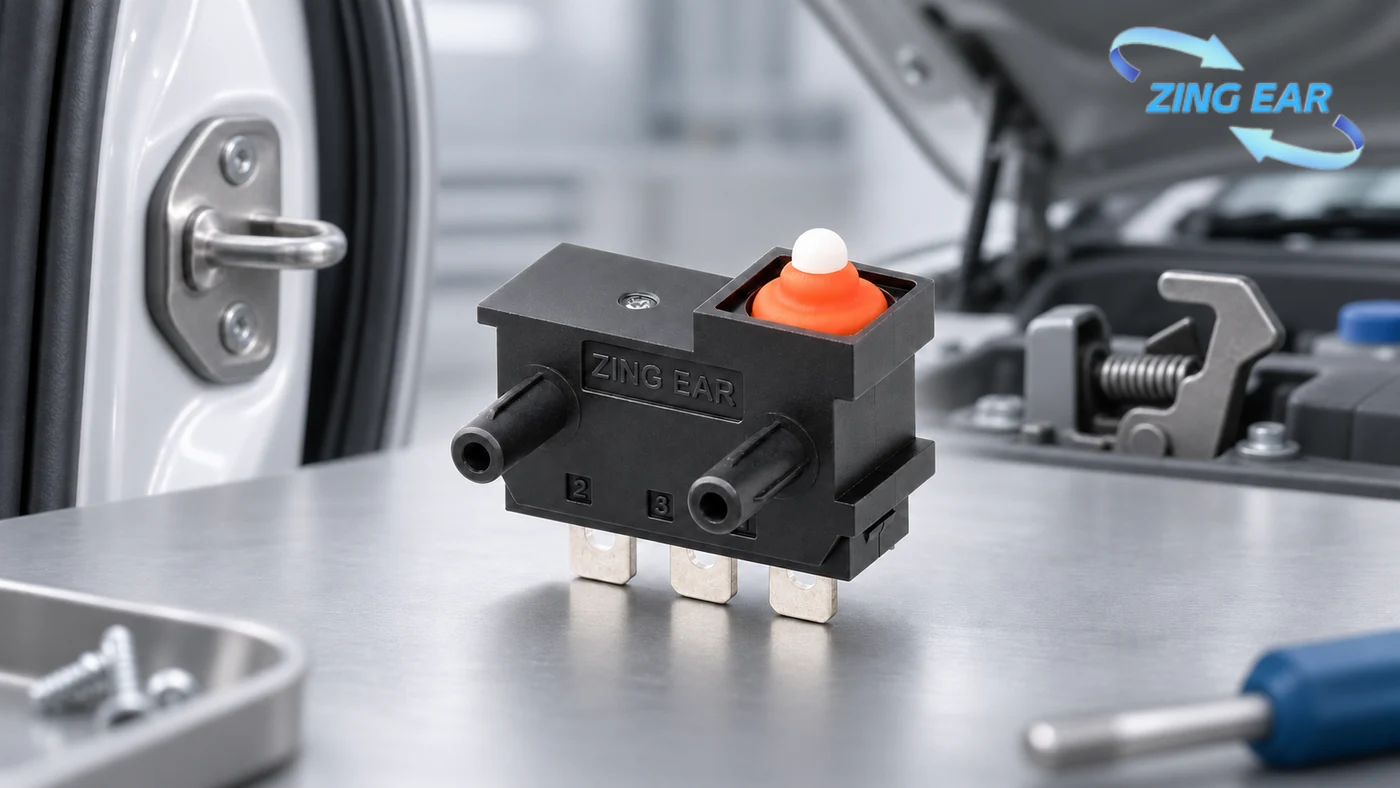
Is this an OE replacement or a switch for a new latch?
A replacement purchase starts with the vehicle's year, make and model. The buyer is usually matching a fitted door or hood part, its connector and its mounting points. A component switch's electrical rating is one input; fitment for that repair comes from the complete service part and its connector and mounting match.
A latch developer starts with the mechanism. The team knows where a cam, slider or locking arm moves and which state the body controller must read. The switch supplier can offer a component with a suitable body, actuator and contact arrangement, then the latch assembly is tested around it. A catalog micro switch becomes a vehicle-program part only after its installed travel and signal are validated in that latch.
| Sourcing task | Identity that matters first | Evidence that settles the choice |
|---|---|---|
| Repairing a named vehicle | Vehicle year, model, trim and OE replacement number | Fitment for the complete service part and its connector |
| Developing a door latch | Door-latch drawing, switching point and controller input | Installed door-latch state and contact trace |
| Developing a hood lock | Main/secondary lock motion, intended warning state and exposure | Installed hood-lock travel, signal and sealing check |
Where does a door-ajar signal change?
Inside a door latch, a cam or slider can press a switch as the latch moves. The controller reads the resulting contact state as a door status. The critical point is the portion of latch travel at which the program intends to report “closed,” especially when the door is resting between open and fully latched positions.
A switch that changes state before the latch reaches its intended closed position can make a partially latched door look closed to the controller. The mounted latch shows where the actuator meets the cam, how mounting tolerance shifts that meeting point, and whether the signal returns correctly when the latch releases.
Recording the switch signal at open, partly latched and fully latched positions shows whether an intermediate position is mistakenly reported as closed. A single switch contact has two states; distinguishing all three mechanical positions requires additional sensing or a circuit designed to provide more information.
What makes a hood-lock position different?
A hood lock can have a main latch and a secondary catch. A switch at the main latch changes contact state when that latch actuates it; a secondary-catch signal requires a switch positioned along the catch's travel. The body controller's warning or alarm circuit defines which motion needs a signal.
Near the front body opening, water and dust can reach the switch; the bracket and harness may move as the hood closes. The mounted harness exit and the complete latch need an exposure check at that position.
The latch designer selects a switch for the lock motion it senses and confirms its signal in the mounted hood lock. The electrical trace should agree with the mechanical state through both closing and release, including the point at which the secondary catch holds the hood. The trace shows how the contact transition corresponds to the lock position at that mounting point.
Switch candidates for the two positions
To make the new-latch route concrete, two ZINGEAR G303 configurations illustrate door-lock and hood-lock positions. The finished latch still determines the installed switching point.
ZINGEAR G303-130K00A6: door-lock sensing
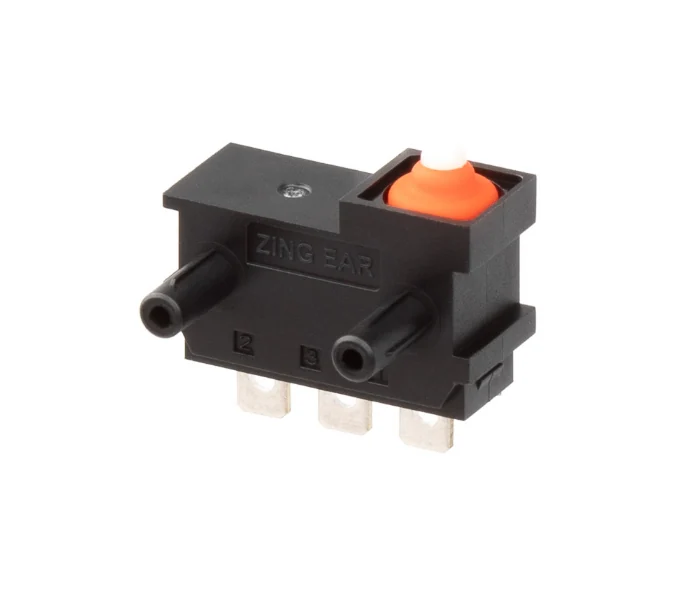
- Published electrical form: Single-pole, double-throw (SPDT) contacts, rated 3 A at 12 V DC. A controller signal is assessed at the actual input level used in the latch.
- Protection and temperature: IP67 rating under IEC 60529 and a published operating range of -40°C to +80°C for this exact model. The tested terminal/lead arrangement matters where moisture reaches the latch.
- Mounting consequence: This version offers PCB contact points and an optional wiring terminal. The available space and wire exit in the door latch decide which arrangement can be assembled and protected.
ZINGEAR G303-130S00A52: hood-lock sensing
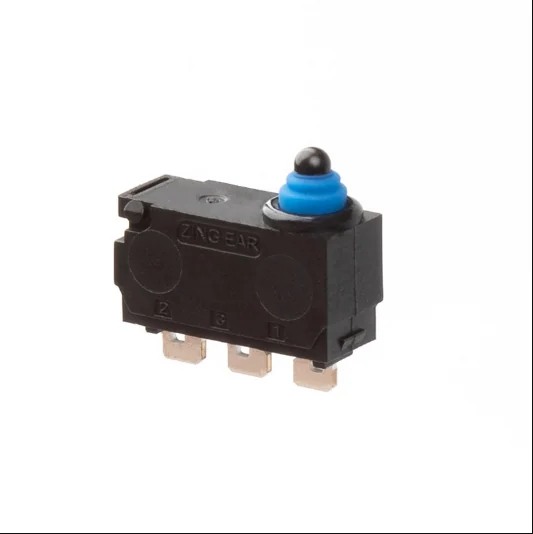
- Published electrical form: Three-pin SPDT contact form, rated 3 A at 12 V DC. The controller input and the intended open/closed logic decide which contact state is used.
- Protection and temperature: IP67 rating and a published operating range of -40°C to +85°C for this exact model. The hood assembly's water path remains an installed-system check.
- Mounting consequence: This version has an A2 body without a positioning post and offers terminal and lever options. The bracket locates the switch and its actuator against the relevant hood-lock motion.
What confirms the switch in the assembled latch?
A latch trial ties three observations together: mechanical state, switch contact and controller reading. For a door, the trial includes the intermediate latch position that could be mistaken for fully closed. For a hood, it includes the main and secondary lock movements relevant to the proposed mounting point.
| Mounted observation | What it reveals | Sourcing consequence |
|---|---|---|
| Contact transition against measured latch travel | Whether the signal changes at the intended lock state | Keep or move the actuation point, or change actuator form |
| Controller reading at its real input voltage/current | Whether a partly latched position is mistakenly reported as closed | Choose the contact path and confirm signal margin |
| Signal after water exposure and hood/door cycling | Whether the installed switch and harness remain readable | Select the terminal/lead arrangement and assembly seal |
| Sample and drawing revision | Which physical build produced the result | Carry the proven version into the production release |
The travel result matters first. The installed latch test can reveal a contact transition that occurs too early for the intended warning state. Once the intended transition is established, electrical and environmental checks show whether that same version maintains the switching point through the vehicle program's conditions.
FAQ About Door-Ajar and Hood Micro Switch Sourcing
How can I source a micro switch for vehicle door-ajar or hood position sensing?
For a new latch design, ZINGEAR G303-130K00A6 is a published door-lock candidate and ZINGEAR G303-130S00A52 is a published hood main/secondary-lock candidate. The mounting point determines the actuator travel and contact state to test in the assembled latch. The ZINGEAR team can start from an early latch sketch or the state the controller needs to detect. For repair of an existing vehicle, the vehicle-year OE service part and connector fitment are the appropriate starting point.
Can the same switch be used in both a door and a hood?
A family can be considered for both positions, but each latch has its own actuation path and exposure. The two named versions give separate starting points. Installed travel and signal results decide whether one configuration can serve both.
Does the hood candidate detect both the main and secondary lock?
A single switch responds to latch movement at its own mounting point. ZINGEAR G303-130S00A52 can serve a main- or secondary-hood-lock position. A finished system may place a switch at one state or use separate sensing positions. The latch drawing and state trace show what the proposed installation actually detects.
Is an IP67 switch enough to make a hood latch waterproof?
IP67 describes the tested switch boundary. The latch housing, bracket, connector and harness exit add water paths in the assembly. A hood-lock exposure test covers those paths together with the switch's chosen terminal or lead arrangement.
Is a listed micro switch a direct replacement for a specific vehicle year?
For a new latch design, the component team can evaluate the two candidates above in its own mechanism. A service repair starts with the correct OE replacement identity and connector match.
Sources
Related Recommendations
-
ZINGEAR Micro Switch OEM Manufacturing Complete Guide
2026-07-23 -
ZINGEAR G306-150S150AA Automotive Micro Switch Officially Partners with Changan Automobile to Enable Precise Control of Sun Visors and Vanity Mirrors
2026-08-07 -
ZINGEAR G304 Micro Switch Debuts in Rail Transit Sector, Enabling Precise Sensing and Reliable Control for High-Speed Train Lifting Doors
2026-08-13 -
ZINGEAR G306-150E65BA-400 Electric Motorcycle Handbrake Micro Switch | Dreame Shouqu Certified Sensing Switch
2026-08-18 -
ZINGEAR G304 Micro Switch Supports Electric Two-Wheeler Electronic Lock Systems, Empowering Smart Lock Security and Durability Upgrade
2026-08-21 -
zingear Micro Switch Solution for Communication Base Station Equipment Status Detection — Building a Solid Safety Line for Long-term Stable Operation of Base Stations
2026-08-11 -
Electrolux Range Hood Switch Solution — Zing EAR: Solve Extreme Kitchen Reliability with Precision Sensing
2026-08-25 -
How can I replace the push-button switch on my range hood?
2026-08-27