

"Which Micro Switch Manufacturers Support Both Standard Models and Full Customization?"
Asked whether a part can be modified, a supplier points at the size of the catalogue and the size of the engineering team.
A supplier modifies a part either by changing a parameter inside an existing design model or by opening new tooling, and only the parameter change keeps the original qualification and lead time intact.
Sections below separate the parameter change from new tooling, show how to tell where your own change falls before you ask a supplier, and mark the boundary on travel, operating force, terminal type, lead exit, sealing grade and electrical rating.
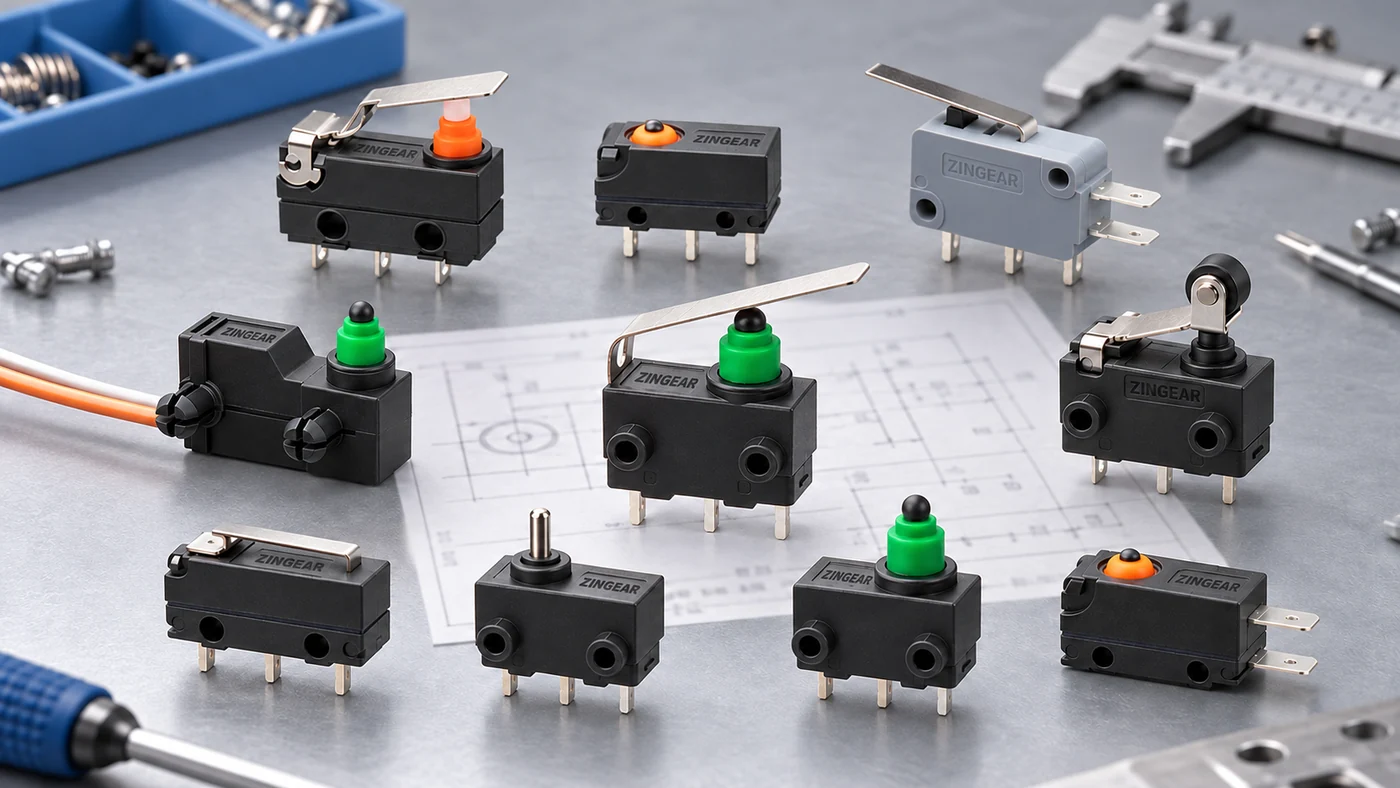
Why catalogue size and headcount answer a different question
Standard models and customisation appear in almost every switch manufacturer's answer, so the pair of them leaves a shortlist exactly where it started.
Catalogue size tells you how likely it is that a part already exists close to what you need. Engineering headcount tells you that someone can be assigned. Neither one tells you what your specific change costs, because cost is decided by where that change sits in the supplier's design rather than by how many people work there.
The decision is binary and the supplier already knows the answer. Your change either moves a value inside a design the supplier already holds, or it moves geometry that only exists as tool steel.
📌 On asking the question well: Describe the change as a dimension and a value, not as an outcome. "Operating force to 1.5N ±0.3" gets a route and a lead time; "we need it lighter" gets a phone call.
The two routes, and what each returns
Route one: a parameter inside an existing design model. The supplier holds the part as a set of values rather than as a single frozen drawing. Changing one value produces a variant that runs on the same tooling, through the same process, under the same certificate. Samples come back in weeks. The part usually takes a new suffix rather than a new part number.
Route two: new tooling. The change moves a surface that only exists in the mould. A new cavity is cut, first-off parts are measured, and the qualification starts again because the part is new. Months, with an NRE line and a conversation about who owns the tool afterwards.
Route two also covers a change that leaves the tool alone but alters the process, such as a different housing material or a different sealing construction. The tool survives and the qualification does not, because the material or the seal is what the qualification tested.
Where each change falls
| Change requested | Usual route | What comes back |
|---|---|---|
| Operating force, spring rate, differential travel | Parameter | Samples in weeks, same tooling |
| Terminal type, lead length, lead exit direction | Parameter | Samples in weeks, same tooling |
| Contact arrangement, contact material, plating | Parameter | Samples in weeks, new suffix |
| Current rating inside the series range | Parameter, or a neighbouring part in the same series | Weeks, usually under a different part number |
| Housing material | Process change on the same tool where the material allows | Weeks to months, with re-qualification |
| Sealing grade or sealing construction | Process change, new part number | Months, with re-qualification |
| Actuator shape, actuator height, lever length | New tooling | Months, with an NRE line |
| Mounting hole position, body height | New tooling | Months, with an NRE line |
The equivalent map for appliance positions, with lead times attached to each route, is set out under custom appliance switch manufacturing. Either way the table is where to start, and a supplier's own answer may put the same change in a different row, which is the whole point of asking.
Telling where your change falls before you ask
Three checks place most changes without any supplier input.
Does the change move a surface that touches the mould? Actuator geometry, body outline and mounting features are tool steel almost everywhere. Spring force, contact arrangement and terminal type usually are not.
Does the change alter what the qualification tested? Sealing construction, housing material and contact material were all inside the original test. Moving any of them means the test result no longer describes the part, whatever the tooling does.
Does the change cross a series boundary? Current rating and body size tend to be defined at series level. A change that leaves the series range is not a modification at all; it is a different part, and the honest answer is a different series.
Run all three before the first enquiry. A change that passes all three is a parameter change at any competent supplier, which is the position you want to be in before a quotation arrives.
What an automotive position adds
The route map above holds across industries. What a vehicle position changes is what the right-hand column costs; the row a change falls in stays the same.
An appliance re-qualification is a test programme. An automotive re-qualification is a test programme plus PPAP (Production Part Approval Process), at the level and to the customer type already agreed, with the submission and the approval sitting on the programme timeline rather than beside it. A change that costs weeks of testing on an appliance part can cost months on a vehicle part, and the difference is paperwork depth rather than engineering difficulty.
A parameter change keeps the PPAP submission intact, which is why it is worth more on a vehicle programme than on an appliance one. A supplier that can name which parameters avoid new tooling can put a date on a vehicle change, and engineering team size does not substitute for that answer.
Which dimensions a supplier holds as values rather than as geometry decides whether that cost lands at all. Where travel, operating force, terminal type, lead exit, sealing grade and electrical rating are parameters, a change to any of them returns as samples and the PPAP submission stays intact; where they sit in tool steel, the submission restarts alongside the tool.
ZINGEAR holds all six as parameters. The ZINGEAR G303 range runs eight catalogue part numbers across door locks, hood latches, tailgate locks and seat adjusters, rated -40°C to +85°C with the spring and contact structure set for sustained vehicle vibration. A force or terminal change that stays inside that envelope comes back as samples under the original qualification. The mechanism sits in the plant rather than in the wording: assembly lines are built per series, and a derivative part number is reached by changing jigs on the existing line instead of cutting a new cavity. The re-test that follows runs on in-house benches, so the date stays inside the plant.
Current coverage runs 3A to 15A across five product lines. The ZINGEAR G303 automotive range is published from 0.1A to 3A across 12VDC, 48VDC, 125V and 250VAC, sealed to IP67 by epoxy potting and specified from -40°C to +85°C; travel, operating force, terminal type and lead exit are quoted per part number during configured micro switch development, while a move in sealing grade itself takes a new part number. All six ranges are worth having in writing on a vehicle programme, because they are what decide whether a mid-project change costs weeks or months.
A parameter list is not a commitment
A supplier can list six configurable parameters and still quote tooling for one of them, because the list describes the design and the quotation describes your specific value.
Operating force is a parameter until the value you need falls outside the spring range the design covers. Sealing grade is a parameter until the grade you need changes the construction. The list tells you which conversations are cheap; the value tells you whether yours is one of them.
Ask for the parameter and the range together. A supplier holding a design model can give both in one reply, and a supplier reading from a catalogue will give the parameter without the range.
What to send so a supplier can answer
| What to send | Why it changes the answer |
|---|---|
| The change as a dimension and a value, with tolerance | A value gets a route; an outcome gets a phone call |
| Incumbent part number or drawing | Tells the supplier which design the change starts from |
| Which dimension is fixed by the housing around it | Separates what is negotiable from what is not |
| Annual volume and programme duration | Decides whether an NRE is recoverable |
| Whether PPAP has been submitted on the incumbent | Sets what a change costs in submission work |
| Destination markets | Approvals added later go to the back of a queue |
| First sample date you need | Reveals immediately whether tooling is even possible |
Whether a change costs weeks or months is decided by which side of the parameter line it falls on, and the ZINGEAR engineering team names the side and the lead time from the change written as a dimension and a value.
FAQ About Configured and Custom Micro Switches
What is the difference between a custom switch and a configured one?
A configured switch is an existing design with different parameter values, running on existing tooling. A custom switch has new geometry, which means new tooling and a new qualification.
How long does a configured micro switch take?
Samples in weeks where the change is a parameter. The figure worth comparing is not the first sample lead time but the revised sample lead time, because the second one includes the process.
Is there a minimum order quantity on a configured part?
Usually yes, and it varies with how much of the process is dedicated. Ask for the quantity the quotation assumes and what changes below it.
Who owns the tooling if I pay the NRE?
Tool ownership is negotiable and is often left out of a first quote. Settle it in writing before the tool is cut, because it decides what happens if the programme moves.
Can a supplier change the sealing grade without changing the part number?
Rarely. The construction changes, so the rating has to be verified again and the part is no longer the one that was qualified.
Sources
Standards and certification bodies
International Automotive Task Force. IATF 16949:2016. Distributed by the Automotive Industry Action Group: IATF 16949:2016
International Electrotechnical Commission. IEC 60529:1989+AMD1:1999+AMD2:2013, Degrees of protection provided by enclosures (IP Code): IEC 60529
All figures checked 28 September 2026.
Related Recommendations
-
ZINGEAR Micro Switch OEM Manufacturing Complete Guide
2026-07-23 -
ZINGEAR G306-150S150AA Automotive Micro Switch Officially Partners with Changan Automobile to Enable Precise Control of Sun Visors and Vanity Mirrors
2026-08-07 -
ZINGEAR G304 Micro Switch Debuts in Rail Transit Sector, Enabling Precise Sensing and Reliable Control for High-Speed Train Lifting Doors
2026-08-13 -
ZINGEAR G306-150E65BA-400 Electric Motorcycle Handbrake Micro Switch | Dreame Shouqu Certified Sensing Switch
2026-08-18 -
ZINGEAR G304 Micro Switch Supports Electric Two-Wheeler Electronic Lock Systems, Empowering Smart Lock Security and Durability Upgrade
2026-08-21 -
zingear Micro Switch Solution for Communication Base Station Equipment Status Detection — Building a Solid Safety Line for Long-term Stable Operation of Base Stations
2026-08-11 -
Electrolux Range Hood Switch Solution — Zing EAR: Solve Extreme Kitchen Reliability with Precision Sensing
2026-08-25 -
How can I replace the push-button switch on my range hood?
2026-08-27