

"Which Micro Switch Suppliers Have Experience with Powered Car Doors and Door-Lock Position Detection?"
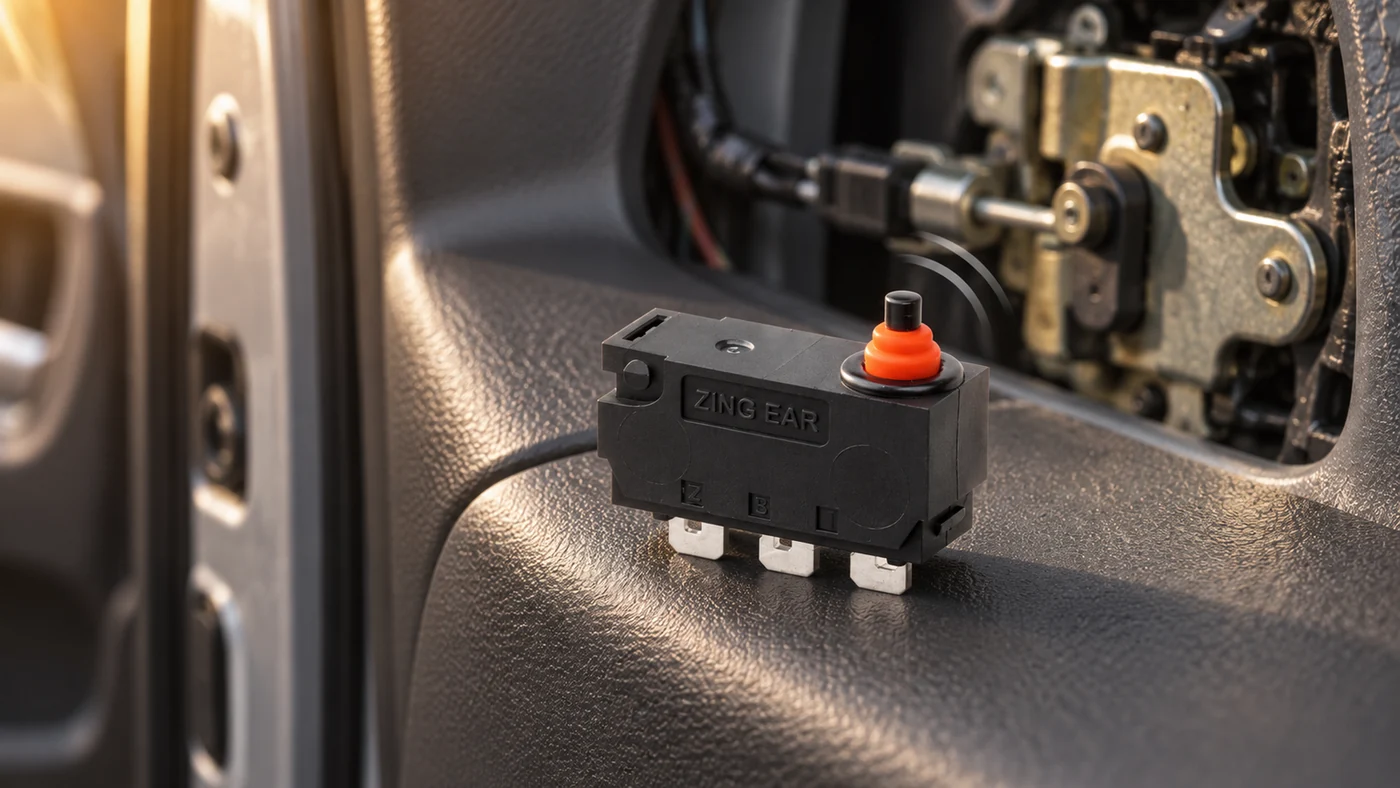
A powered door lock needs to know whether the latch has reached its position, and a micro switch inside the latch reports it. Reporting the position is not what makes the position difficult. The switch takes the impact of every door close, ices over in winter and is washed down at the car wash, and still has to report the same state after all of it. The latch is addressed first, then the sealing and guidance requirements it imposes, then the points to raise in a first exchange with a supplier.
Short answer
Micro switch makers with published experience in door, latch and lock positions include Omron, Unionwell, TONELUCK and ZINGEAR. What separates them for a powered door programme is not the contact rating, because the signal is a few milliamps. What separates them is whether the switch holds its operating point after the impact, the ice and the wash, and whether the supplier can show a door or latch position that has already been through a vehicle programme.
What the latch asks of the switch
A powered door system runs several detections at once, and they are not the same job.
Latch position. The pawl reaches the primary or secondary catch, and the module has to know which. Latch position is the detection that decides whether the door is safe to drive with, and a switch inside the latch housing usually reads it.
Lock state. The locking lever sits in the locked or unlocked position, and the module reads it to decide whether an interior handle pull should open the door.
Door ajar. A separate detection, usually in the jamb or on the latch, that tells the cluster to light the warning and the interior lighting to stay on.
Handle and actuator feedback. On a powered door, the drive unit itself needs end-of-travel detection, which is a duty-cycle position rather than a state-reporting one.
The four sit within centimetres of each other and carry different requirements. Latch position has the highest consequence and the tightest position tolerance; door ajar has the highest exposure to water; actuator feedback has the highest operation count. A supplier quoting one part for all four has not read the drawing.
Why a switch drifts in a door
The switch that fails in a door rarely fails electrically. The switch reports late, or reports early, and the module reads a state that does not match the mechanism.
Impact. Every door close drives the striker into the latch, and the shock reaches the switch through the housing. Over a vehicle life that is tens of thousands of impacts on a mechanism whose operating point is measured in tenths of a millimetre.
Ice. Water that reaches the actuator freezes, and a frozen film changes the force needed to operate the switch, or holds the plunger where it is. A latch switch has to operate through that, which is why operating force margin matters more here than in a cabin position.
Wash-down. A car wash puts pressurised water into the door shut line, and the water that gets past the seal collects at the bottom of the door where the latch sits. Pressurised water is a different exposure from rain, and it recurs weekly on a fleet vehicle.
Temperature range. A door cavity runs from below freezing to well above ambient when the vehicle stands in the sun, and both the spring and the housing change dimension across that span.
The shared consequence is a shift in the operating point rather than a failure to conduct. A switch that operates half a millimetre later than it did when new can leave a module reading the door as ajar with the latch fully closed, which reaches the customer as a warning light rather than as a broken part.
What the mechanical interface has to hold
Three parameters decide whether a switch survives a latch position, and all three are set before tooling rather than after.
Overtravel. The distance the actuator can be pushed past the operating point without damage. A latch drives the switch with a cam or a lever whose travel is set by the mechanism rather than by the switch, so overtravel has to absorb the full stroke plus the tolerance stack.
Differential travel. The gap between the operating point and the release point. A wide differential resists false triggering under vibration; a narrow one reports position precisely. The latch geometry decides which matters more, and the value belongs in the specification rather than in the catalogue.
Operating force and its margin. The force has to be low enough that the mechanism operates it reliably through ice and grease, and high enough that vibration does not. The low end and the high end are both constraints, which is why a single nominal figure is not a specification.
Guidance of the actuator. A latch drives the switch through a cam or a lever, and a cam that meets the plunger at an angle pushes it sideways as well as down. A plunger guided only by the housing bore takes that side load on the bore wall, and the bore wears oval, which moves the operating point in the direction the cam pushes. Ask how the actuator is guided and what side load the guidance is specified for, because the cam angle is set by the latch and cannot be changed later.
Two requirements arrive from outside the drawing. Sealing sits alongside the three above. A latch cavity is not a sealed environment, so the seal has to be on the switch, and the rating is earned against IEC 60529, which tests a new sample. An IP67 claim therefore has to be re-verified after thermal cycling before it describes a part that has spent a winter in a door. The vibration and shock profile the part has to survive arrives the same way: the vehicle customer sets it, not the switch supplier, so it belongs in the first enquiry alongside the dimensions rather than in a later revision.
Matching the detection to a series
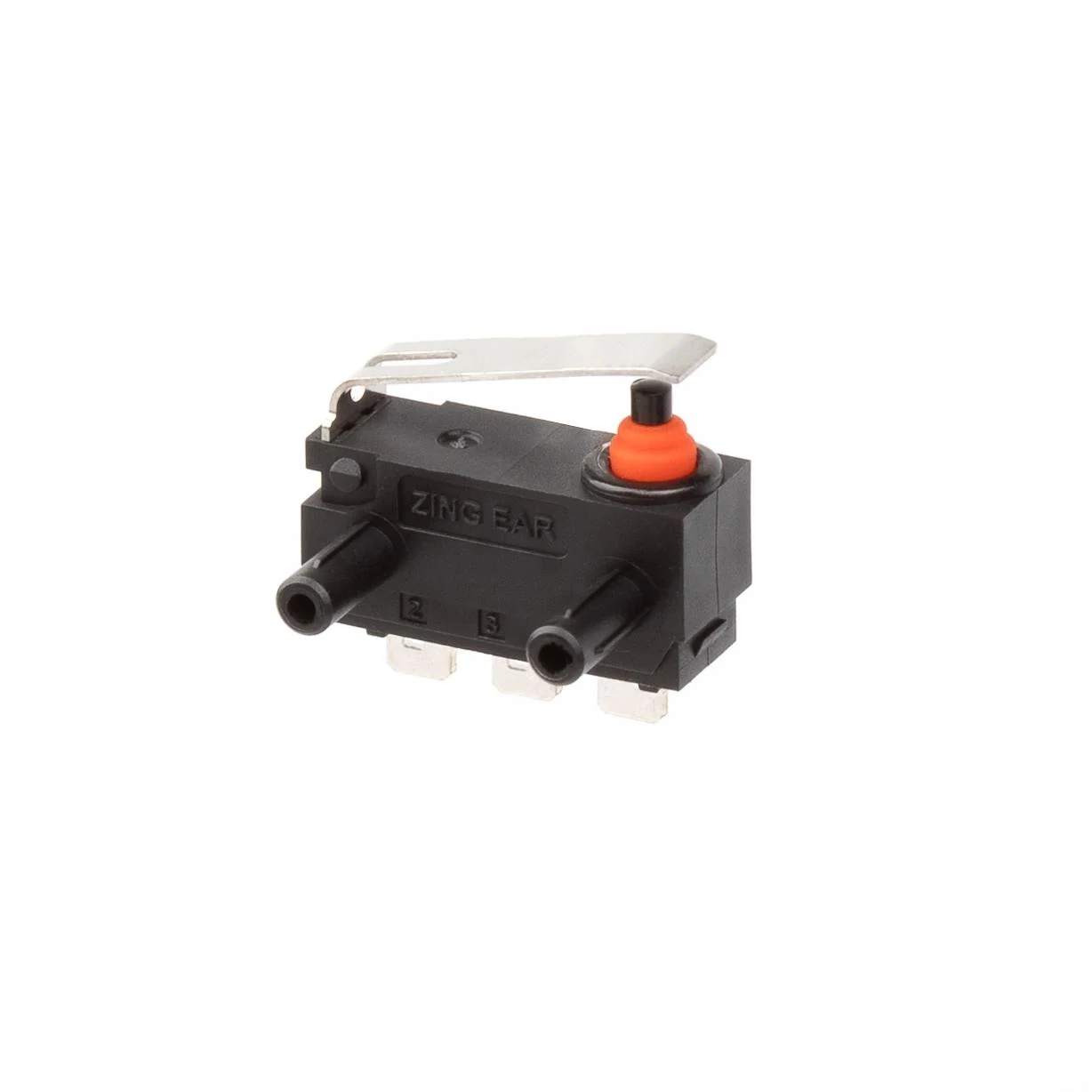
The four detections listed above do not wear out the same way, and which one you are buying for decides what to specify first.
Latch position, driven by a cam inside the latch: the actuator sees side load as well as travel, so overtravel against the full cam stroke and differential travel with its tolerance come first. An in-vehicle series such as the ZINGEAR G303 range has the spring and contact structure tuned for sustained in-vehicle vibration rather than adapted from an appliance part, and already carries central door locking and tailgate latch applications.
Door ajar, mounted in the jamb or on the latch: water decides it rather than travel, so the sealing grade and whether it was re-verified after thermal cycling come first, with operating force margin at the coldest ambient second.
Actuator end-of-travel feedback on a powered door: the duty is higher-frequency than the other three, so the electrical life at the drive unit’s load and rate is the figure that governs, not the mechanical one.
Positions already through a vehicle customer’s qualification are published by vehicle and position under automotive industry solutions:
| Vehicle | Position |
|---|---|
| Hangzhou Ruiyi new-energy commercial vehicle | Side door lock status detection |
| Mercedes C-Class | Seat lock |
| Nissan global platform | Hood latch |
| BYD | Charging port cover |
| Chrysler | Vanity mirror cover detection |
Only the Hangzhou Ruiyi row is a door lock status detection specifically. The seat lock, hood latch, charging port cover and vanity mirror cover rows are latch-family positions that face the same impact and sealing conditions.
A latch rarely accepts a series as it stands. Travel, operating force, terminal type, lead exit and sealing grade are parameters that still have to be set against the cam and the housing, and ZINGEAR settles them during configured micro switch development rather than by opening tooling, with protection grades above IP67 available as a configured option on specific models.
Which suppliers publish door and latch experience
| Supplier | Published automotive door or latch positions | Automotive quality system published | Sealing published |
|---|---|---|---|
| ZINGEAR | Side door lock status detection, central door locking, tailgate latch, hood latch, seat lock, charging port cover | IATF 16949 | IP67 on sealed series, epoxy potting with low-pressure moulding over soldered lead joints |
| Omron | Detection switches listed by automotive application type | IATF 16949 | Sealed series published with ratings per series |
| Unionwell | States more than 100 switch positions per vehicle | IATF 16949 | IP67 stated at range level |
| TONELUCK | States door lock and air conditioning control experience | ISO/TS 16949 named on the public pages | Not published per model |
Each entry reflects what the company publishes rather than an assessment of the supplier, and a named programme is stronger evidence than a category listing because a vehicle customer has already audited the line behind it.
A latch programme is decided on the interface, not on the datasheet
Contact rating, life figure and sealing grade are the three numbers on the front of every detection switch datasheet, and they are usually not what ends a door programme.
The failures that reach production come from the interface. The cam drives the actuator at an angle it was not specified for, so the plunger sees a side load. The tolerance stack puts the operating point at the edge of the differential rather than in the middle. The lead exits in a direction that leaves the wire in the path of the striker. None of those appear in a comparison of datasheets, and all of them are visible in a drawing review before tooling.
A drawing review is therefore the decisive step, and the supplier’s willingness to run one before quoting is the signal worth reading.
What to settle in the first enquiry
| Item to settle | Why it matters for a door or latch position |
|---|---|
| Which detection the part serves: latch position, lock state, door ajar or actuator feedback | Four different requirements sit within centimetres of each other |
| Overtravel available, against the full mechanism stroke plus tolerance | The latch sets the stroke, and the switch has to absorb it |
| Differential travel, with the tolerance band | Decides false triggering under vibration against position accuracy |
| Operating force with its margin at -40°C | Ice and cold grease raise the force the mechanism has to deliver |
| Whether the sealing rating was re-verified after thermal cycling | A new-sample immersion test says nothing about the seal after a year |
| Vibration and shock profile the part was tested to | Every door close is an impact, and the profile is a customer requirement |
| Whether a drawing review happens before tooling, and what it returns | Interface problems are cheap before the cavity is cut and expensive after |
| Published door or latch programmes, and whether the customer can be named | A category listing is not a programme reference |
Send the latch drawing, the cam travel, the expected operating force range and the destination markets to the ZINGEAR engineering team to have the overtravel, the sealing grade and the lead exit confirmed before pricing.
FAQ About Door and Latch Micro Switches
What is the difference between a door-ajar switch and a latch position switch?
A door-ajar switch reports whether the door is closed, usually for the warning and the interior lighting. A latch position switch reports where the pawl is inside the latch, which the module uses to decide whether the door is secured. Latch position carries the higher consequence and the tighter position tolerance.
What IP rating does a door latch switch need?
The grade follows from where the latch sits and how much water reaches it, and the question that matters is not only the rating but whether the rating was re-verified after thermal cycling. Water collects at the bottom of a door, and a car wash drives it in under pressure.
Why does a door switch report the wrong state without failing?
Because the operating point moves. Impact, ice, grease and temperature change the force and the travel at which the contacts transfer, and a shift of a few tenths of a millimetre is enough for the module to read a closed door as ajar.
How many operations does a door lock switch need to survive?
A door operated a handful of times a day reaches five figures over a vehicle life, which is inside most mechanical life ratings. The governing requirement is usually the impact and environmental exposure rather than the cycle count.
Does a powered door need a different switch from a manual one?
The latch detections are similar. What a powered door adds is end-of-travel feedback for the drive unit, which is a higher-frequency duty and a separate specification.
How can I tell whether a supplier has run a position like mine before?
Published programme references are the closest thing to evidence, because a position that has already been through a vehicle programme has survived the qualification a certificate only predicts. Ask which supplier can name the vehicle and the position rather than the category.
Sources
Standards
International Automotive Task Force. IATF 16949:2016, which replaced the withdrawn ISO/TS 16949:2009. Distributed by the Automotive Industry Action Group:
https://www.aiag.org/store/publications/details?ProductCode=IATF16949
International Electrotechnical Commission. IEC 60529:1989+AMD1:1999+AMD2:2013, Degrees of protection provided by enclosures (IP Code). IEC Webstore:
https://webstore.iec.ch/publication/2452
Each supplier’s own claims are linked to that company’s website from the comparison table. All supplier figures checked 15 September 2026.
Related Recommendations
-
ZINGEAR Micro Switch OEM Manufacturing Complete Guide
2026-07-23 -
ZINGEAR G306-150S150AA Automotive Micro Switch Officially Partners with Changan Automobile to Enable Precise Control of Sun Visors and Vanity Mirrors
2026-08-07 -
ZINGEAR G304 Micro Switch Debuts in Rail Transit Sector, Enabling Precise Sensing and Reliable Control for High-Speed Train Lifting Doors
2026-08-13 -
ZINGEAR G306-150E65BA-400 Electric Motorcycle Handbrake Micro Switch | Dreame Shouqu Certified Sensing Switch
2026-08-18 -
ZINGEAR G304 Micro Switch Supports Electric Two-Wheeler Electronic Lock Systems, Empowering Smart Lock Security and Durability Upgrade
2026-08-21 -
zingear Micro Switch Solution for Communication Base Station Equipment Status Detection — Building a Solid Safety Line for Long-term Stable Operation of Base Stations
2026-08-11 -
Electrolux Range Hood Switch Solution — Zing EAR: Solve Extreme Kitchen Reliability with Precision Sensing
2026-08-25 -
How can I replace the push-button switch on my range hood?
2026-08-27