

"Standard or Custom Micro Switch: What Changes for an Appliance Buyer?"
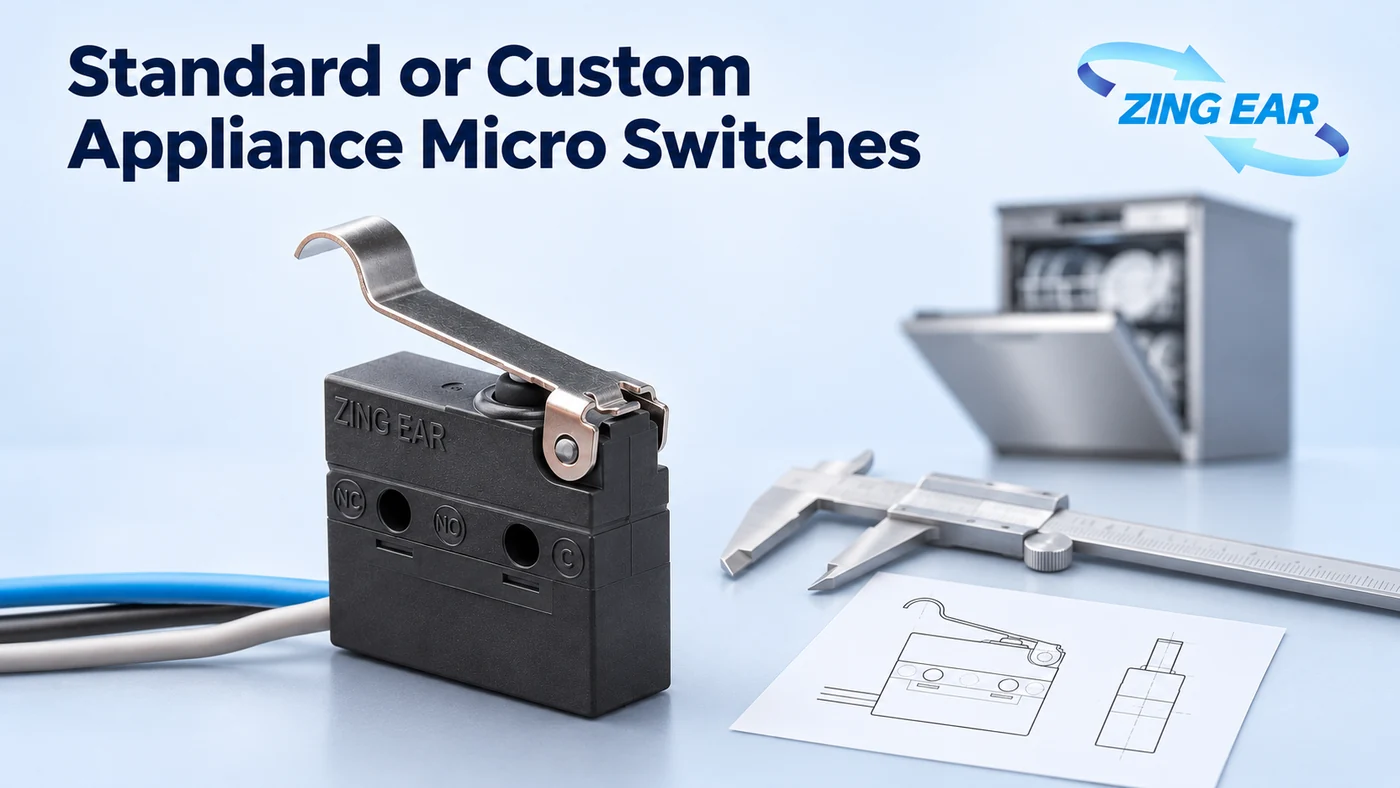
An appliance buyer can start with a standard switch when its actuator, mounting and terminals match the installed position. A mismatch in one of those features gives a specific reason to request a configured version; the revised version then needs its own fit and function check. Using a dishwasher-door position and a Zingear Switch model, this article shows when to order a standard part and when to approve a configured version.
Check the space and mechanism around the dishwasher-door switch
A dishwasher-door switch is pressed by the machine's own latch or door mechanism. The useful dimensions are the distance between the switch mounting points and the moving part, the amount of travel available at full closure, and the space left for the terminals and wiring. The electrical circuit determines whether the switch supplies a controller input or carries another specified load.
The switch drawing gives the lever dimensions and permitted travel. Comparing these with the latch movement shows whether the latch can press the lever far enough to operate the switch. A lever that changes state before the latch engages, or remains untouched after the door closes, needs a different reach or mounting position.
The installation position also determines exposure to moisture. A door switch near the wet cavity has a different exposure from one behind a dry enclosure. The position of the switch and its lead connection determines which parts of the assembly need protection.
A standard micro switch for the dishwasher example
For a practical example, Zingear Switch offers the following dishwasher-oriented model:
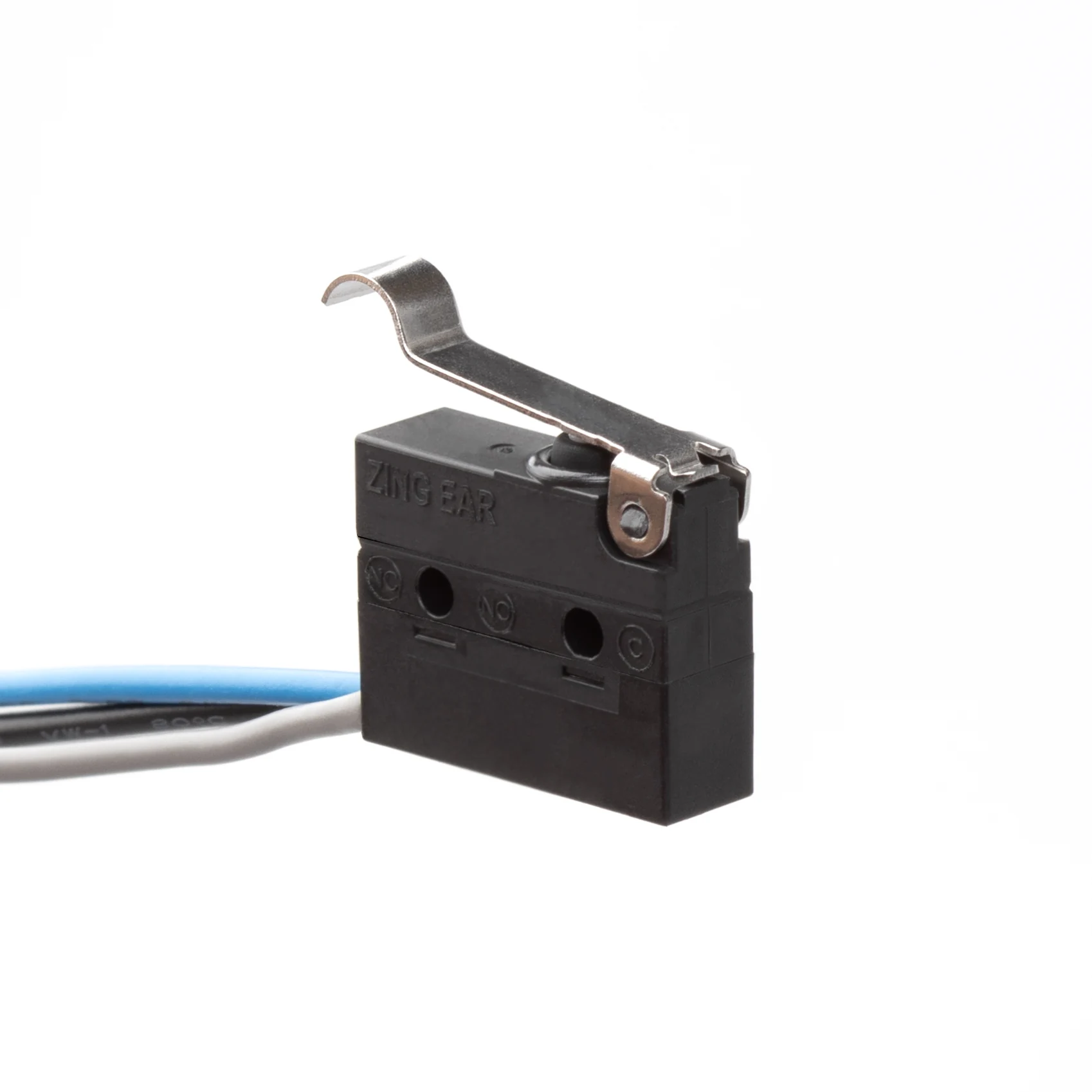
Zingear Switch G905-150F05W1
- Application: Dishwasher and disinfection-cabinet door positions.
- Actuator: Short lever.
- Protection: IP67 (ingress protection rating 67) under IEC 60529 (International Electrotechnical Commission standard for enclosure ingress protection).
The door or latch presses the short lever to operate the switch. The sample check establishes whether the latch reaches it at the required door position and whether the attached wires fit beside the mechanism.
If the standard lever reaches the latch and the wires have enough space, the existing version can proceed to an appliance trial. If the latch misses the lever or the wires interfere with the housing, the next discussion concerns that specific installation problem.
Lever changes affect switching position; connection changes affect wiring space. A longer lever can reach a latch that misses the standard lever, but it also changes the movement needed to operate the switch. A different wire-exit direction can keep the cable away from a housing rib. Testing the changed feature in the appliance confirms whether the alteration solves the original problem.
Installation changes to discuss for a door switch
| Installation problem | Possible change | Result to confirm in the appliance |
|---|---|---|
| Latch reaches the switch too early or too late | Lever shape, length or mounting position | Contact changes state at the intended door position throughout the door's travel tolerance |
| The mechanism cannot provide the force required by the selected switch | An operating-force option, assessed alongside lever geometry | The mechanism can complete the switching movement with the proposed version |
| Switch body fits but wire routing clashes with the housing | Terminal or lead-exit direction | Harness can be assembled without strain and the connection stays within the intended protected area |
| Mounting points do not align with the available bracket | An alternative mounting arrangement or model | Switch seats securely and maintains the same actuation position after assembly |
A fitted sample makes these differences visible: the latch either reaches the lever at the required position or it does not; the wires either clear the housing and moving parts or need a different route. If the cable connection is exposed to water, its location or sealing also needs to suit that exposure.
Ordering a standard part versus approving a configured version
The appliance trial leads to three possible decisions:
- Order the standard version when the door trial confirms switching position, wiring clearance and the required electrical and moisture conditions for the selected configuration.
- Approve a configured version when a defined lever, force or terminal change solves the measured mismatch. The revised drawing, sample result and quotation then identify the agreed configuration.
- Choose another model when the standard configuration fails and the available changes cannot meet the door's mechanical, electrical or exposure requirements.
The model code and drawing revision identify which lever and connection are included in the order. A lever can fit the same case but change the door position at which the contacts switch. A terminal change can leave the switch body unchanged while placing its connection where water can reach it. Keeping the sample and order tied to those identifiers helps ensure the ordered switch has the arrangement tested in the appliance.
How standard and custom switches differ in cost and preparation time
An existing switch option and a newly designed component involve different preparation work. The main differences are:
| Purchase item | Standard configuration | Configured or newly designed version |
|---|---|---|
| Sample preparation | Availability of the selected model and quantity | Preparation of the proposed lever, force or connection arrangement |
| Engineering work | Checking the existing drawing against the appliance | Agreeing the revised dimensions and characteristics before sampling |
| Tooling | Existing construction is the reference | Existing options may be usable; a new component design can introduce tooling work |
| Quotation | Unit price and order conditions for the selected configuration | Unit price plus any separately agreed development or tooling charge |
| Approval | Appliance team evaluates the chosen model | Appliance team evaluates the revised sample against the agreed changes |
An existing lever or terminal option can avoid the work of designing a new component. A new body or actuator design can involve more preparation. The project quotation identifies the applicable work and any associated charge. Sample preparation and production dates can then be discussed for the selected design and quantity.
Discussing standard and custom options with Zingear Switch
Zingear Switch provides adjustments to travel, contact material and wiring method through its configuration support. If the standard dishwasher switch does not fit, a description of where the latch misses the lever or where the cable meets the housing can start the discussion. Zingear Switch can help identify available options and discuss customization for the installation.
Frequently Asked Questions About Standard and Custom Appliance Micro Switches
Does changing the lever always require new tooling?
An existing lever option may already use available tooling. A new lever shape can require additional design and tooling work. Zingear Switch can discuss which approach suits the requested change and how it affects sample preparation and cost.
Can a quotation compare a standard part and a customized version?
A comparison can list the standard model and requested change separately, with the unit price, any development cost, sample timing and production lead time for each. Describing the lever and connection used in each option keeps the price comparison clear.
How are sample and production lead times confirmed?
The Zingear Switch contact team can discuss sample preparation, production and delivery for the selected model or requested customization. Quantity and the required arrival date help establish a schedule that includes transport.
Is a standard model automatically in stock?
A standard model uses an existing design, but it may still need to be manufactured for an order. The contact team can confirm stock for the model, quantity and requested date.
Sources
- International Electrotechnical Commission. IEC 60529, Degrees of protection provided by enclosures (IP Code).
- Zingear Switch: technical FAQ.
Related Recommendations
-
ZINGEAR Micro Switch OEM Manufacturing Complete Guide
2026-07-23 -
ZINGEAR G306-150S150AA Automotive Micro Switch Officially Partners with Changan Automobile to Enable Precise Control of Sun Visors and Vanity Mirrors
2026-08-07 -
ZINGEAR G304 Micro Switch Debuts in Rail Transit Sector, Enabling Precise Sensing and Reliable Control for High-Speed Train Lifting Doors
2026-08-13 -
ZINGEAR G306-150E65BA-400 Electric Motorcycle Handbrake Micro Switch | Dreame Shouqu Certified Sensing Switch
2026-08-18 -
ZINGEAR G304 Micro Switch Supports Electric Two-Wheeler Electronic Lock Systems, Empowering Smart Lock Security and Durability Upgrade
2026-08-21 -
zingear Micro Switch Solution for Communication Base Station Equipment Status Detection — Building a Solid Safety Line for Long-term Stable Operation of Base Stations
2026-08-11 -
Electrolux Range Hood Switch Solution — Zing EAR: Solve Extreme Kitchen Reliability with Precision Sensing
2026-08-25 -
How can I replace the push-button switch on my range hood?
2026-08-27