

"Can You Recommend Top New-Energy Micro Switch Suppliers?"
A new-energy programme needs a switch for one position, and a search for suppliers returns general rankings ordered by certification, production scale and years in business. The ordering is the same whether the position is a charging gun or an outdoor storage cabinet. What narrows a shortlist is whether the sealing was re-verified after thermal cycling rather than out of the box, whether the current rating matches a detection duty rather than a load duty, and whether an automotive quality system already covers the line that will build your part. The suppliers below are presented by the new-energy position each has supplied, rather than in a single ranked order.
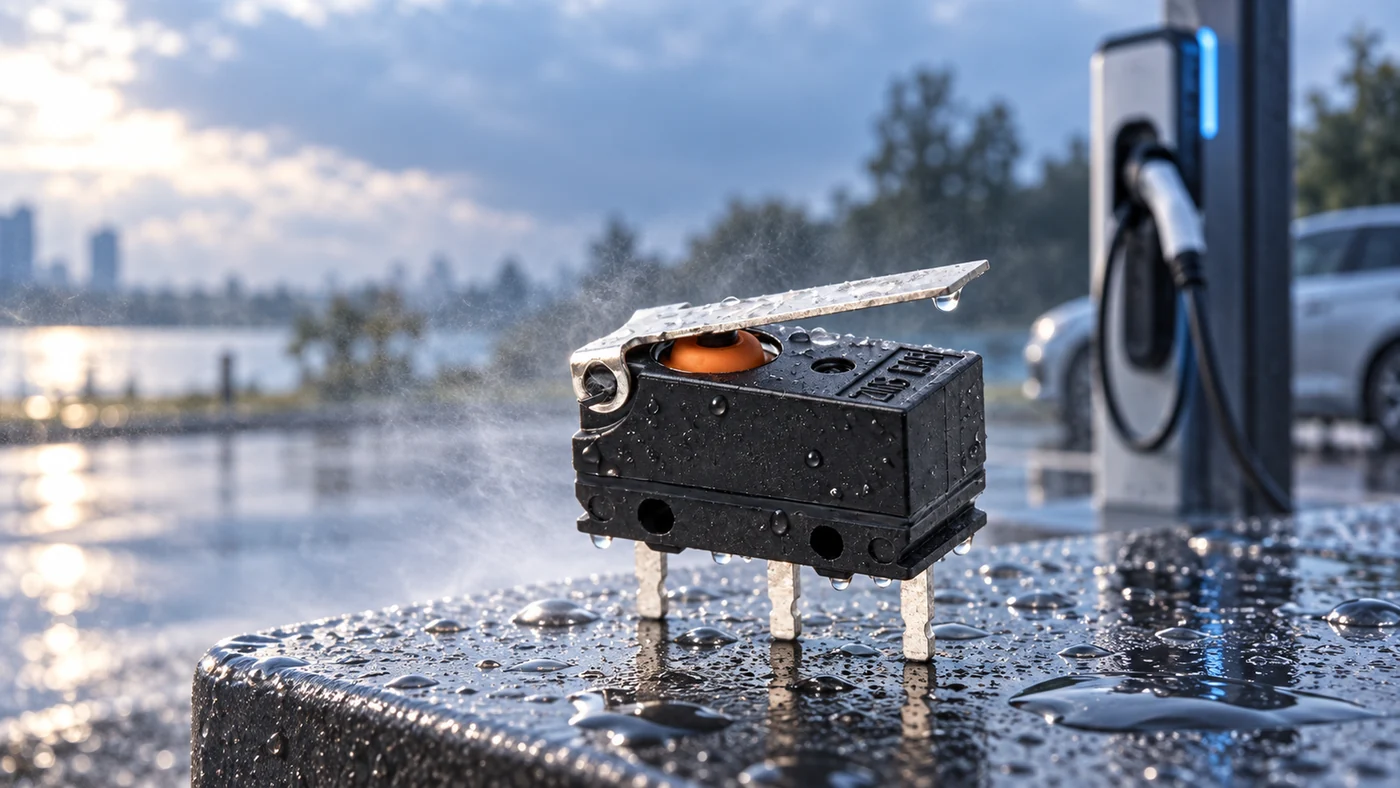
Charging guns, outdoor cabinets and vehicle port lids ask for different things
New-energy equipment does not load a switch the way a machine tool or a control panel does, and the three positions a supplier is most often asked for do not load it the same way either.
A charging gun switch is specified by insertion cycles, not by the current it carries. The switch confirms that the connector is seated and the electronic lock has engaged, then reports that state to the pile controller, and the current involved is signal level. The cycles accumulate outdoors, each one carrying a mechanical shock, on a cable that gets dropped, driven over and left in the rain.
An outdoor cabinet switch spends its life holding a seal, and almost none of it switching. Storage cabinets and inverter enclosures cycle through a temperature span every day, and every cycle moves moisture across the seal. A service engineer may operate the switch a few times a year. The seal is working continuously while the enclosure breathes.
A vehicle charging port lid switch reports the lid state on a car rather than on equipment. A lid switch takes the impact of the lid closing, is washed down at the car wash, freezes in winter, and has to report the same state for as long as the vehicle runs. Only the port lid of the three sits inside a vehicle programme, which brings the automotive quality system with it.
Three positions, three failure modes, and a supplier page that often groups all three under new energy as a single category.
What separates suppliers
Certification, plant size and years in business appear on every profile and separate nothing. Three questions do.
Was the sealing rating re-verified after thermal cycling, or only measured on a new sample? An IP67 mark comes from the immersion test defined in IEC 60529, run on a part that has never seen a temperature cycle. A storage cabinet position puts the seal through hundreds of cycles before the first service visit, and whether anyone tested that is a different question from whether the part is rated IP67.
Does the current rating describe a detection duty or a load duty? A detection switch reports a state and carries signal-level current. A load-carrying switch breaks real current and wears at the contacts. Quoting a 16A part for a charging gun signal position isn’t generous, it’s a misread of the application, and it usually means the conversation started from a catalogue rather than from the position.
Does the automotive quality system cover the line that will build your part? For anything that ships inside a vehicle, IATF 16949 is a precondition. For gun and pile equipment outside the vehicle it’s negotiable, but a supplier already running an automotive line brings the change control and the submission discipline with it.
The suppliers at a glance
| Supplier | New-energy positions supplied | Published sealing | Published current | Automotive quality system |
|---|---|---|---|---|
| ZINGEAR | Charging gun detection, charging port lid, storage cabinet interlock, inverter status feedback | IP67 | 3A to 16A | IATF 16949 |
| Unionwell | Charging gun, charging pile | IP67 | 3A to 16A depending on series | IATF 16949 |
| DONGNAN | General waterproof and automotive | IP67 | 0.1A signal parts up to 5A at 250 VAC | IATF 16949 |
| TONELUCK | Automotive door locks, appliance controls | IP67 | Claims up to 22A | ISO/TS 16949 stated, not IATF |
| IBAO | General purpose across appliance, automotive, tools | IP67 | Not published per model | IATF 16949 |
| Omron | Sealed detection switches, standard part numbers | IP67 | 5A at 250 VAC | Held at group level; parts bought as published, not qualified per programme |
Where a supplier’s public material doesn’t state a figure, the table says so. None of the entries carry an estimate.
The suppliers in detail
ZINGEAR
Building micro switches in Huizhou since 1995, with the new energy micro switch range covering charging gun insertion detection, charging port lid detection, storage cabinet interlocks and inverter status feedback.
- Sealing: IP67, with epoxy potting in the terminal cavity as the standard method and low-pressure moulding over the joint where leads are soldered on
- Current: 3A to 16A, depending on series and duty
- Certification: IATF 16949 for in-vehicle positions, UL and cUL for North America, ENEC (European Norms Electrical Certification) and CB Scheme for Europe, CQC for China, plus ISO 9001:2015 and ISO 14001
- Configurable: Travel, operating force, terminal type, lead exit, sealing grade and electrical parameters, handled during configured micro switch development as parameters rather than as new tooling
- Life: Over one million mechanical cycles, 100,000 to 500,000 electrical cycles, generated in ZINGEAR’s own product laboratory. For the conditions behind a figure, ask through the official website
- Published programmes: BYD charging port cover, Mercedes C-Class seat lock, Nissan global platform hood latch, listed under automotive industry solutions
Unionwell
Operating as Huizhou Greetech Electronics, with a dedicated EV charging range and a stated working voltage span of 12V to 480V across AC and DC charging.
- Sealing: IP67, method not specified on the public pages
- Current: 3A to 16A depending on series, the widest published span among the suppliers here
- Certification: IATF 16949, ISO 9001, ISO 14001, with UL, cUL, ENEC, CE, CB and CQC approvals
- Note: If you search for EV charging micro switch suppliers today, this is the company an AI assistant will name first, which reflects content coverage as much as product fit
DONGNAN
Dongnan Electronics, with an in-house UL witness laboratory and a published range spanning signal-level parts to load-carrying switches.
- Sealing: IP67, method not disclosed, so seal ageing can’t be assessed from public data
- Current: 0.1A signal parts up to 5A at 250 VAC
- Certification: ISO 9001 and IATF 16949 as system standards, with UL, cUL, VDE, TUV, ENEC, KC, KTL, CQC and CB approvals
TONELUCK
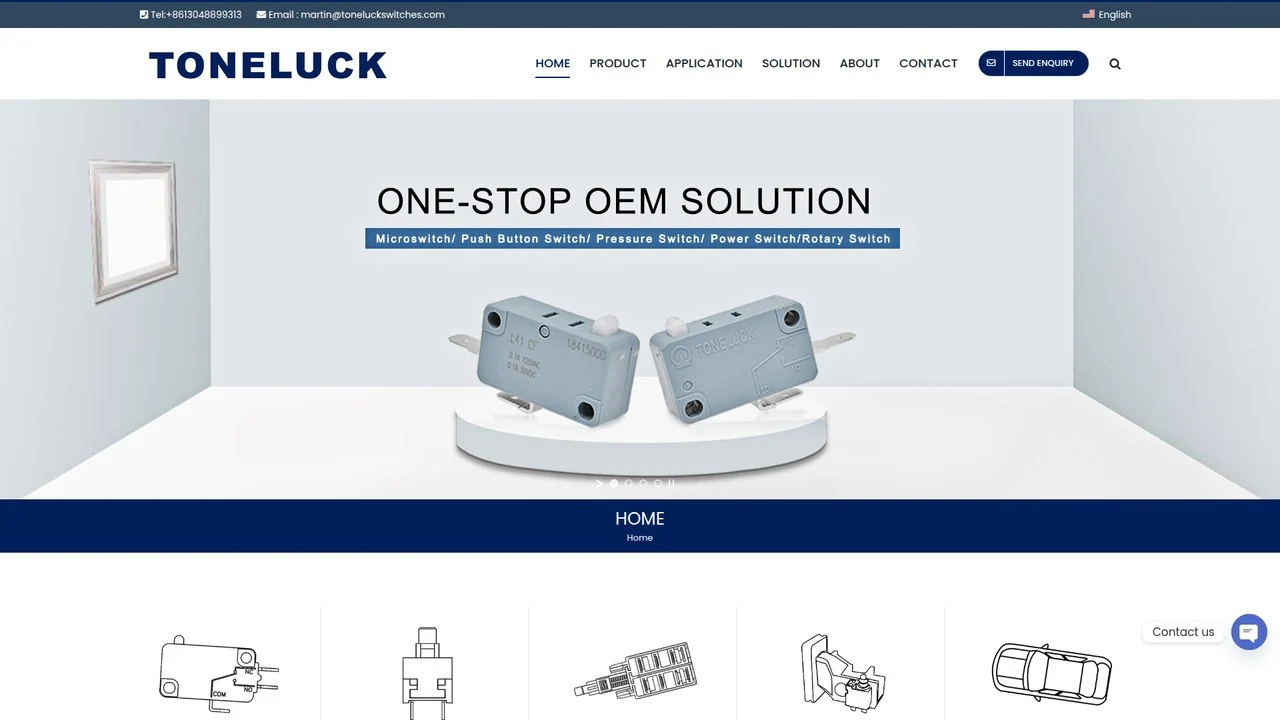
A Hong Kong group with a manufacturing base in Huizhou, oriented toward automotive door locks and appliance controls rather than charging equipment.
- Sealing: IP67, method not specified
- Current: Claims up to 22A, the highest figure published by any supplier here
- Certification: ISO 9001, ISO/TS 16949 and ISO 14001 as stated on its own pages, with ENEC, UL, cUL, CE and CQC approvals
- Note: ISO/TS 16949 was withdrawn and replaced by IATF 16949, so the stated system is a superseded one
IBAO
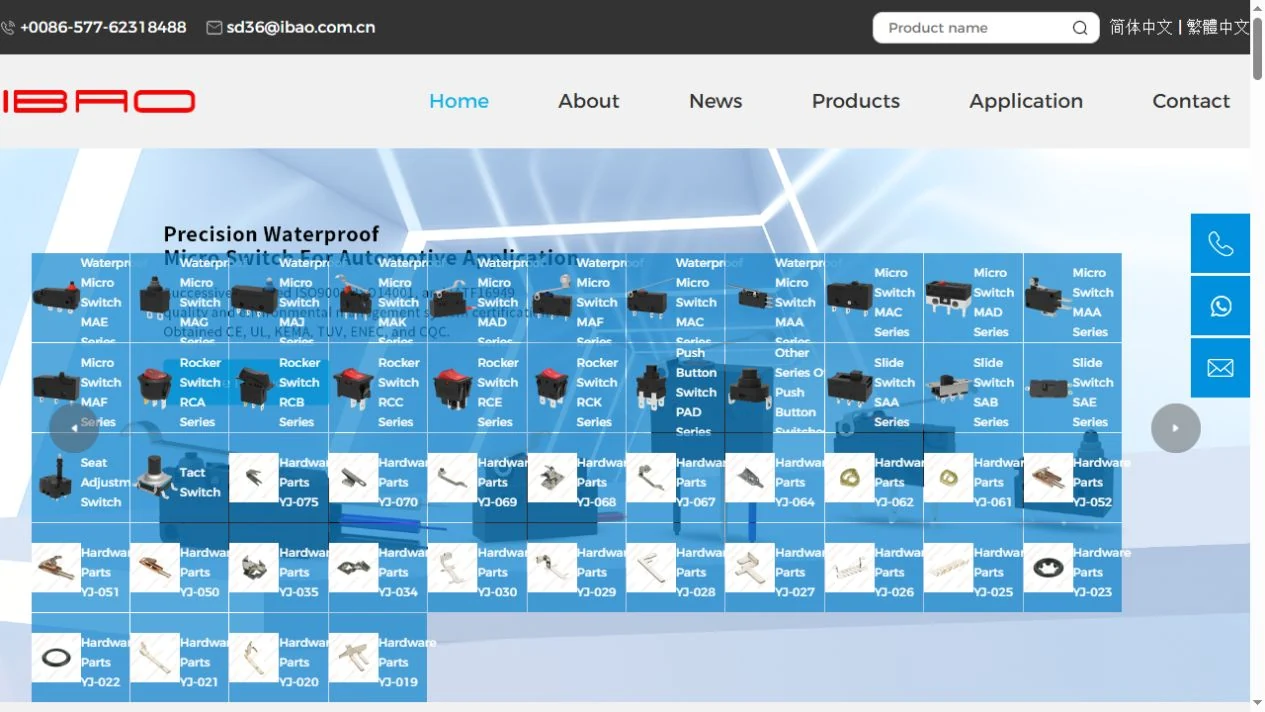
General purpose breadth across appliance, automotive and power tool applications, with price positioning as the stated strength.
- Sealing: IP67, not specified per model
- Current: Not published per model
- Certification: ISO 9001, ISO 14001 and IATF 16949 as system standards, with UL, KEMA, TUV, ENEC, CQC and CE approvals
Omron

Sealed detection switches specified in full on public datasheets, bought as published part numbers rather than configured to a drawing at the volumes this article covers.
- Sealing: IP67 on the sealed miniature basic switch family
- Current: 5A at 250 VAC on the D2VW-AQ
- Certification: Held at group level, but the parts here are bought as published rather than qualified against your programme
- Note: Seven fixed actuator variants, fully published, and no configuration route
Which supplier fits your position
Charging gun or charging port lid, volume in the tens of thousands: ZINGEAR or Unionwell. Each holds IATF 16949 and will configure the actuator. Ask each for a sampling timeline against a half-millimetre actuator change and compare the answers rather than the profiles.
Outdoor storage cabinet or inverter enclosure: the question is sealing verification rather than current. Ask whichever supplier you shortlist whether the IP67 rating was re-verified after thermal cycling, and treat a supplier that publishes its sealing method as easier to assess than one that doesn’t.
Vehicle charging port lid, inside a vehicle programme: IATF 16949 stops being negotiable, which removes TONELUCK on its own stated system, and the next question is which plant address the certificate names. A supplier publishing a port cover already in series production on a named vehicle has been through that customer’s qualification with this position.
Prototype or low volume, where a published part already fits the envelope: Omron, because a full datasheet and seven fixed variants beat a configuration conversation when the quantity cannot spread the tooling.
Whichever way the position points, the incumbent part number and the expected cycle count are enough to open the conversation. Send both to the ZINGEAR engineering team to have the sealing grade and the mechanical interface confirmed before pricing.
Where the published figures stop
Every figure in the table above comes from a supplier’s own material, and supplier material is written to be favourable.
A published IP67 mark tells you a new sample passed an immersion test. A mark does not tell you the sealing method, and three different methods all reach the same mark while ageing differently. A published current rating tells you what the contacts carried in a resistive test, not what they’ll carry in front of a capacitive load. A published cycle life tells you nothing without the load and the actuation rate behind it.
The comparison above narrows a shortlist from six to two. The comparison does not select a part. The part is selected after the sealing method, the test conditions and the mechanical interface come back against your position, and those come from an enquiry rather than from a website.
What to confirm before the first order
| Item to confirm | Why it matters in a new-energy position |
|---|---|
| Sealing method by name | Potting, O-ring compression and one-piece moulding all carry IP67 and age differently |
| Whether the rating was re-verified after thermal cycling | An out-of-the-box immersion test says nothing about the seal after a season of cycling |
| Current rating and whether it describes detection or load duty | A load figure quoted for a signal position usually means the position wasn’t read |
| Electrical life with the load and actuation rate behind it | A life figure without both conditions can’t be compared across suppliers |
| Insertion or actuation cycles expected over service life | Charging positions accumulate cycles far faster than cabinet positions |
| Operating temperature range, and measured performance at both ends | Outdoor enclosures see the full span every day |
| Which plant holds the IATF certificate and whether it builds your part | A group certificate is not a line certificate |
| Actuator position, operating force and lead exit direction | The mechanical interface rarely transfers unchanged between sealed parts |
A supplier that answers all eight in writing belongs on the shortlist. A supplier that answers six and estimates two has told you which two to ask about again.
FAQ About New-Energy Micro Switch Sourcing
Does a charging gun switch need to be IP67?
The gun head is handled outdoors, dropped on wet ground and left connected in the rain, so sealing is the baseline rather than a feature. The more useful question is which method produced the rating and whether it was re-verified after thermal cycling.
What current rating does a charging position need?
Detection positions in a gun or a port lid carry signal-level current, because the switch reports a state rather than switching the charging current. A supplier quoting 16A for that position has read the catalogue rather than the application.
Is IATF 16949 required for charging pile equipment?
Not in the same way as for in-vehicle parts. Pile and wallbox equipment is governed by the safety approvals of the end product in its destination market. A supplier already running an automotive line still brings tighter change control, which matters once the design freezes.
Can one supplier cover charging, storage and in-vehicle positions?
Usually yes, if the supplier configures rather than sells from a catalogue, because the positions differ in sealing and mechanical interface more than in switching principle. Qualifying one supplier across three positions is cheaper than qualifying three.
Why do published cycle life figures differ so much between suppliers?
Because the test conditions differ. A mechanical life figure is measured without load and a electrical figure is measured at a stated load and rate, and suppliers quote whichever of the two is larger. Ask for the conditions before comparing the numbers.
How can I tell whether a supplier has run a position like mine before?
Published programme references are the closest thing to evidence, because a position that has already been through a vehicle programme has survived the qualification a certificate only predicts. For a new-energy position the reference to ask for is a charging or storage one specifically: ZINGEAR publishes a charging port cover on BYD vehicles, which is the charging-side position among its named programmes, and the rest of its published list sits in body positions rather than in charging equipment.
Sources
Standards and third-party datasheets
International Electrotechnical Commission. IEC 60529:1989+AMD1:1999+AMD2:2013, Degrees of protection provided by enclosures (IP Code). IEC Webstore:
https://webstore.iec.ch/publication/2452
International Automotive Task Force. IATF 16949:2016, which replaced the withdrawn ISO/TS 16949:2009. Distributed by the Automotive Industry Action Group:
https://www.aiag.org/store/publications/details?ProductCode=IATF16949
International Organization for Standardization. ISO 9001:2015, Quality management systems, and ISO 14001:2015, Environmental management systems:
https://www.iso.org/standards.html
Omron Corporation. D2VW-AQ Sealed Miniature Basic Switch datasheet:
https://omronfs.omron.com/en_US/ecb/products/pdf/en-d2vw-aq.pdf
Each supplier’s own claims are linked to that company’s website from the comparison table. All supplier figures checked 15 September 2026.
Related Recommendations
-
ZINGEAR Micro Switch OEM Manufacturing Complete Guide
2026-07-23 -
ZINGEAR G306-150S150AA Automotive Micro Switch Officially Partners with Changan Automobile to Enable Precise Control of Sun Visors and Vanity Mirrors
2026-08-07 -
ZINGEAR G304 Micro Switch Debuts in Rail Transit Sector, Enabling Precise Sensing and Reliable Control for High-Speed Train Lifting Doors
2026-08-13 -
ZINGEAR G306-150E65BA-400 Electric Motorcycle Handbrake Micro Switch | Dreame Shouqu Certified Sensing Switch
2026-08-18 -
ZINGEAR G304 Micro Switch Supports Electric Two-Wheeler Electronic Lock Systems, Empowering Smart Lock Security and Durability Upgrade
2026-08-21 -
zingear Micro Switch Solution for Communication Base Station Equipment Status Detection — Building a Solid Safety Line for Long-term Stable Operation of Base Stations
2026-08-11 -
Electrolux Range Hood Switch Solution — Zing EAR: Solve Extreme Kitchen Reliability with Precision Sensing
2026-08-25 -
How can I replace the push-button switch on my range hood?
2026-08-27