

"How to Plan a Replacement for a Discontinued Appliance Micro Switch"
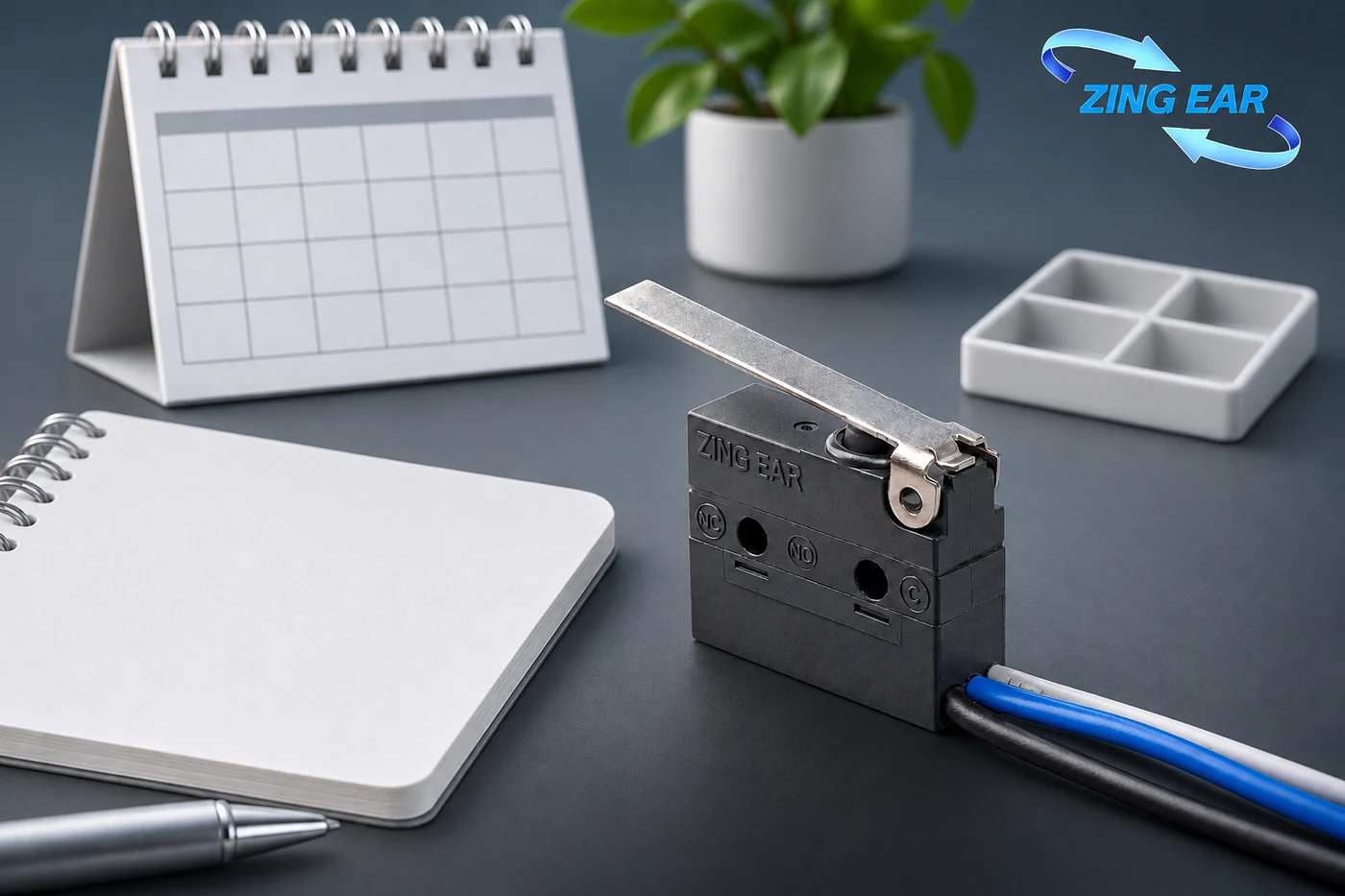
When a micro switch used in an appliance that is still in production is discontinued, the purchasing team’s work typically includes maintaining supply for ongoing production and coordinating the selection of a suitable replacement. A final order of the original switch can provide time for replacement work, but the quantity depends on how long that work will take and how much stock is already available. The purchasing plan and the replacement test schedule therefore need to be developed together. Starting with the supplier’s notice, the sections below explain how to size the final purchase and prepare a replacement for the appliance’s production line.
Establish exactly what the supplier is changing
A product change notification (PCN) can describe several different changes to a switch used in a production appliance:
- Ordering reference: A new number may reflect an administrative or distribution change.
- Material, process or factory: The outside dimensions may remain the same while affected performance or compliance information needs review.
- Discontinuation: Purchasing needs to plan remaining stock while the appliance team assesses a replacement.
The notice’s affected-part list is the starting point. A family name alone can be too broad: some versions may change while others remain available. Matching the notice to the exact part number used by purchasing avoids extending the change to unaffected products.
The scope also determines who becomes involved. Purchasing handles ordering and delivery arrangements. Engineering and quality assess changes that could affect assembly, switching or appliance approval. A clear description from the supplier helps each team focus on the relevant work.
Separate the last order date from the last shipment date
A last order date is the deadline for placing the final purchase. A last shipment date concerns when the supplier will finish delivering the product. The two dates can leave different amounts of time for stock planning and replacement testing.
The final-order terms also matter. A supplier may specify order acceptance conditions, quantity limits or cancellation restrictions. Those conditions belong in the purchasing decision because the remaining stock could become difficult to use if appliance demand falls.
| Notice or order detail | Effect on the transition plan |
|---|---|
| Exact affected part numbers | Identifies which appliance builds need attention |
| Final order deadline | Sets the time available to commit the remaining purchase |
| Final shipment date | Sets the final dispatch window; transport and receiving time determine arrival |
| Order acceptance and cancellation terms | Defines the financial commitment |
| Proposed replacement reference | Starts the comparison and sample discussion |
A replacement recommendation is the beginning of a component comparison. It helps locate an alternative, while the appliance’s installation and circuit determine whether that alternative is suitable for the existing design.
Estimate the stock needed during replacement approval
The final purchase covers appliances expected to use the original switch before replacement approval and any service repairs afterward. Usable stock and confirmed incoming deliveries reduce the quantity still to buy; the company’s usual allowance can account for demand changes and production losses.
The replacement schedule changes that estimate. Later approval extends the period covered by original stock; earlier approval can leave excess components. Purchasing can update the quantity as the sample and test dates become clearer.
Stock held by another factory counts if it can be transferred in time; material reserved for service or another product cannot also cover current production. If further orders are accepted before the final deadline, purchasing may be able to cover immediate demand first and decide the remaining quantity later. The supplier’s order terms determine whether that staged approach is available.
Calculate the quantity for the transition period
The calculation starts with a dated assumption: when is the replacement expected to be approved and available for production? The original switch must cover appliance builds until that changeover, plus any service requirement that will continue afterward.
Final-purchase estimate = planned use before changeover + reserved service quantity + agreed allowance − usable stock − confirmed incoming quantity. Each term needs the same complete part number. Stock at another factory counts only if it can reach the factory that needs it in time; stock already reserved for service cannot also cover production.
Two dates make the estimate meaningful. The replacement-test schedule sets the expected end of original-part production use. The supplier’s last order date sets when the final quantity must be committed. If testing moves beyond the assumed changeover, purchasing can recalculate the gap before that order deadline. If the deadline arrives first, the remaining uncertainty belongs in the final-buy decision rather than being hidden in an annual forecast.
Compare the replacement at the appliance installation
Compare a proposed replacement with the switch already used in the appliance. The differences below show whether the existing bracket and wiring can remain in place and which checks the new version needs.
- Mounting and body dimensions: Fixing-hole positions and body clearance determine whether the existing bracket can be retained. A changed fixing arrangement adds bracket work to the replacement project.
- Actuator and operating position: A different lever or operating position can cause the contacts to change before or after the appliance’s intended door position. Comparing the installed movement shows whether the existing mechanism can operate the replacement correctly.
- Terminal arrangement: Moving a terminal can require a longer wire or a different connector. The contact connections also need to match the intended open and closed circuit states.
- Electrical rating and contact arrangement: The comparison uses the appliance’s voltage, current and load type. A motor circuit and a small controller signal call for different contact-selection considerations.
- Temperature and exposure: The replacement’s operating range and protection need to cover the existing mounting location, including cleaning water or dust that can reach it.
The result of this comparison can be a close match, a usable part requiring an assembly change, or a part unsuitable for the existing appliance. That distinction helps purchasing compare the total work involved rather than selecting only by component price.
For example, a lower-priced alternative with a different terminal arrangement could require a wiring revision. A closer mechanical and electrical match could reduce that development work. The comparison identifies those costs before the order is committed.
Schedule sample testing before the production changeover
The assembled appliance shows how the replacement interacts with the existing mechanism and circuit. A door-position switch can be checked for operation as the door moves through its intended positions. Temperature and electrical testing can then address the conditions relevant to that application.
The engineering team defines the tests needed for the differences found in the comparison. A change to the lever calls for attention to installed movement and switching position. A change to contact construction or electrical rating calls for review of the switched load and endurance requirements. The appliance’s applicable approval arrangements also need to be considered when a safety-related component changes.
Once the replacement is approved, the changeover record can identify the new part number, drawing revision and first appliance production batch that will use it. Remaining original stock can then be allocated intentionally to ongoing production or service needs. Clear labelling helps factories keep the original and replacement parts separate during the transition.
Discussing replacement options
A replacement enquiry can start with an existing part reference, drawing or description of the appliance installation. Taking Zingear Switch as an example, there are two routes to discuss:
- Available arrangement: Compare an actuator and connection from the micro switch range with the original part.
- Changed component or housing: Assess the required development using the group’s mold-making, metal-stamping and injection-molding resources.
The first discussion can identify which features need to match and which the appliance team is willing to change. Samples and any customization can then be planned around that comparison. The appliance team can then evaluate the sample against the features agreed during the discussion.
For help exploring options, discuss a replacement enquiry.
Frequently Asked Questions
Does a new part number always mean the switch has changed physically?
The supplier’s notice establishes the reason for the new number. Ordering and distribution changes can use new references, while other notices cover changes to the product itself. The affected-part list and description should be read together.
Can a higher current rating make a switch a suitable replacement?
Current rating is one part of the comparison. The mounting, actuator movement, terminal arrangement, contact function and operating environment also need to suit the appliance. Low-current signal applications require attention to reliable switching at the actual signal level.
Can Zingear Switch help when the original drawing is unavailable?
An existing sample, clear photographs and an explanation of the installation can start the discussion. Measurements and circuit details can be developed with the appliance team as the replacement requirements become clearer.
Related reading
Related Recommendations
-
ZINGEAR Micro Switch OEM Manufacturing Complete Guide
2026-07-23 -
ZINGEAR G306-150S150AA Automotive Micro Switch Officially Partners with Changan Automobile to Enable Precise Control of Sun Visors and Vanity Mirrors
2026-08-07 -
ZINGEAR G304 Micro Switch Debuts in Rail Transit Sector, Enabling Precise Sensing and Reliable Control for High-Speed Train Lifting Doors
2026-08-13 -
ZINGEAR G306-150E65BA-400 Electric Motorcycle Handbrake Micro Switch | Dreame Shouqu Certified Sensing Switch
2026-08-18 -
ZINGEAR G304 Micro Switch Supports Electric Two-Wheeler Electronic Lock Systems, Empowering Smart Lock Security and Durability Upgrade
2026-08-21 -
zingear Micro Switch Solution for Communication Base Station Equipment Status Detection — Building a Solid Safety Line for Long-term Stable Operation of Base Stations
2026-08-11 -
Electrolux Range Hood Switch Solution — Zing EAR: Solve Extreme Kitchen Reliability with Precision Sensing
2026-08-25 -
How can I replace the push-button switch on my range hood?
2026-08-27