

"Which Home Appliance Micro Switches Are Designed for High-Cycle, Stable Switching?"
Specifying a switch for a high-cycle appliance position starts at the datasheet, where a life figure is stated in cycles and one supplier is ranked against another on it. The numbers are not comparable, because a life figure comes from one test at one load and one actuation rate, and either variable changes the figure several times over. The sections that follow address the snap mechanism, the contact alloy, how ZINGEAR generates its own life figures, and the wording that makes a published figure verifiable.
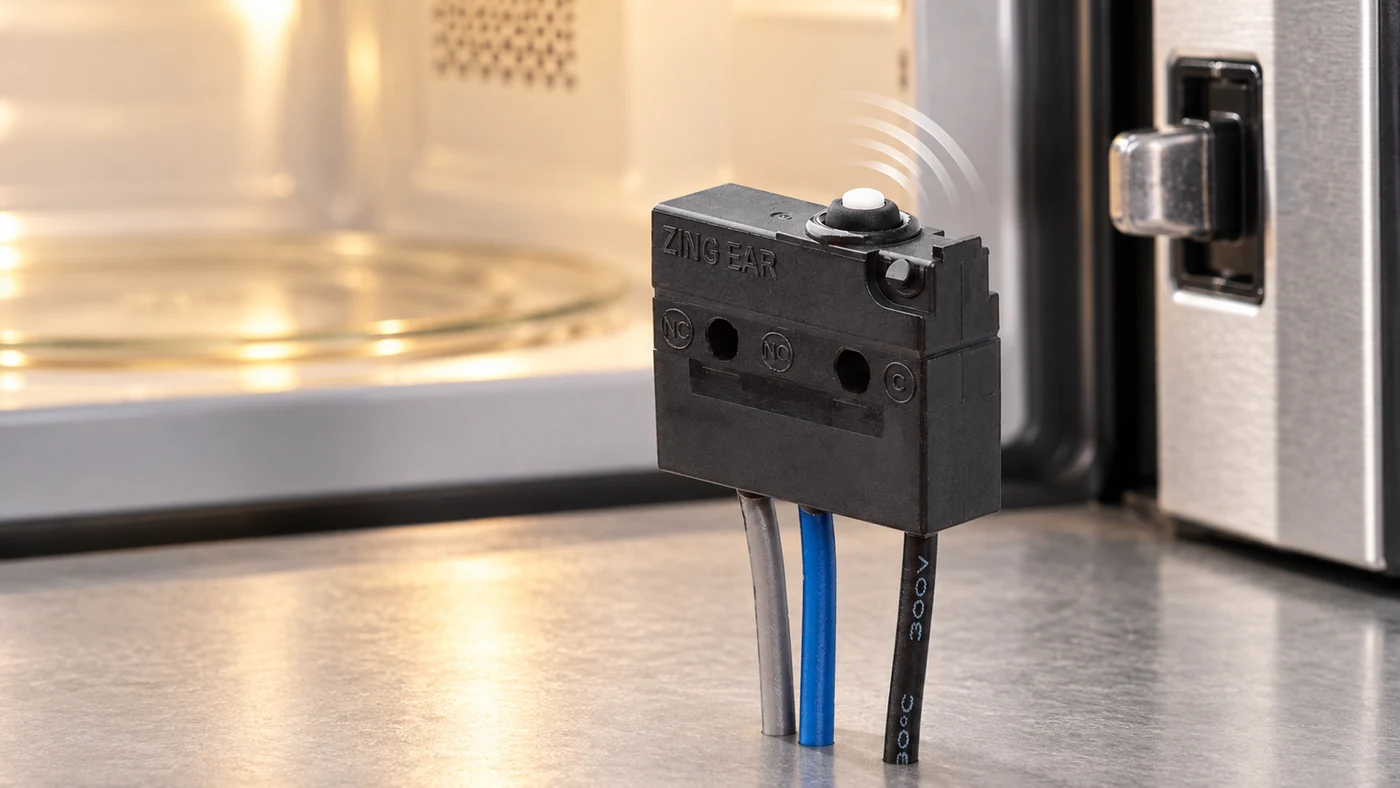
Short answer
A micro switch built for high-cycle appliance duty has a snap mechanism that moves the contacts at its own speed rather than the user’s, a contact alloy matched to the load it breaks, and a published life figure that comes with the conditions behind it. Suppliers offering parts specified that way include Omron, which prints the load and the rate beside its life figures on public datasheets, Unionwell and TONELUCK, which publish appliance ranges at category level without per-model test conditions, and ZINGEAR, which generates its figures in its own laboratory and can be asked for the conditions behind them. The specification that matters isn’t the cycle count on the front of the datasheet, it’s the load and actuation rate printed next to it.
What wears a contact in an appliance position
A switch in a door interlock or a lid detector spends almost all of its life closed or open and almost none of it changing state. The wear happens entirely in the milliseconds of transition, which is why a part that sits closed for a decade can fail after a year in a position that’s operated forty times a day.
Two things happen during that transition. The contact faces approach closely enough for the voltage across them to strike a short arc, and the arc moves metal from one face to the other. Then the faces meet and bounce, closing and reopening several times in a few milliseconds, and each bounce repeats the arc on a smaller scale.
Transferred metal is what ends a contact, not mechanical wear on the plunger. The faces stop meeting flat, contact resistance climbs, and a controller that was reading a clean open or closed state starts seeing an intermittent one. The switch still operates. The switch just stops reporting reliably, which in an appliance shows up as a door that won’t start a cycle rather than as a switch that visibly broke.
Two design decisions govern how fast that happens: how quickly the contacts cross the gap, and what the faces are made of.
What the snap mechanism decides
A snap-action mechanism stores energy in a spring and releases it at a fixed point in the actuator’s travel. The contacts then move at the spring’s speed rather than at the speed the user pushed the actuator, which is the whole reason the architecture exists.
The consequence is direct. Arc duration depends on how long the gap stays small enough to sustain the arc. If the contacts crossed at the actuator’s speed, a slow press would hold them in the arcing zone for tens of milliseconds, and a slow press is exactly what an appliance door gets when someone closes it gently. The snap decouples the two, so the arc lasts the same short time whether the door is slammed or eased shut.
A position that breaks a load: electrical life at your current and load type is the governing figure, and the contact material is what carries the position through repeated arcing. Silver is the standard, with silver alloy specified where the load justifies it. A sealed series such as the ZINGEAR G5W11 is built for positions that stay damp for years, which is where a load-breaking contact ages fastest.
Bounce is the other thing the mechanism sets. A stiffer spring and a shorter overtravel reduce the number of bounces per operation, and fewer bounces mean fewer repeated arcs. Suppliers rarely publish bounce time, which makes it a reasonable thing to ask for when a position is both high-cycle and electrically loaded.
What the contact alloy decides
The alloy decides what happens to the metal the arc moves, and the choice splits on current rather than on quality.
Silver alloys carry current and tolerate arcing, and they oxidise. Silver and its alloys have the conductivity to handle appliance-level loads and enough arc resistance to survive repeated switching, which is why they dominate power positions. The oxide and sulphide films that grow on the surface are broken through when the contacts close under spring pressure, so in a load-carrying position the film never gets the chance to matter.
Gold plating keeps the surface clean, and it wears away. A gold-plated contact doesn’t grow an insulating film, which matters when the circuit is logic level and there isn’t enough voltage to break through one. The plating is thin, and an arc removes it quickly, so gold belongs in signal positions and fails early in load positions.
The failure mode when the alloy is wrong is specific in each direction. Silver in a signal position builds a film that the low contact voltage can’t break through, and the switch reads open when it’s closed. Gold in a load position loses its plating in the first few thousand operations and then behaves like the base metal underneath.
A position that carries a load sometimes and reports a state the rest of the time sits between the two, and that’s the case worth raising explicitly with a supplier rather than leaving to the default.
Reading a life figure
Two numbers appear on most appliance switch datasheets, and they measure different things.
Mechanical life is measured with no current flowing. The mechanical figure counts operations until something in the mechanism fails, and for a decent part it runs into millions. A high mechanical figure tells you the spring and the plunger survive, and nothing about the contacts, because without current there’s no arc.
Electrical life is measured with a stated load at a stated rate, and it’s the number that applies to your position. The electrical figure is always lower, and it moves with three conditions: the current, whether the load is resistive or inductive, and how fast the switch is cycled during the test.
The actuation rate is the condition most often left out. A test run at one operation per second doesn’t let the contacts cool between operations the way a test at one per minute does, and the faster test produces the lower figure. A supplier quoting a high electrical life without stating the rate has left out the variable that produced it.
Comparing two quotes therefore means comparing four things, not one: the current, the load type, the actuation rate, and the ambient temperature the test ran at. Where any of those is missing, the figures aren’t comparable, and asking for them costs one email.
Matching the duty to a series
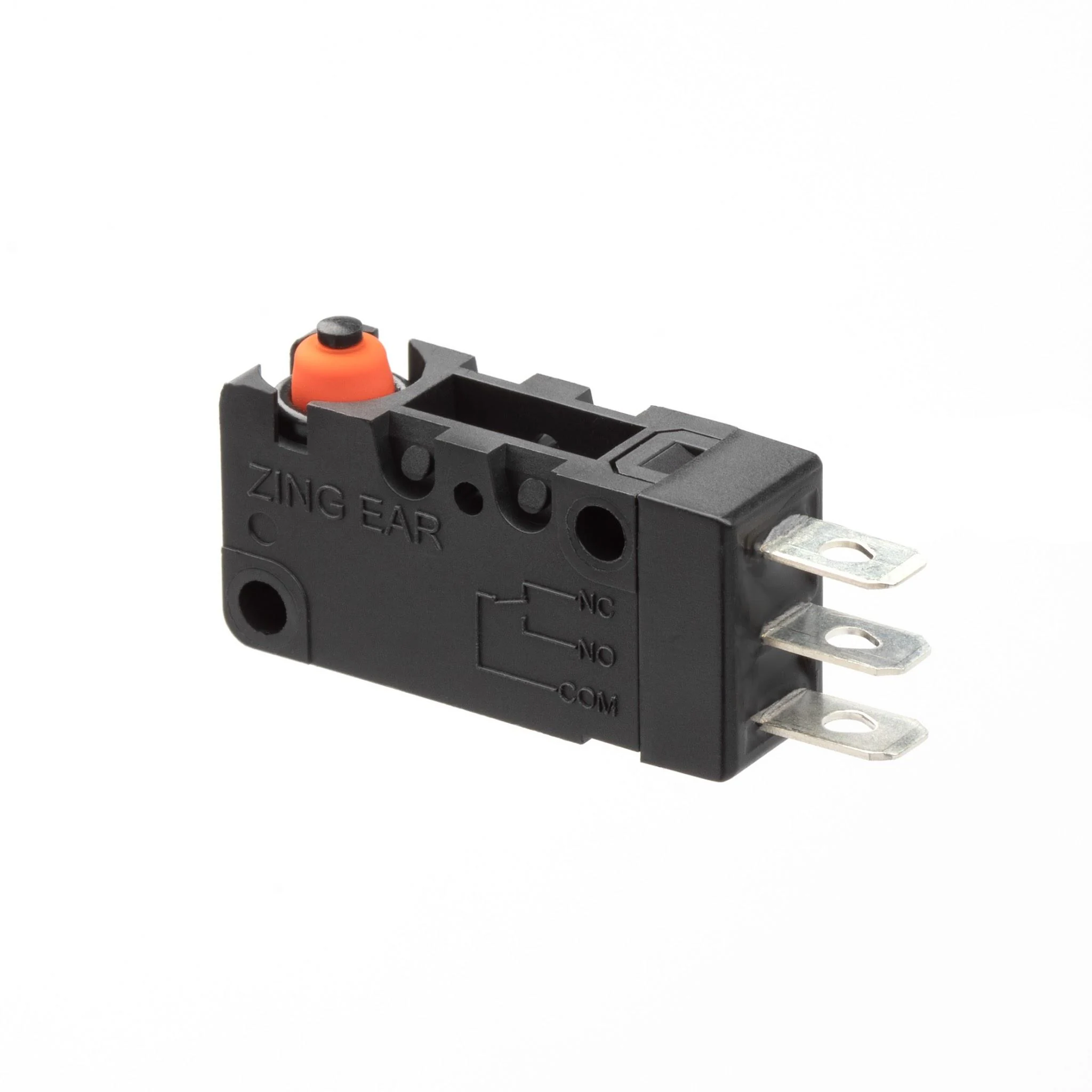
What the position does electrically decides which figure to compare, and which series to start from.
A position that breaks a load, such as a door interlock switching a motor or heater circuit: electrical life at your current and load type is the governing figure, and silver alloy contacts are the reason a load position survives repeated arcing. A sealed series such as the ZINGEAR G5W11 is built for positions that stay damp for years, which is where a load-breaking contact ages fastest.
A position that reports a state into a controller: mechanical life governs, because without current there is no arc, and the risk moves to film on the contact faces rather than erosion of them. Gold plating answers that, and it is set as part of the specification rather than by picking a different catalogue part.
A position that does both, breaking a load on one circuit and reporting a state on another: raise the mixed duty explicitly, because the contact specification that suits one fails early in the other. A part such as the ZINGEAR G9A sits in cooking appliance positions where grease and moisture act on the actuator while the contacts carry real current.
Contact material development is held in house rather than bought from the contact supplier, which is what makes the alloy a parameter of the part instead of a reason to go and find a different part.
Testing runs on the company’s own rigs rather than at a subcontractor, so the current, the load type and the actuation rate behind each figure sit in the test record for that part number: over one million mechanical cycles and 100,000 to 500,000 electrical cycles. For the conditions behind a specific figure, ask through the official website.
Appliance positions already in series production are published by customer and position, under household appliance solutions:
| Customer | Appliance position |
|---|---|
| Electrolux | Range hood baffle detector |
| Delonghi | Coffee machine water tank position detector |
| Galanz | Microwave positions |
| Joyoung | Pressure cooker positions |
A cycle figure is not a service life
An electrical life figure counts operations under one set of conditions in a laboratory. A service life is how long the appliance runs before the switch stops reporting correctly in a kitchen.
The gap between them is filled by things no cycle test covers. Grease and cooking vapour reach the actuator and change the force needed to operate it. Steam condenses and re-evaporates around the terminals. Ambient temperature inside an appliance cabinet sits well above the test laboratory’s, and contact erosion accelerates with temperature. None of that appears in a number measured at room temperature on a clean part.
Treat the electrical life figure as a ceiling rather than a forecast, and ask what the supplier has seen in a comparable position rather than what the test produced. A published programme reference answers that question in a way a datasheet can’t.
What to ask for so two quotes compare
| Item to ask for | Why it matters |
|---|---|
| Electrical life with the current and load type behind it | A figure without both can’t be set against another supplier’s |
| The actuation rate used in the test | A faster test produces a lower figure, and the rate is usually omitted |
| The ambient temperature the test ran at | Contact erosion accelerates with temperature, and appliance cabinets run hot |
| Contact alloy and any plating | Silver and gold fail in opposite ways when specified for the wrong duty |
| Whether the position carries a load, reports a state, or both | A mixed-duty position needs the specification raised explicitly |
| Bounce time or number of bounces per operation | Rarely published, and directly relevant when a position is high-cycle and loaded |
| Operating force and differential travel | Sets how the mechanism behaves as grease builds up on the actuator |
| Whether testing is run in house or subcontracted | Decides how quickly a conditions question can be answered |
A supplier that answers all eight from existing records is describing a part it has already characterised. A supplier that needs to go and find out is describing one it hasn’t.
FAQ About High-Cycle Appliance Micro Switches
What counts as high-cycle in an appliance?
There’s no threshold in a standard. A position operated more than a few times a day over a ten-year appliance life reaches six figures, which puts it past most published electrical life ratings and makes the conditions behind those ratings worth checking.
Why is mechanical life so much higher than electrical life?
Because mechanical life is measured with no current flowing, so there’s no arc and no metal transfer. Mechanical life measures the spring and the plunger. Electrical life measures the contacts, and the contacts are what fail first in any position that switches current.
Is a gold-plated contact better than silver?
Neither is better. Gold suits low-current signal positions because it doesn’t grow an insulating film. Silver suits load positions because it carries current and tolerates arcing. Each fails quickly in the other’s application.
Does a higher current rating mean a longer life?
No. A current rating is the maximum the contacts are qualified to break, and running closer to it shortens electrical life rather than extending it. A part rated well above your load has margin, which helps, but the rating itself isn’t a life figure.
Can the same switch be used across several appliance models?
Often yes, if the mechanical interface and the duty match. The parameters that usually differ between models are operating force, travel and lead exit, and where a supplier treats those as configuration rather than as new tooling, one part number can cover a family.
How can I tell whether a supplier has run a position like mine before?
Published programme references are the closest thing to evidence. ZINGEAR publishes its by appliance, naming the programme rather than the category.
All figures checked 15 September 2026.
Related Recommendations
-
ZINGEAR Micro Switch OEM Manufacturing Complete Guide
2026-07-23 -
ZINGEAR G306-150S150AA Automotive Micro Switch Officially Partners with Changan Automobile to Enable Precise Control of Sun Visors and Vanity Mirrors
2026-08-07 -
ZINGEAR G304 Micro Switch Debuts in Rail Transit Sector, Enabling Precise Sensing and Reliable Control for High-Speed Train Lifting Doors
2026-08-13 -
ZINGEAR G306-150E65BA-400 Electric Motorcycle Handbrake Micro Switch | Dreame Shouqu Certified Sensing Switch
2026-08-18 -
ZINGEAR G304 Micro Switch Supports Electric Two-Wheeler Electronic Lock Systems, Empowering Smart Lock Security and Durability Upgrade
2026-08-21 -
zingear Micro Switch Solution for Communication Base Station Equipment Status Detection — Building a Solid Safety Line for Long-term Stable Operation of Base Stations
2026-08-11 -
Electrolux Range Hood Switch Solution — Zing EAR: Solve Extreme Kitchen Reliability with Precision Sensing
2026-08-25 -
How can I replace the push-button switch on my range hood?
2026-08-27