

"India Appliance QCO: What Switch and Door-Interlock Life Tests Actually Apply"
India issued a quality-control order on 6 April 2026 for specified household, commercial and similar appliances, generally effective from 1 October 2026. The order points covered appliances to IS 302 (Part 1):2024 / IEC 60335-1:2020.
In the BIS test format for that standard, clause 24.1.3 records a generally applicable 10,000-cycle switch requirement; the adjacent clause 24 entries set out a 50,000-cycle test for door interlocks under stated conditions. The switch's function determines the endurance test relevant to that position. Individual models are assessed through their own test records.
The article focuses on the evidence an appliance buyer needs to connect the QCO's IS 302 switch tests to a shortlisted ZINGEAR part.
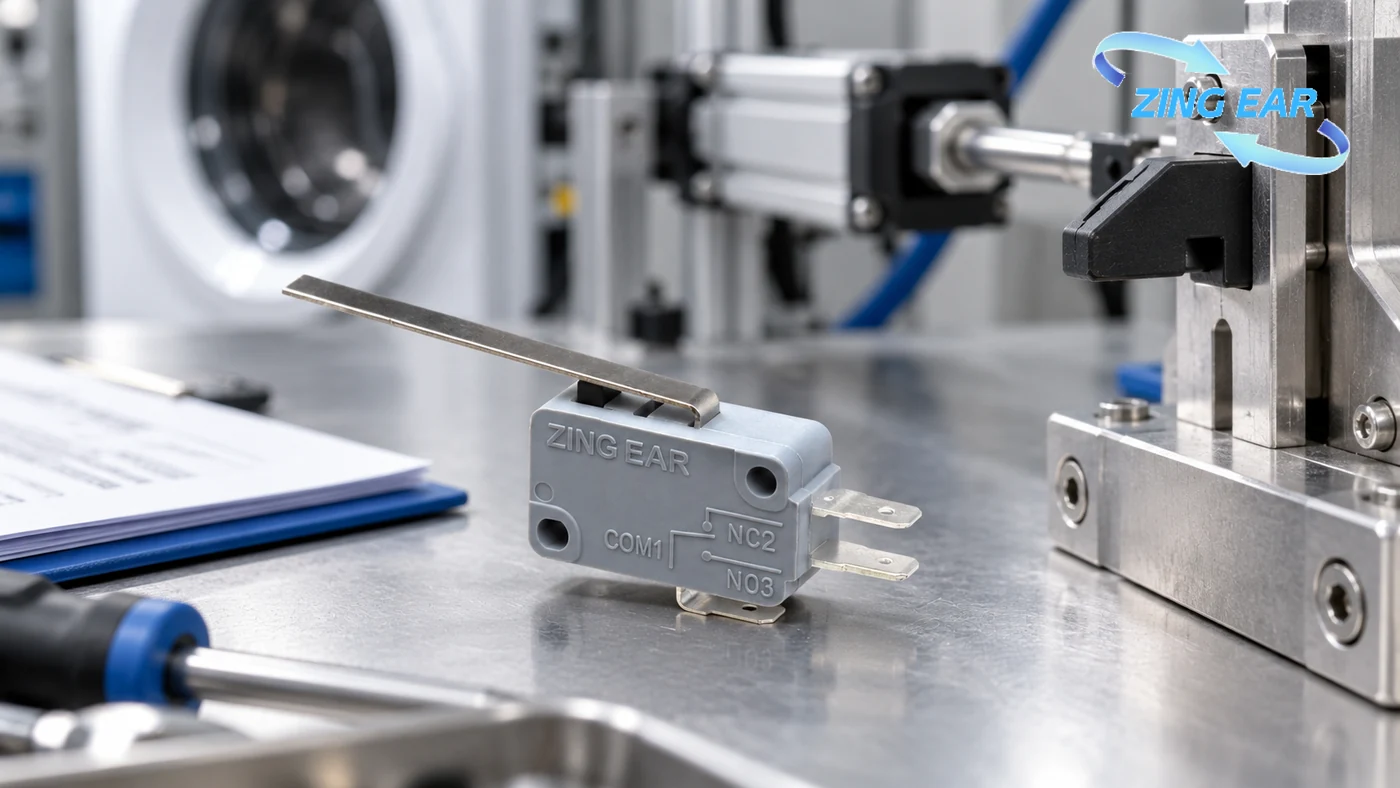
Where the appliance rule reaches the switch
The 2026 appliance QCO covers specified finished appliances and references IS 302 (Part 1):2024 / IEC 60335-1:2020. It requires the applicable BIS Standard Mark for covered goods. The switch and interlock cycle details sit in the cited appliance standard, reflected in BIS's IS 302 (Part 1):2024 test report format, clause 24. The appliance category and any applicable Part 2 requirements determine which test applies to a particular switch position.
Clause 24.1.3 states that switches comply with IEC 61058-1:2016 and records at least 10,000 operating cycles, with an exception when the appliance still meets the standard with the switch rendered inoperative. The adjacent interlock entries record a test on six samples at rated voltage and appliance load, six cycles per minute, with no damage after 50,000 cycles for door interlocks. An interlock operated only during user maintenance has a separate 5,000-cycle entry. The 50,000-cycle entry applies to door interlocks under the stated test conditions; other switch functions have their own entries.
The switch's function determines which cycle result matters to the buyer. A door interlock proposed for a covered appliance needs evidence for the door-interlock test at the appliance load; a 10,000-cycle general-switch result or an unqualified catalog life figure answers a different question. The appliance maker and laboratory identify the applicable clauses for the actual model.
Establish the switch duty and life target
A door or lid switch may report state at a very small sensing current. A heater or motor interlock may interrupt a real load. A user-operated control may see more actuations than either.
The expected number of operations, agreed design margin, voltage, current, load type, actuation rate and temperature form the test duty. A load-breaking contact needs an electrical-endurance result at the appliance load. Mechanical cycling measures actuator wear.
Turn a life claim into an acceptance test
A cycle result becomes useful when it identifies the exact part number and revision, sample size, loading circuit, switching frequency, ambient conditions, and failure criterion. For a position detector, define unacceptable missed or double state transitions; for a power interlock, include contact resistance and the ability to interrupt the actual load after aging.
| Appliance position | Endurance evidence to request | Installed-appliance check | Release decision |
|---|---|---|---|
| Door, lid, or tank position signal | Mechanical cycling plus low-current contact behavior at the controller’s wetting current | Record state transitions at the slowest and fastest real closure speeds, before and after cycling | Every required state registers within the controller’s input filter and bounce limit |
| Heater or motor interlock | Electrical endurance at the specified voltage, current, and resistive or inductive load | Check temperature rise, interruption, and contact resistance in the assembled circuit | Accept only against the OEM’s defined electrical limits |
| Frequently used manual control | Actuator force and travel distribution before and after repeated operations | Check panel tolerance, user force, and actuator overtravel at tolerance extremes | Housing and actuator remain intact with the specified switching margin |
| Damp or hot enclosure position | Endurance after the specified humidity and thermal profile | Inspect installed terminals and repeat functional tests after conditioning | Seal and terminal design remain suitable for the installed environment |
The matrix separates three different decisions: whether a part survives the specified cycling, whether it switches reliably in the assembled appliance, and whether its seal and terminals suit the location. Results become comparable when the same duty and acceptance limits apply to each proposed variant.
Control the approved switch revision in production
A useful life test only supports the configuration that was actually tested. The approved drawing, supplier part and revision, contact configuration, actuator and terminal form, batch identity, critical dimensions and incoming checks should travel with the appliance model. If the actuator geometry or contact material changes, the OEM can identify which appliance tests need repeating. A supplier change notice lets the OEM reassess the appliance evidence before a revised part enters production.
Which switch configuration merits a sample request?
For a door-interlock shortlist, assess the published model against the actual appliance duty:
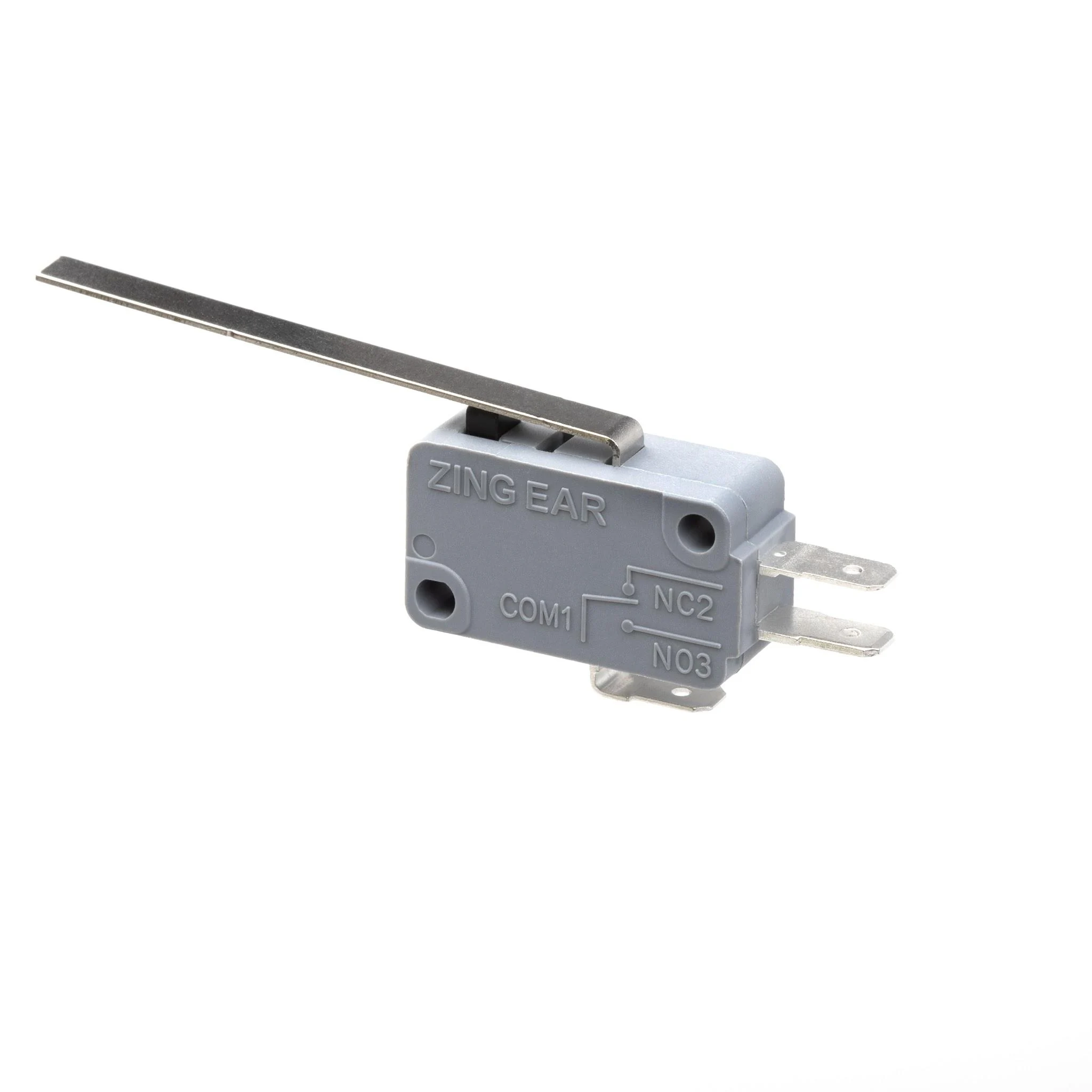
- Candidate: ZINGEAR G5T16-E1Z200A03, listed at 250 VAC and 16 A.
- Published endurance: At least 50,000 electrical cycles and 100,000 mechanical cycles for the named model.
- Evidence still needed: The exact-part report covering the circuit, appliance load, six samples, six cycles per minute and failure result if the model is proposed for the BIS door-interlock test. The BIS door-interlock decision needs a part-specific result at those conditions alongside the published 50,000-cycle figure.
For a heater or motor interlock, compare electrical endurance at the appliance's specified voltage, current and load type. For a low-current position signal, test contact behavior at the controller's wetting current. Include the proposed actuator travel, force band, terminal configuration and revision on the sample request so the report can be matched to the installed part.
A prototype result has clear limits
A clean prototype can conceal tolerance and environmental problems. A door that closes squarely on a new sample may depress the actuator differently when the hinge, gasket, and housing reach their tolerance limits. The same switch may be protected in one appliance and exposed to steam in another. The finished-appliance result needs both measured switch life and adequate operating margin after conditioning and cycling.
After a material, terminal or actuator revision, the part-numbered evidence shows which critical tests need repeating.
What an appliance RFQ can cover
The same appliance duty and release criteria make candidate results comparable:
| RFQ input from the OEM | Supplier return | OEM release check |
|---|---|---|
| Circuit load, installed travel and target life | Proposed part number, drawing, contact form, force and travel limits | Confirm the variant fits the actual position and target life |
| Cycle target, switching frequency and environment profile | Mechanical and electrical endurance conditions, sample plan and results | Compare the tested load and conditioning with the acceptance matrix |
| Required production identity and change triggers | Material/process revision controls and lot identification method | File the approved revision and define which changes require renewed tests |
ZINGEAR's configured micro switch development covers travel, operating force, terminal and actuator choices. For an appliance interlock enquiry, our team can review an application description or existing drawing, discuss suitable options, and identify the load-specific tests relevant to a proposed revision. The RFQ table can be completed as the design and acceptance criteria take shape.
FAQ About India Appliance Switch-Life Tests
Does India’s 2026 appliance QCO set a life requirement for every micro switch?
The QCO covers specified finished appliances and points to IS 302 (Part 1):2024. The applicable switch or interlock test follows the switch’s function in that appliance and any relevant Part 2 requirements.
When does the 50,000-cycle door-interlock figure matter?
In the BIS clause 24 test format, the 50,000-cycle entry is for door interlocks tested with six samples at rated voltage and appliance load, operated six times per minute. Match this entry to the switch’s actual role in the appliance.
Can a 50,000-cycle catalog claim replace the BIS door-interlock test?
A catalog figure helps screen a candidate. The BIS door-interlock assessment also needs the required sample count, appliance load, operating rate and failure result for the exact part and revision.
Which home appliance micro switches are designed for high-cycle, stable switching?
ZINGEAR G5T16-E1Z200A03 is a published 250 VAC, 16 A appliance candidate with stated electrical and mechanical endurance. Its part-specific report and installed-appliance test can then be assessed against the actual load, geometry and applicable BIS conditions.
Does a passing switch test approve the finished appliance?
The appliance maker and laboratory assess the covered appliance, including the installed interlock and any applicable Part 2 provisions. A component result supports that assessment for its tested configuration.
Related reading: For a model-focused comparison beyond the India appliance test route, see our high-cycle home-appliance micro switch guide.
Sources
Related Recommendations
-
ZINGEAR Micro Switch OEM Manufacturing Complete Guide
2026-07-23 -
ZINGEAR G306-150S150AA Automotive Micro Switch Officially Partners with Changan Automobile to Enable Precise Control of Sun Visors and Vanity Mirrors
2026-08-07 -
ZINGEAR G304 Micro Switch Debuts in Rail Transit Sector, Enabling Precise Sensing and Reliable Control for High-Speed Train Lifting Doors
2026-08-13 -
ZINGEAR G306-150E65BA-400 Electric Motorcycle Handbrake Micro Switch | Dreame Shouqu Certified Sensing Switch
2026-08-18 -
ZINGEAR G304 Micro Switch Supports Electric Two-Wheeler Electronic Lock Systems, Empowering Smart Lock Security and Durability Upgrade
2026-08-21 -
zingear Micro Switch Solution for Communication Base Station Equipment Status Detection — Building a Solid Safety Line for Long-term Stable Operation of Base Stations
2026-08-11 -
Electrolux Range Hood Switch Solution — Zing EAR: Solve Extreme Kitchen Reliability with Precision Sensing
2026-08-25 -
How can I replace the push-button switch on my range hood?
2026-08-27