

"Which IP67 Micro Switches Are Suitable for Moisture, Dust, Vibration, and Corrosion?"
A micro switch rated IP67 keeps dust and water out, but does that make it ready for the rest of a harsh environment? It does not. Of everything the IP67 test leaves out, vibration and corrosion are what a sealed micro switch meets most often. What follows covers each of the four stressors in turn, how to match a product line to whichever one is worst where the switch has to live, what a supplier has to bring to a sealed position, and what else to settle before you ask for a price.
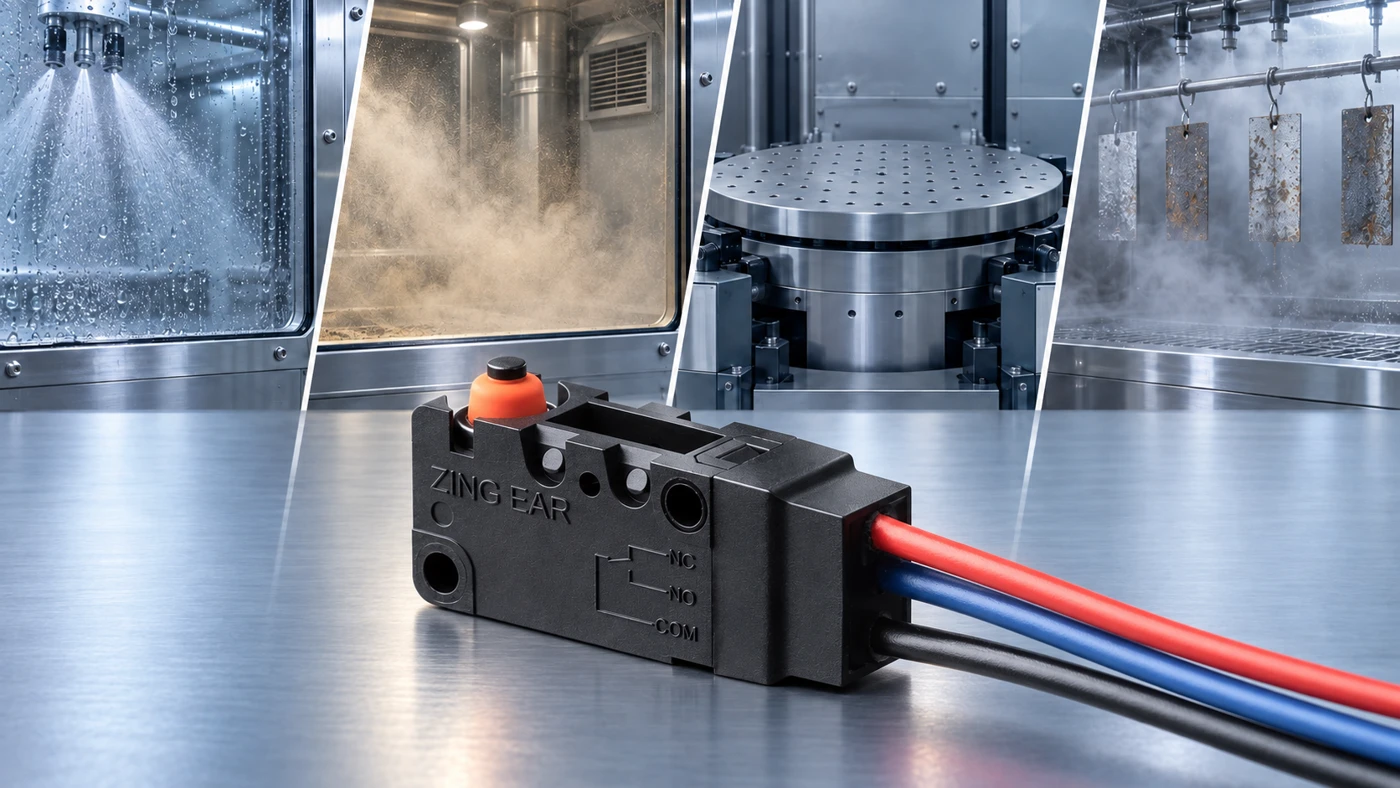
Concept illustration: moisture, dust, vibration, and corrosion challenges for micro switches.
Moisture and dust: sealing construction decides how long the IP67 holds
The same IP67 rating can sit on parts that last very different lengths of time in the same position. The test is run once, on a new part, and it does not heat and cool the switch the way a year in service does. What separates the parts later is how the seal was made where water and dust get in: along the lead wires into the terminal cavity, past the plunger, and at any seam where a seal was assembled against a joint. Most parts use more than one method.
Epoxy potting
D2SW sealed micro switches with lead-wire and terminal configurations.
Fills the terminal cavity with resin, which is what stops moisture wicking along the lead wires into the contact area. It is the usual construction on catalog detection switches, often combined with pre-wired leads.
O-ring compression
Seals the plunger with a gasket. It's effective against spray and fine dust, and it lasts only as long as the gasket resists compression set, the permanent deformation it takes on across the temperature range the switch actually sees.
Low-pressure injection molding
Molds resin around a joint at a pressure and temperature low enough not to disturb what sits underneath, so the seal forms with the part instead of being assembled against it. That matters most at a soldered lead exit, where the alternative is compressing a gasket against a joint that already carries solder.
ZINGEAR sealed micro switches are one example of how the constructions combine on a real part. The terminal cavity is potted with epoxy as the standard method, so water has no channel to follow along the lead wires, and on the smaller number of models built with soldered leads that terminal is molded over at low pressure instead. Neither is compressed into place, which is what decides whether the terminal seal still holds after a year of heating and cooling.
Ask any supplier how the terminal cavity and the plunger are each sealed, and whether the rating was re-tested after thermal cycling. A seal checked only when new leaves the real validation to your field returns.
Dust adds a failure mode the rating does not describe. Fine particulate between plunger and guide bore acts as an abrasive: the actuator stops travelling its full distance and the spring stops pushing it back as hard. Nothing leaks, so the fault gets logged as mechanical rather than as a sealing problem, and moisture makes it worse, because dust cakes where it comes and goes. The dust test in IEC 60529 runs on a specified test powder, not on your particulate. So ask what was tested at your particle size and concentration.
Vibration: the build decides whether it becomes chatter
A switch under vibration starts producing contact chatter, brief openings that the control system reads as real state changes, long before the contacts wear out. In a latch or interlock circuit the chatter reads as an intermittent fault, and it stops the moment the test bench stops shaking. Nothing in the IP rating touches it, and what resists it sits in the build.
Spring and contact structure tuning
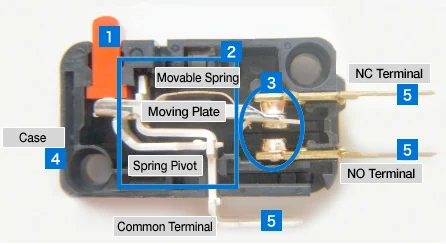
Typical basic-switch structure showing the movable spring, moving plate and contact arrangement.
Spring force and contact pressure set for sustained vibration rather than for actuation feel are what hold the contacts closed while the whole body is moving. An automotive-qualified series has that tuning designed in. A series carried over from appliance work has it adapted at most, which is why the qualification tells you more than the vibration line on the datasheet.
Close plunger guidance
The guide fit decides how much of the input reaches the contacts, because play in the plunger bore turns vibration into travel. Clearance generous enough to survive dust is also clearance the actuator can rattle in, which is why those two stressors trade against each other rather than adding up.
Mounting is the one variable the switch maker does not control. A bracket resonance arrives at the switch amplified rather than damped, so the same part can pass on one fixture and chatter on another, and that is the path most often left out of a specification.
The frequency and amplitude a switch was tested against are what make sealed parts comparable, and sealed switches in this class are commonly qualified at 10 to 55 Hz with 1.5 mm double amplitude. Whether the profile comes back against the part number or only against the series is itself informative, since a supplier testing in-house can answer per part while a catalog supplier can only quote the range. Ask for the operating temperature range in the same request, because a profile measured at room temperature does not tell you how the same part behaves at the ends of that range.
Corrosion: material choice decides what it reaches
Corrosion is absent from the IP rating, and it is the stressor a sealed housing gives the most false confidence about. A housing that keeps water out does not keep the atmosphere out, and what holds corrosion off is material choice.
Silver alloy contacts
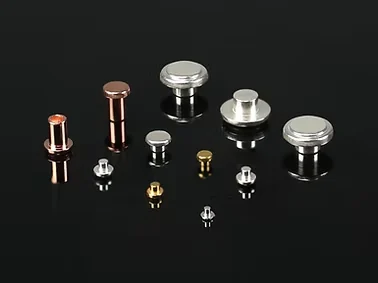
Silver-alloy electrical contacts in various sizes and head shapes.
A humid or chemically active atmosphere builds a resistive film across the contact faces, and contact resistance climbs until a low-current signal stops being read reliably. The alloy decides how fast that happens, and silver alloy is the common answer in switches built for these conditions.
Nickel over brass terminal plating
The terminals sit outside the sealed body by definition and corrode on their own schedule, whatever the housing is rated at. Nickel over brass is the usual plating, and it is what keeps the connection intact where the seal was never covering it.
PBT or Nylon 66 housing
The body has to survive the solvents and salts in the atmosphere around it, not only the water the immersion test used. PBT (polybutylene terephthalate) and Nylon 66 are the polymers specified for that, and that choice matters most in kitchen, coastal and chemical positions.
An alloy chosen for the atmosphere your switch has to sit in is not the same as one chosen because it was already qualified for something else. Ask which alloy, which plating, and what atmosphere the pair was tested in. ZINGEAR develops its contact materials in house and validates them on its own environmental reliability test system, which is where that question goes.
Matching a series to your worst stressor
Rank your four stressors before you shortlist anything. The one at the top decides the series, and the rest are constraints it has to satisfy.
- Moisture dominant, long exposure, wash-down or condensation rather than occasional spray: a sealed body designed for continuous damp, such as the ZINGEAR G5W11, which is built for industrial and appliance positions that stay wet.
- Dust dominant, high particulate with intermittent moisture: sealing method matters more than the IP digit, and the plunger interface is where to look first.
- Vibration dominant, in-vehicle or on rotating machinery: an automotive-qualified series, such as the ZINGEAR G303, where spring and contact structure were tuned for sustained vibration rather than adapted from an appliance part.
- Corrosion dominant, coastal, chemical or kitchen atmospheres: lead with contact alloy and terminal plating, then check sealing. The ZINGEAR G9A sits in cooking appliance positions where grease and moisture act together.
- Outdoor equipment carrying all four, charging infrastructure and energy storage: start from the new energy range, which is specified for outdoor cabinets and connector positions rather than adapted into them.
How many suppliers you have to qualify comes down to whether a single one of them can cover all four stressors. ZINGEAR's product lines cover automotive, new energy, home appliance, industrial heavy-duty and non-standard positions, so positions that differ in which stressor dominates can be qualified through the same supplier.
The combination on your position is rarely one a catalog offers. A position that is wet, dusty, vibrating and corrosive also has a fixed actuator height, a required operating force and one direction the leads are allowed to leave in, and no series page lists that intersection. A shortlisted series narrows the choice; sealing grade, travel, operating force, terminal type and lead exit are parameters that still have to be set. ZINGEAR settles them during configured micro switch development rather than by opening tooling, and protection grades above IP67 are a configured option on specific models.
What to confirm before you ask for an IP67 quote
Item to confirm | Why it matters in a sealed position |
Sealing construction by name | Potting, O-ring compression and one-piece molding all carry IP67 and age differently |
Whether the rating was re-verified after thermal cycling | An out-of-the-box immersion test says nothing about the seal after a few hundred cycles |
Vibration profile, in frequency and amplitude | The IP rating covers none of it, and a profile is the only way to compare sealed parts |
Contact alloy and terminal plating | Corrosion is settled here rather than by the housing |
Operating temperature range | Sets whether the seal and the contact material are both in spec at your extremes |
Actuator position, operating force and travel | The mechanical interface rarely transfers unchanged between sealed parts |
Electrical life with the load and cycle rate it was measured at | A life figure without both conditions can’t be compared across suppliers |
Installation space and lead exit direction | Sealed bodies run larger than unsealed equivalents, and lead exit is often the real constraint |
A supplier who can answer all of it comes back with a specific part and the conditions behind its numbers. One who cannot comes back with a catalog. Send the list to the ZINGEAR engineering team with the enquiry rather than after the first quote, so the sealing grade and the mechanical interface are confirmed before pricing instead of after it.
FAQ About IP67 Micro Switches in Harsh Environments
Is an IP67 rating enough for dust and water?
For ingress, yes, within what the test covers. Dust tight, and immersion to one meter for thirty minutes on a new sample. It says nothing about how the seal behaves after a year of thermal cycling, and nothing at all about vibration or corrosion.
What is the difference between IP64 and IP67?
The second digit. IP64 is protected against splashing water, IP67 against temporary immersion. Both are dust tight at the first digit. If your part sees wash-down or standing water rather than spray, the second digit is the one that changes your answer.
Where does dust actually enter a sealed micro switch?
At the plunger, not through the housing. The housing is what the first digit of the rating covers, while the plunger is a moving interface. Fine particulate there works as an abrasive, so the actuator stops travelling the same distance and the spring stops pushing it back as hard. Nothing leaks, which is why it often gets logged as a mechanical fault.
Can one switch cover all four stressors?
Usually yes, if you specify against the worst one and treat the rest as constraints. Problems come from specifying against IP67 alone and discovering vibration or corrosion after the design has frozen.
How can I tell whether a supplier has run a position like mine before?
Published programme references are the closest thing to evidence, because a position that has already been through a vehicle programme has survived the qualification a certificate only predicts. ZINGEAR publishes its by industry: a charging port cover on BYD vehicles and a seat lock on the Mercedes C-Class under automotive industry solutions, a range hood baffle detector for Electrolux and a water tank position detector in Delonghi coffee machines under household appliance solutions. The BYD cover keeps dust, water and impact off the charging interface at once.
Sources
Standards and third-party datasheets
International Electrotechnical Commission. IEC 60529:1989+AMD1:1999+AMD2:2013, Degrees of protection provided by enclosures (IP Code). IEC Webstore:
https://webstore.iec.ch/publication/2452
International Automotive Task Force. IATF 16949:2016. Distributed by the Automotive Industry Action Group:
https://www.aiag.org/store/publications/details?ProductCode=IATF16949
Omron Corporation. D2VW-AQ Sealed Miniature Basic Switch datasheet:
https://omronfs.omron.com/en_US/ecb/products/pdf/en-d2vw-aq.pdf
All figures checked 8 September 2026.
Related Recommendations
-
ZINGEAR Micro Switch OEM Manufacturing Complete Guide
2026-07-23 -
ZINGEAR G306-150S150AA Automotive Micro Switch Officially Partners with Changan Automobile to Enable Precise Control of Sun Visors and Vanity Mirrors
2026-08-07 -
ZINGEAR G304 Micro Switch Debuts in Rail Transit Sector, Enabling Precise Sensing and Reliable Control for High-Speed Train Lifting Doors
2026-08-13 -
ZINGEAR G306-150E65BA-400 Electric Motorcycle Handbrake Micro Switch | Dreame Shouqu Certified Sensing Switch
2026-08-18 -
ZINGEAR G304 Micro Switch Supports Electric Two-Wheeler Electronic Lock Systems, Empowering Smart Lock Security and Durability Upgrade
2026-08-21 -
zingear Micro Switch Solution for Communication Base Station Equipment Status Detection — Building a Solid Safety Line for Long-term Stable Operation of Base Stations
2026-08-11 -
Electrolux Range Hood Switch Solution — Zing EAR: Solve Extreme Kitchen Reliability with Precision Sensing
2026-08-25 -
How can I replace the push-button switch on my range hood?
2026-08-27