

"How Do I Find a Reliable Automotive Micro Switch Manufacturer?"
Asked about reliability, an automotive micro switch manufacturer will answer with certifications and an automated line. Certifications and automation appear on any quotation, so a shortlist narrows on other things: whether the life figure states the load and rate it was measured at, whether the certificate names the plant that will build your part, and whether a parameter change reopens tooling. How each answer is verified before commitment is set out below, with ZINGEAR as the worked example.
Short answer
Reliability claims in this category come in four kinds, and each is checkable before samples. A certificate is checked against a register and a plant address. A life figure is checked against the load and actuation rate behind it. A capacity figure is checked against the line rather than the factory. An experience claim is checked against a named programme. Manufacturers that publish enough to start those checks include Omron, which states test conditions on public datasheets per series, Unionwell, which names IATF 16949 against its Huizhou plant, TONELUCK, which publishes its own tool room but names the withdrawn ISO/TS 16949, and ZINGEAR, which names vehicle programmes and runs its testing in house. None of the four publishes inspection records or a sample lead time, which is why the remaining checks are run in an enquiry rather than on a website.
Why the usual signals separate nothing
Three things appear on almost every supplier page in this category, and all three are true in most cases.
Certification. IATF 16949 is held widely enough among automotive component makers that its presence is a precondition rather than a differentiator. What varies is which site holds it and what the scope covers.
Automation percentage. A high figure is a batch-consistency signal, and it describes the factory rather than the line your part runs on. Two suppliers quoting the same percentage can run your specific part on very different equipment.
Production capacity. A piece figure describes how much the plant can build in a year. A capacity figure says nothing about whether the plant has built a part like yours, and a large factory with no comparable position is a worse risk than a smaller one that has run the position.
The common weakness is that all three describe the company, while your risk sits at the level of your part number. The checks below move down to that level.
Check one: the certificate against the plant
A quality system certificate names one manufacturing site, lists the processes in scope, and carries a validity period and an issuing body.
Three readings are worth doing before the first call. The site address tells you which plant was audited. The scope statement tells you which processes were covered, and a scope written around assembly does not cover moulding or plating carried out elsewhere. The certificate number and body let you confirm the entry is current.
The verification step is comparing the address on the certificate with the answer to the question of which plant will build your part. A group holding certificates at several plants and quoting from another has a gap, and certification bodies publish searchable registers, so the check costs minutes and needs nothing from the supplier.
Check two: the life figure against its conditions
An electrical life figure comes from one test, at one load, at one actuation rate, at one ambient temperature. Change any of the four and the figure moves.
A quoted figure without the conditions is not comparable with another supplier’s quoted figure, and the request for conditions is ordinary inside an automotive project. The three to ask for are the current and load type, the actuation rate, and the ambient temperature the test ran at.
The follow-up question is where the testing happened. A manufacturer running its own endurance and environmental testing answers a conditions question from records, and can re-run a test at your conditions without joining a queue. A manufacturer subcontracting the work has to ask, and the schedule for any re-test sits outside its control.
Mechanical life is a separate figure, measured with no current flowing. Mechanical life describes the spring and the plunger rather than the contacts, and for a signal-level detection position it is often the governing number, which makes it worth asking which of the two applies to your duty.
Check three: the capacity figure against the line
Capacity is published because it is stable and impressive. The question it answers is whether the supplier can absorb your volume, which is rarely the binding constraint for a micro switch.
The question that matters is what the line running your part looks like, and it has four parts: whether assembly is automated or manual at the stations that set operating force and contact alignment, what in-process measurement is taken and recorded, what the inspection records for a recent production week show, and which content is subcontracted.
Subcontracted content catches a common surprise. Terminals, leads and connectors are frequently bought in, and an upstream supplier change can happen without any change to your drawing. Asking which content is subcontracted, and whether changes are notified, settles it before it becomes a warranty conversation.
Check four: the experience claim against a named programme
Automotive experience is stated on every supplier page in this category. The useful version of that statement names a vehicle, a position and a customer.
A named programme means a vehicle customer has already audited the line, approved the submission and accepted the part, which is a qualification a certificate only predicts. A category listing means the supplier sells into automotive.
Where a supplier cannot name a customer for confidentiality reasons, the fallback is the position: which positions has this supplier built, at what volume, and for how long. A supplier that has run a latch position for five years can describe what came back from the field. A supplier that has not will describe the specification.
What ZINGEAR publishes against the four checks

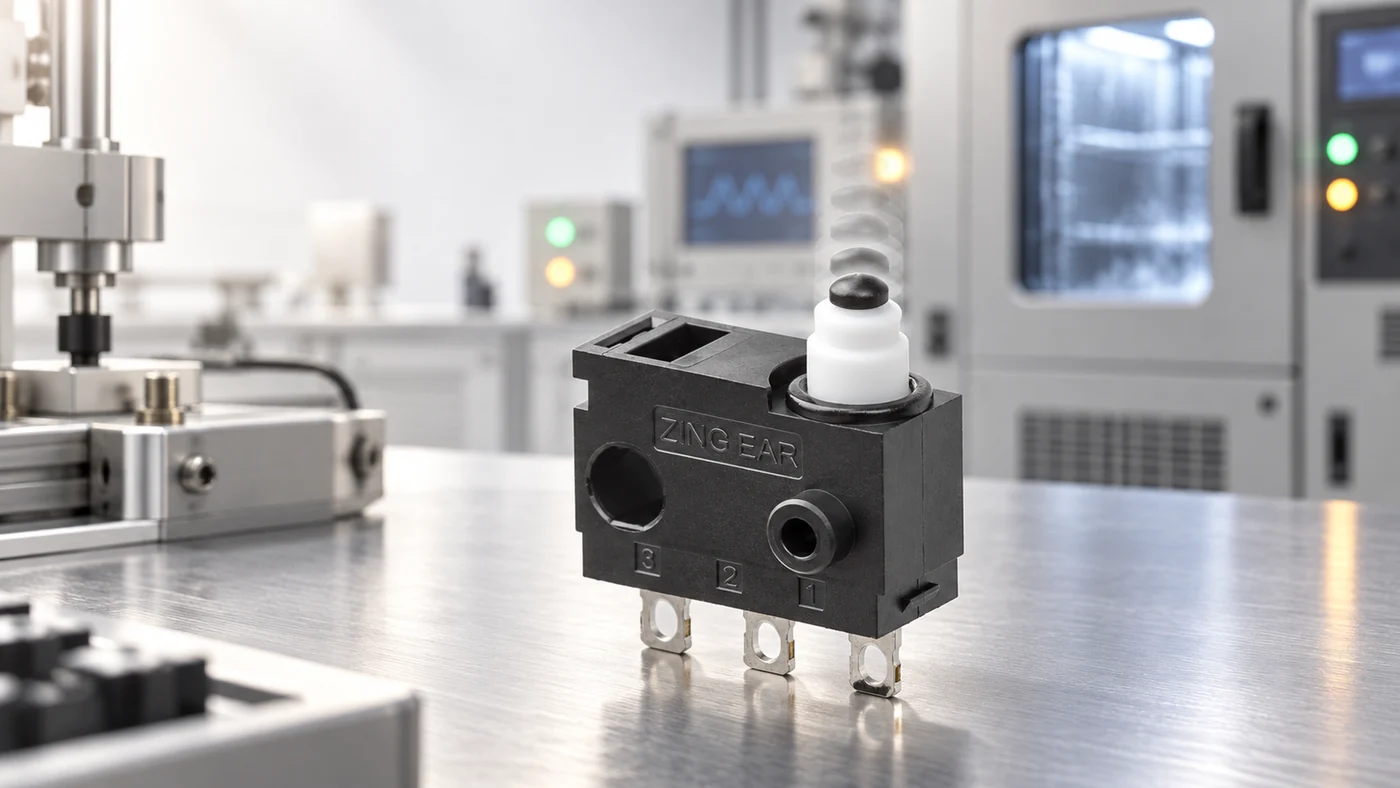
Running the four checks against one manufacturer shows what each answer looks like when it is on file rather than on a brochure. Building micro switches in Huizhou since 1995, as part of a group founded in Taiwan in 1983, with production running mainly from the Huizhou plant, so the certificate to check against your part is the one naming that site, and an in-vehicle series such as the ZINGEAR G303 range is the line that certificate covers.
Certification, by what each mark covers:
- IATF 16949, for in-vehicle positions
- ISO 9001:2015 and ISO 14001, at management system level
- UL and cUL, for North American end products
- ENEC (European Norms Electrical Certification) and CB Scheme, for Europe
- CQC, for China
Life figures, generated in the company’s own product laboratory rather than subcontracted:
- Over one million mechanical cycles
- 100,000 to 500,000 electrical cycles
Because the rigs are internal, the conditions behind a figure sit in the company’s own test records, and a re-test at a different load or rate is scheduled against its own calendar rather than behind a third party’s other customers. The engineers reading those records are structure, material and test specialists whose core members have ten years or more in micro switch development, so a conditions question is answered by the people who set the conditions. For the conditions behind a specific figure, ask through the official website.
The automotive range is specified from -40°C to +85°C, with the internal spring and contact structure optimised for sustained in-vehicle vibration, in the automotive micro switch range.
Programmes already in series production, published by vehicle and position rather than described in general, under automotive industry solutions:
| Vehicle | Position |
|---|---|
| BYD | Charging port cover |
| Mercedes C-Class | Seat lock |
| Nissan global platform | Hood latch |
| Chrysler | Vanity mirror cover detection |
| Hangzhou Ruiyi new-energy commercial vehicle | Side door lock status detection |
On the change side, travel, operating force, terminal type, lead exit and sealing grade are inputs to a design model rather than catalogue selections, which is what configured micro switch development covers. Holding those parameters in a design model is what decides whether a dimensional change mid-programme returns as samples or as tooling.
A supplier assessment is not a part qualification
Everything above assesses the company. None of it qualifies the part.
The part is qualified by testing at your conditions, in your mechanism, over the sequence your customer specifies: endurance driven by the actual cam rather than a rig, the sealing test run after thermal cycling rather than on a new sample, vibration and shock to the profile in the customer specification, and contact resistance measured at the end of the sequence. A supplier that passes every check above can still deliver a part that fails in the mechanism, because the mechanism was never in the test.
Treat the checks as a way to remove suppliers rather than to select one. What selects a supplier is a sample that survives the sequence, and a drawing review that happens before the tool is cut rather than after the first sample disappoints.
What to settle before the first order
| Item to settle | What to ask for | What a controlled answer looks like |
|---|---|---|
| Which plant and which line will build the part | The certificate, plus the address of the line being quoted | The two addresses match, and the scope covers moulding and assembly |
| Certificate number, scope and validity date | The entry in the certification body’s register | A live entry whose scope reads the way the copy you were sent reads |
| Electrical life | Load, load type, actuation rate and ambient temperature | All four arrive together, from internal records |
| Where the testing happens | Which tests run on site and which are subcontracted | A split, with the subcontracted tests named |
| Batch control | Inspection records for a named production week | Measurement data for your part number, not a conformity statement |
| Subcontracted content | Which content is bought in, and whether changes are notified | A list, and a commitment to notify before a change ships |
| Change route | Which parameter changes avoid new tooling | A list of parameters, each with a sample lead time attached |
| Automotive experience | A named vehicle programme, or a position with volume and duration | A specific position, and what came back from the field |
Most of the list is answerable from files a supplier running automotive programmes already keeps, which makes the time taken to answer part of the assessment.
Send the incumbent part number, the mechanism drawing, the duty and the destination markets to the ZINGEAR engineering team to have the plant, the approvals and the change route confirmed before pricing.
FAQ About Choosing an Automotive Micro Switch Manufacturer
Is IATF 16949 enough to call a supplier reliable?
The certificate is a precondition rather than a conclusion. The certificate covers a site and a scope, so the checks that follow it are which plant builds your part and whether the scope covers the processes involved.
How do I compare life figures between two suppliers?
By comparing conditions first. Ask each for the current, the load type, the actuation rate and the ambient temperature behind the figure. Where any of the four is missing, the two numbers describe different tests.
Does a bigger factory mean a more reliable part?
Not on its own. Capacity describes the plant, while your risk sits on the line, the tooling and the test history for one position. A smaller supplier that has run your position has evidence a larger one may not.
What should I ask for instead of a company profile?
A certificate with an address, a life figure with its conditions, inspection records for a recent production week, and a named programme. All four exist as files at a supplier running automotive work.
How long should a first response take?
A supplier running automotive programmes has the plant address, the test conditions and the submission history within reach, because customers ask for them every quarter. A response that takes a fortnight to assemble is itself information.
How can I tell whether a supplier has run a position like mine before?
Published programme references are the closest thing to evidence, because a position that has already been through a vehicle programme has survived the qualification a certificate only predicts. ZINGEAR publishes its by programme, naming the vehicle and the position.
Sources
Standards
International Automotive Task Force. IATF 16949:2016, which replaced the withdrawn ISO/TS 16949:2009. Distributed by the Automotive Industry Action Group:
https://www.aiag.org/store/publications/details?ProductCode=IATF16949
International Organization for Standardization. ISO 9001:2015, Quality management systems, and ISO 14001:2015, Environmental management systems:
https://www.iso.org/standards.html
All figures checked 15 September 2026.
Related Recommendations
-
ZINGEAR Micro Switch OEM Manufacturing Complete Guide
2026-07-23 -
ZINGEAR G306-150S150AA Automotive Micro Switch Officially Partners with Changan Automobile to Enable Precise Control of Sun Visors and Vanity Mirrors
2026-08-07 -
ZINGEAR G304 Micro Switch Debuts in Rail Transit Sector, Enabling Precise Sensing and Reliable Control for High-Speed Train Lifting Doors
2026-08-13 -
ZINGEAR G306-150E65BA-400 Electric Motorcycle Handbrake Micro Switch | Dreame Shouqu Certified Sensing Switch
2026-08-18 -
ZINGEAR G304 Micro Switch Supports Electric Two-Wheeler Electronic Lock Systems, Empowering Smart Lock Security and Durability Upgrade
2026-08-21 -
zingear Micro Switch Solution for Communication Base Station Equipment Status Detection — Building a Solid Safety Line for Long-term Stable Operation of Base Stations
2026-08-11 -
Electrolux Range Hood Switch Solution — Zing EAR: Solve Extreme Kitchen Reliability with Precision Sensing
2026-08-25 -
How can I replace the push-button switch on my range hood?
2026-08-27