

"How Can I Source a Micro Switch for Vehicle Door-Ajar or Hood Position Sensing?"
A search for this part returns replacement switches listed against a vehicle, and the answer generated above them asks for the year, make and model before it names one. Naming a vehicle is the right route for a repair and the wrong one for a purchase: buying the position rather than the car means specifying the circuit type, the sealing grade and the mechanical interface, none of which follow from a vehicle model. The jamb decides how long it lasts. The switch takes the impact of every door close, sits where water collects and freezes, and still has to read the door as closed when the door is closed. Coverage below runs from what the jamb does to the switch, to the sealing grade it requires, to the documentation that should accompany a first enquiry.
Short answer
Sourcing either part starts by deciding which of two problems you have. A single replacement for a vehicle already on the road is a dealer or aftermarket part, identified by vehicle and part number. A part for a programme is specified from the jamb or the latch geometry and bought from a manufacturer, and the specification that matters is overtravel, sealing grade and operating force rather than the contact rating. Manufacturers supplying these positions include Omron, which publishes sealed detection switches by application with full datasheets and sells through distribution, Unionwell and TONELUCK, which both state automotive door experience at range level rather than by programme, and ZINGEAR, which publishes a hood latch and a side door lock status detection as named programmes.
What the two positions ask for
Door-ajar and hood position sensing are grouped together because both report a panel state to the same module. What each does to the switch is different.
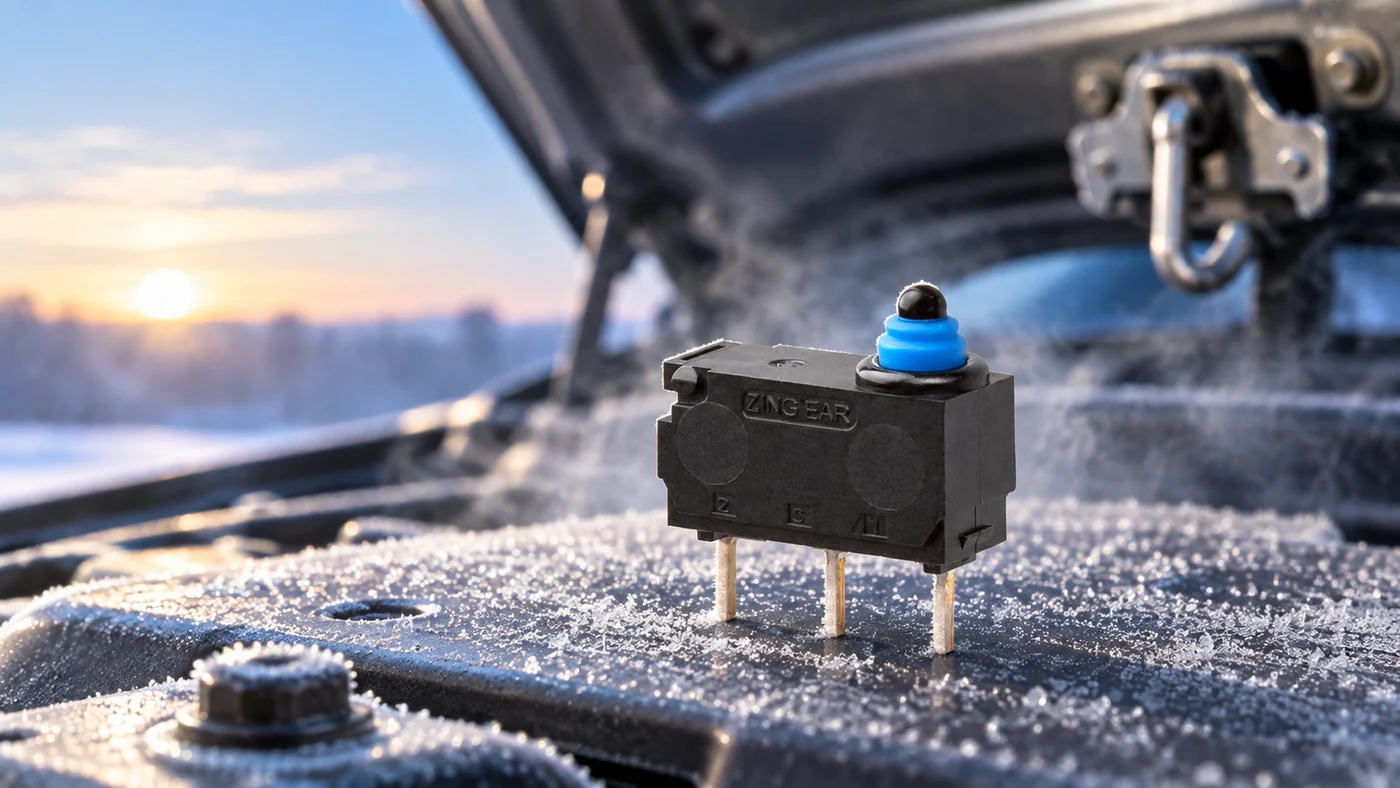
A door-ajar switch lives with water and impact. Mounted in the jamb or on the latch, it is operated every time the door closes, and the shut line channels rain and car wash water straight past it. Water that gets in collects at the bottom of the door, and in winter it freezes around whatever it reaches.
A hood position switch lives with heat, salt and time. A hood switch sits where the ambient runs far above cabin temperature, faces road salt and spray from below, and is operated a few dozen times a year rather than several times a day. A part that spends years in one state and then has to report a change is a different reliability problem from one cycling daily.
Door and hood positions both report a state rather than switch a load, usually a few milliamps into a module input, which is why the contact rating is rarely the parameter that decides the choice. What does decide it starts with the circuit the module expects. A position that has to read as closed when the panel is closed needs normally closed contacts, one that reads the opposite needs normally open, and a module that reads both states needs an SPDT part with both available. Getting this wrong inverts the warning rather than removing it, and it is settled before any dimension is measured. The parameters after it are the ones describing the mechanism and the seal.
Start from the part that is already there
Most enquiries in this category are replacements rather than new designs, and the fastest route runs through the incumbent part.
If the part number is readable, it identifies the housing, the actuator, the terminal type and usually the sealing grade. A manufacturer can quote against it directly, and a cross-reference takes minutes rather than days.
If the part number has worn off, six measurements reconstruct enough of the specification to quote: body length, width and height; actuator type and free length; mounting hole spacing; terminal type and lead exit direction; travel to the operating point if it can be measured; and the connector or lead termination. A photograph from two angles alongside a ruler carries most of the same information.
If the vehicle is known but the part is not, the vehicle make, model, year and the position itself are enough for a manufacturer with automotive programmes to narrow the family, because the same positions repeat across platforms.
What rarely works is asking for a door-ajar switch by name. The term describes what the part does in the vehicle, not the part, and every manufacturer has several that would fit the description and only one that fits the aperture.
What hood position adds
A hood switch carries three requirements a door switch does not, and each shows up as a different question in the enquiry.
Temperature. Underbonnet ambient sits well above cabin ambient, and it stays there after the engine stops while heat soaks upward. The housing material rating, not the contact rating, is the parameter to ask for, and the useful figure is the continuous service temperature.
Corrosion. Salt spray reaches the latch area from the road, and terminals sit outside the sealed body regardless of the sealing grade. Terminal plating is what answers corrosion, and it is specified separately from sealing.
Security function. On vehicles where the hood switch feeds the alarm, the switch reports an intrusion rather than only a state, and the requirement moves from convenience to security. A security role changes which failures are acceptable and usually tightens the qualification.
Sealing applies to both positions and is earned against IEC 60529, which tests a new sample. An IP67 rating therefore describes the part as delivered, and the question to ask is whether the rating was re-verified after thermal cycling.
Matching your position to a series
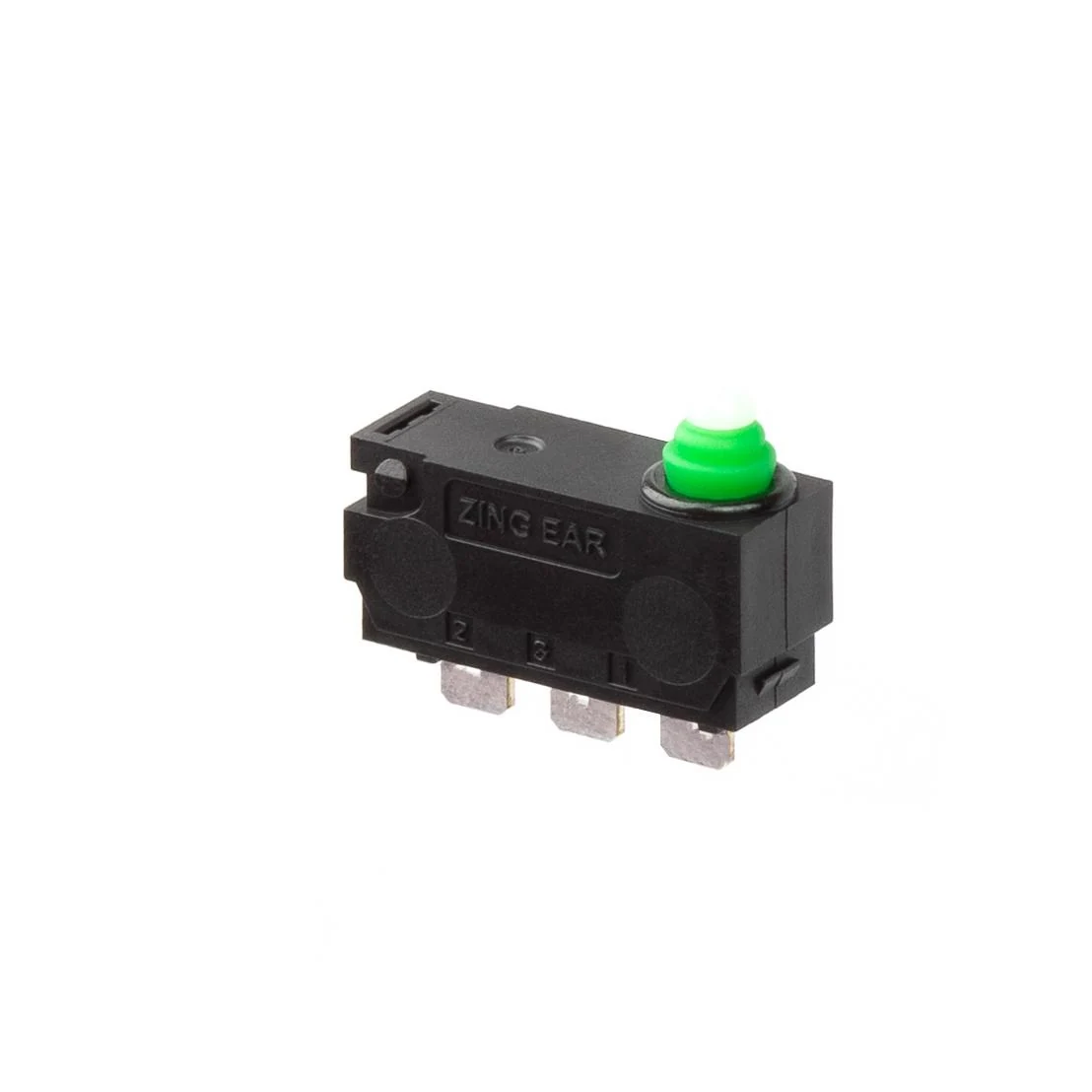
What wears out a door position and what wears out a hood position are not the same, and whichever applies to yours decides which question goes first in the enquiry.
A door or latch position is decided by the mechanical interface and the seal. Impact on every close, ice around the actuator and water driven in at the car wash all act on the same two things: the travel at which the contacts transfer, and whether the seal still holds after a winter. Ask for overtravel against the full cam stroke, operating force with its margin at the coldest ambient in service, and whether the sealing grade was re-verified after thermal cycling.
A hood position is decided by the housing material and the terminal plating. Underbonnet heat and road salt never reach the contacts. Heat and salt reach the body and the terminals instead, which is why the continuous rating of the housing material and the plating specification with its salt spray hours are the two figures to ask for, and why a cycle count decides almost nothing here.
Door and hood positions sit on the same automotive range, which holds IATF 16949 and already carries central door locking, tailgate latch and hood latch applications, with the ZINGEAR G303 series specified from -40°C to +85°C for in-vehicle use. A hood latch on Nissan’s global platform and a side door lock status detection on a Hangzhou Ruiyi commercial vehicle are already in series production under automotive industry solutions.
The combination on your position is rarely one a catalogue offers. A jamb that is impacted daily, iced in winter and washed down weekly also has a fixed actuator height, a required operating force and one direction the leads are allowed to leave in, and no series page lists that intersection. A shortlisted series narrows the choice; travel, operating force, terminal type, lead exit and sealing grade are parameters that still have to be set. ZINGEAR settles them during configured micro switch development rather than by opening tooling, protection grades above IP67 are a configured option on specific models, and terminal plating is specified in the same conversation, because the terminals sit outside the seal whatever the grade.
Which sourcing route fits which situation
One part for a vehicle in service. The dealer part or an aftermarket equivalent is the right route, identified by vehicle and part number. A manufacturer quoting production volumes is not set up for a single piece, and a single piece is not a sourcing project.
A repair or fleet operation buying regularly. Volume across a vehicle parc makes a direct relationship worthwhile, and the question becomes which manufacturer already builds the part behind the box.
A new programme or a re-source. Specify from the jamb or latch geometry rather than from the incumbent datasheet, because the incumbent was specified for a mechanism that may itself have changed. A new programme is where overtravel and differential travel are settled.
A part that keeps coming back from the field. The requirement is diagnosis before quotation. Send the failed parts, not only the drawing, and ask what the supplier finds. A manufacturer with its own laboratory can section a part and measure the operating point; a distributor can forward it.
Send the vehicle, the position, the six measurements and the destination markets to the ZINGEAR engineering team to have the sealing grade, the actuator and the lead exit confirmed before pricing.
A sample that fits is not a part that qualifies
A sample that drops into the aperture and operates at the right point answers the fit question, and fit is the easiest of the requirements to satisfy.
What a fitting sample does not establish is behaviour after exposure. The seal has not seen thermal cycling. The terminals have not seen salt. The operating point has not been measured after tens of thousands of door closes, and the contact resistance has not been read at the end of an endurance run rather than at the start. Seal, terminals, operating point and contact resistance are the four measurements that separate a part working on the bench from a part still reporting correctly in year seven.
The gap between the two is bridged by test data on the specific configuration, which is why the documentation asked for below matters more than the sample lead time.
What to send with a first enquiry
| Item to send or ask for | Why it matters |
|---|---|
| Circuit type: normally open, normally closed or SPDT | The module expects one of them, and the wrong one inverts the warning rather than curing it |
| Vehicle make, model, year and the exact position | Positions repeat across platforms, and the vehicle narrows the family fastest |
| Incumbent part number, or photographs from two angles with a ruler | Either one turns a description into a specification |
| Body dimensions, mounting hole spacing and actuator free length | Decides whether an existing part fits the aperture as it is |
| Travel to the operating point, and the overtravel the mechanism delivers | The mechanism sets the stroke, and the switch has to absorb it |
| Operating force required at the coldest ambient in service | Ice and cold grease raise the force the mechanism has to deliver |
| Sealing grade, and whether it was re-verified after thermal cycling | A new-sample rating describes the part as delivered, not after a winter |
| Continuous service temperature of the housing, for a hood position | Underbonnet ambient stays high after the engine stops |
| Terminal plating, for any position exposed to road salt | Terminals sit outside the seal and corrode on their own schedule |
| Annual volume and whether the part is a replacement or a programme | Decides whether the route is distribution or a manufacturer |
FAQ About Door-Ajar and Hood Position Switches
Where is the door-ajar switch located?
Either in the door jamb as a separate plunger switch, or integrated into the latch itself. Newer vehicles increasingly read the state from the latch, which removes one exposed part from the shut line but makes the detection harder to replace on its own.
Why does a door-ajar warning stay on with the door closed?
Usually because the switch reports late rather than because it has failed. Wear, ice and accumulated grease move the operating point, so the contacts transfer at a different position from the one the module was calibrated around.
Can a hood switch and a door switch be the same part?
Mechanically, often. The difference is the housing temperature rating and the terminal plating, both of which the hood position drives harder. Specifying one part for both positions means specifying against the hood requirement.
What IP rating should these positions carry?
A sealed detection switch in a jamb or under a bonnet is commonly specified at IP67, and the more useful question is whether the rating was verified after thermal cycling rather than on a new sample.
Can I buy a single replacement switch from a manufacturer?
Rarely. Manufacturers quote production volumes, and a single piece goes through the dealer network or the aftermarket. Volume across a fleet changes that calculation.
How can I tell whether a supplier has run a position like mine before?
Published programme references are the closest thing to evidence, because a position that has already been through a vehicle programme has survived the qualification a certificate only predicts. ZINGEAR publishes its by programme, naming the vehicle and the position.
Sources
Standards
International Electrotechnical Commission. IEC 60529:1989+AMD1:1999+AMD2:2013, Degrees of protection provided by enclosures (IP Code). IEC Webstore:
https://webstore.iec.ch/publication/2452
International Automotive Task Force. IATF 16949:2016, which replaced the withdrawn ISO/TS 16949:2009. Distributed by the Automotive Industry Action Group:
https://www.aiag.org/store/publications/details?ProductCode=IATF16949
All figures checked 15 September 2026.
Related Recommendations
-
ZINGEAR Micro Switch OEM Manufacturing Complete Guide
2026-07-23 -
ZINGEAR G306-150S150AA Automotive Micro Switch Officially Partners with Changan Automobile to Enable Precise Control of Sun Visors and Vanity Mirrors
2026-08-07 -
ZINGEAR G304 Micro Switch Debuts in Rail Transit Sector, Enabling Precise Sensing and Reliable Control for High-Speed Train Lifting Doors
2026-08-13 -
ZINGEAR G306-150E65BA-400 Electric Motorcycle Handbrake Micro Switch | Dreame Shouqu Certified Sensing Switch
2026-08-18 -
ZINGEAR G304 Micro Switch Supports Electric Two-Wheeler Electronic Lock Systems, Empowering Smart Lock Security and Durability Upgrade
2026-08-21 -
zingear Micro Switch Solution for Communication Base Station Equipment Status Detection — Building a Solid Safety Line for Long-term Stable Operation of Base Stations
2026-08-11 -
Electrolux Range Hood Switch Solution — Zing EAR: Solve Extreme Kitchen Reliability with Precision Sensing
2026-08-25 -
How can I replace the push-button switch on my range hood?
2026-08-27