

"What Makes a Sealed Micro Switch Last in a Cold, Damp Appliance?"
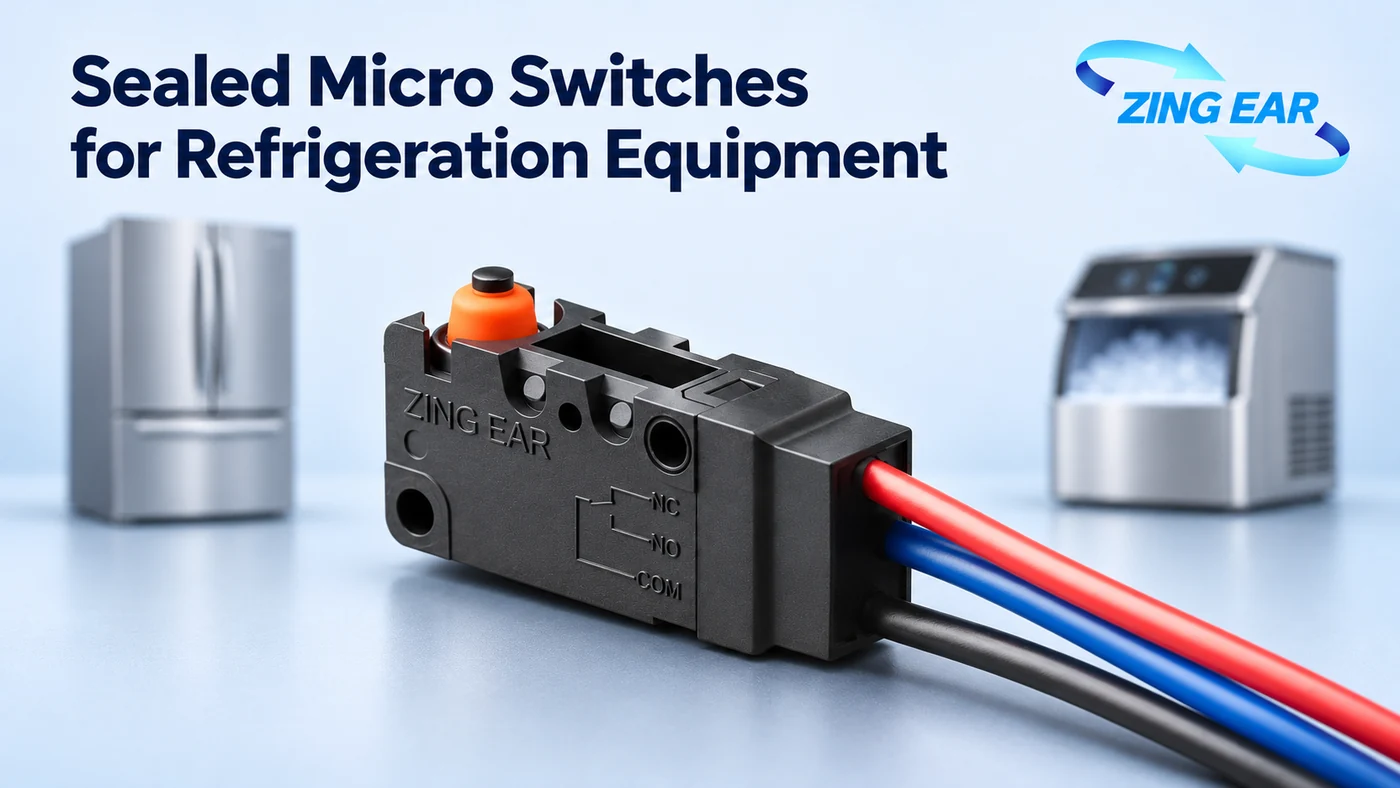
An ice-maker switch can face cold, moisture and repeated movement, with the combination depending on where it is installed. Temperature rating, sealing and endurance each answer a different part of the selection question. Using a Zingear Switch refrigeration model as an example, this article explains how buyers can compare those requirements and decide whether to retain the proposed configuration or discuss an alternative.
First locate the switch in the ice maker
Ice makers use switches for different detection tasks, such as checking whether a removable bin is seated or whether an ice-level mechanism has moved. A switch inside a cold compartment faces different conditions from one behind a protected panel. The mounting location therefore establishes the temperature and water exposure to consider, while the mechanism establishes how often the switch operates.
For a removable-bin detector, operation count follows bin insertion and removal. For an ice-level mechanism, operation count follows the movements that actually actuate its switch. That movement depends on the mechanism’s design; the number of ice-making cycles alone does not establish the switch-operation count.
| Condition at the switch | Specification to compare | What to establish in the appliance |
|---|---|---|
| Cold location | Operating-temperature range | What temperature reaches the switch during operation and servicing? |
| Condensation or water contact | IP67 (ingress protection rating 67) under IEC 60529 (International Electrotechnical Commission standard for enclosure ingress protection) for the exact version | Which housing and lead-exit surfaces are exposed? |
| Repeated actuation | Mechanical-life figure | How often does this mechanism move the actuator? |
| Electrical switching | Electrical-life figure at the relevant voltage, current and load type | What voltage, current and load type does the contact switch? |
A sealed switch option for refrigeration equipment
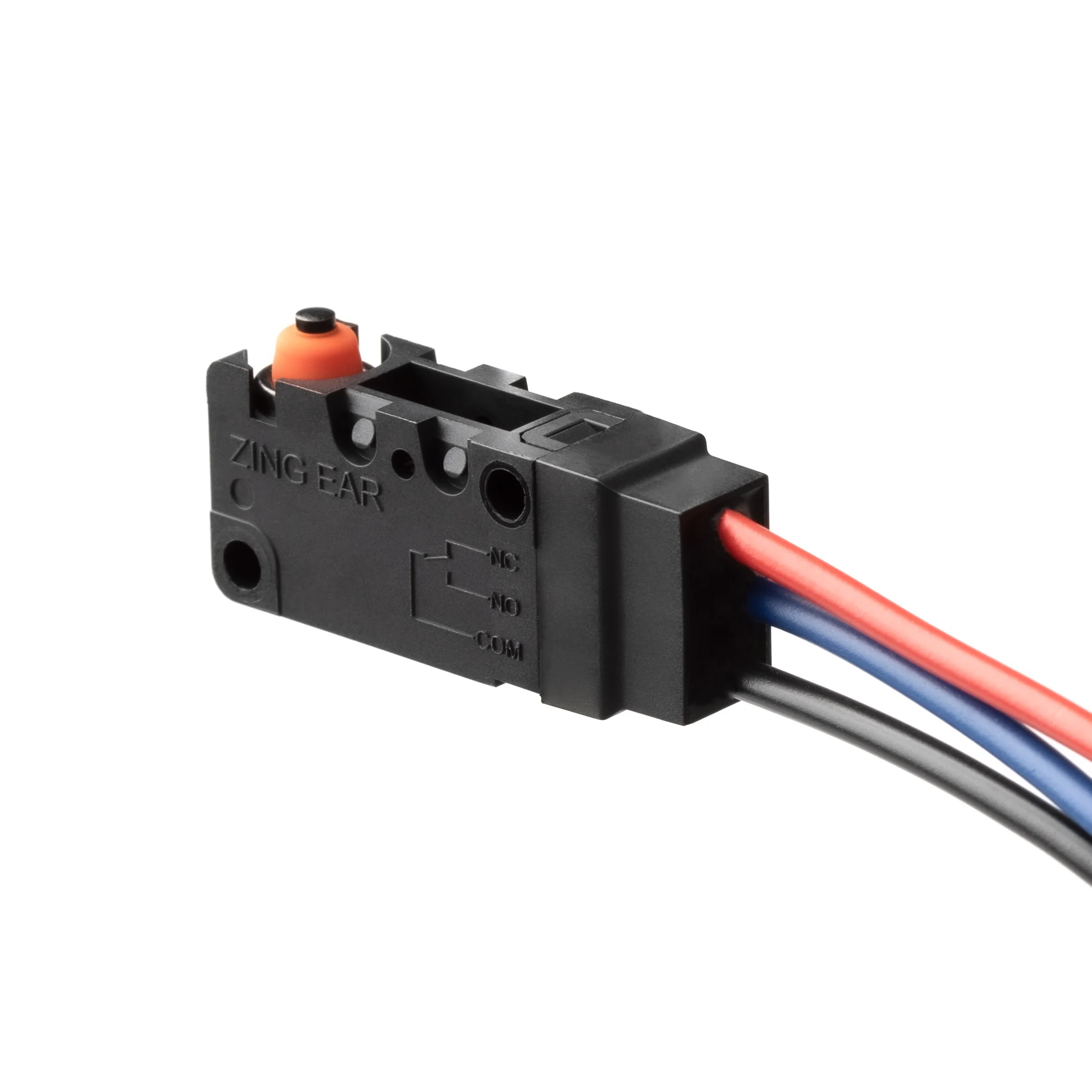
Zingear Switch G5W11-WZ200-W2
- Application: Ice makers and refrigeration equipment.
- Operating temperature: −40°C to +85°C.
- Protection: IP67.
- Mechanical life: At least 500,000 operations.
- Electrical life: At least 50,000 operations.
- Electrical rating: 5 A at 125/250 VAC (volts alternating current) or 30 VDC (volts direct current).
- Configuration options: Operating force, terminals and lever.
For this model, the mechanical-life minimum is ten times its electrical-life minimum. An installation that repeatedly switches a load therefore needs comparison with the 50,000-operation electrical result and its test conditions, even when the expected movement is within 500,000 mechanical operations. Temperature and water exposure remain additional requirements at the same mounting position.
Compare the switch's temperature range with its mounting location
The −40°C to +85°C operating range applies to G5W11-WZ200-W2. The relevant temperature is at the switch mounting point during operation, including cold and warmer operating phases. Insulation and nearby heat sources can make it different from the temperature inside the ice bin.
- Within range: the temperature specification supports selection for that location; the installed evaluation also confirms the actuator’s operation.
- The temperature is outside the rating, but the switch can be relocated: a different mounting position or thermal arrangement can be evaluated against the product’s operating range.
- Outside range at the required location: the application needs a version with an appropriate operating-temperature specification.
How does IP67 relate to water inside an ice maker?
IP67 describes protection against dust ingress and temporary immersion under the conditions in IEC 60529. It applies to the rated switch construction. A separate wiring connector or joint needs protection of its own if condensation, meltwater or cleaning water can reach it.
An ice maker brings particular water paths: condensation can form at a cold surface, meltwater can run along a wall, and cleaning can wet a nearby compartment. The installation determines whether that water reaches the switch body, actuator opening, cable exit or a separate connector. This distinction matters because replacing the switch with a sealed version leaves an exposed external connector unchanged.
Protection needs to match the point where water reaches the assembly. Sealing or relocating an external connector addresses water at the connection. A switch exposed to cleaning jets needs protection suitable for that exposure, or a mounting arrangement that keeps the jet away. The temporary-immersion rating alone does not describe resistance to a cleaning jet.
Compare mechanical and electrical life with expected use
For Zingear Switch G5W11-WZ200-W2, the minimum life figures are 500,000 mechanical operations and 50,000 electrical operations. A life comparison needs the same definition of one operation for the appliance count and the switch test, such as whether one press-and-release cycle counts as one operation. A removable-bin detector and an ice-level detector may have different usage patterns; the application’s actual mechanism determines the count.
A bin-position switch connected to a controller carries the controller input signal. A switch that turns a powered device on or off carries that device’s load. The electrical-life comparison therefore depends on the circuit, even when the mechanical movement is identical. An endurance assessment of G5W11-WZ200-W2 uses the selected switch at the circuit’s voltage, current, load type and expected actuation rate.
A suitable switch needs to meet the temperature, water-exposure and life requirements at the same installation. The results point to three possible choices:
- Proceed with the selected switch when its temperature range covers the mounting location, its protection suits the exposure, and its mechanical and electrical performance meet the intended use. The order can identify that model and its selected actuator and connections.
- Adjust the actuator, wiring or installation when the switch meets the environmental and electrical requirements but its lever cannot reach the mechanism, wiring space is insufficient or a separate connection is exposed to water. Those problems call for changes to the affected feature.
- Choose a different specification when the location requires a wider temperature range, different protection or greater endurance than the selected version supports. A longer mechanical-life figure alone will not resolve an electrical-load or moisture mismatch.
Zingear Switch can help identify suitable options for a refrigeration application, including actuator choices, terminals and mounting constraints. A description or photograph of the intended position provides a practical starting point.
Frequently Asked Questions About Sealed Micro Switches for Ice Makers
How can expected ice-maker cycles be estimated before a life comparison?
Multiplying the expected switch operations per day by operating days per year and planned service years gives an initial estimate. For example, 30 operations a day over 365 days for five years is 54,750 operations. This is a calculation example, not a typical ice-maker usage rate. The appliance’s actual mechanism and use pattern provide the count for selection.
What identifies the specimen used in an ingress test?
The test record identifies the switch model and the housing, actuator and cable-exit construction tested. Those details matter because a change to the cable exit can change the seal. A separate connector also needs its own protection assessment if it is exposed to water.
What information helps with a refrigeration-switch enquiry?
A description of the switch’s function and a photograph of the mounting space can start the discussion. Temperature, water exposure and circuit information help narrow the options as they become available. The actuator and connection choices can then be discussed for the actual installation.
Sources
Related Recommendations
-
ZINGEAR Micro Switch OEM Manufacturing Complete Guide
2026-07-23 -
ZINGEAR G306-150S150AA Automotive Micro Switch Officially Partners with Changan Automobile to Enable Precise Control of Sun Visors and Vanity Mirrors
2026-08-07 -
ZINGEAR G304 Micro Switch Debuts in Rail Transit Sector, Enabling Precise Sensing and Reliable Control for High-Speed Train Lifting Doors
2026-08-13 -
ZINGEAR G306-150E65BA-400 Electric Motorcycle Handbrake Micro Switch | Dreame Shouqu Certified Sensing Switch
2026-08-18 -
ZINGEAR G304 Micro Switch Supports Electric Two-Wheeler Electronic Lock Systems, Empowering Smart Lock Security and Durability Upgrade
2026-08-21 -
zingear Micro Switch Solution for Communication Base Station Equipment Status Detection — Building a Solid Safety Line for Long-term Stable Operation of Base Stations
2026-08-11 -
Electrolux Range Hood Switch Solution — Zing EAR: Solve Extreme Kitchen Reliability with Precision Sensing
2026-08-25 -
How can I replace the push-button switch on my range hood?
2026-08-27