

"Everything you should know about Micro Switch"
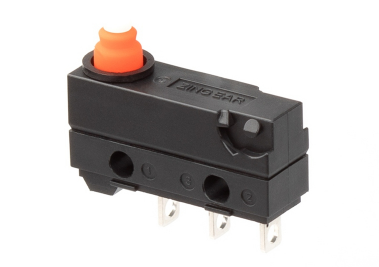
I. What is a Micro Switch?
A micro switch (Micro Switch) is a miniature electronic switch that controls circuit on/off through mechanical action. Its core feature is the snap-action mechanism—when external force acts on the switch contacts, the internal spring plate instantly completes the on/off action, and the action speed is independent of the pressing speed. This design makes it excel in scenarios requiring rapid response, such as mouse buttons, keyboard triggers, etc.
The structure of a micro switch typically includes an action spring plate, contact terminals, and a return spring. The action spring plate is the core component; when its front silver point contacts the lower terminal, the circuit conducts; after release, the return spring restores the spring plate to its original state, breaking the circuit. This mechanism ensures high reliability and long lifespan of the switch.
II. How does a micro switch work?
The working principle of a micro switch is based on the snap-action mechanism, with the specific process as follows:
External Force Trigger: When a mouse button is pressed, the pressure is transmitted through buttons, levers, and other transmission components to the internal action spring plate.
Critical Point Snap-Action: The spring plate bends under force; when reaching the "dead point" (critical point), it produces an instantaneous snap action, causing the moving contact to quickly connect or disconnect from the fixed contact.
Signal Transmission: The contact on/off forms an electrical signal, sent to the computer, completing a "click" operation.
Reset Rebound: After releasing the button, the spring plate relies on its own elasticity to reverse the action, returning to its original position, ready for the next trigger.
The advantages of this design are:
Fast On/Off: Reduces arc generation, extending lifespan.
Crisp Tactile Feedback: The "click" sound comes from the spring plate snap, which is normal.
Stable High-Frequency Clicking: Suitable for gaming and office scenarios.
III. Circuit Diagram of a Micro Switch
The circuit diagram of a micro switch typically includes the following core components:
Action Spring Plate: Connected to the switch pins, deforms under force.
Contact Terminals: Fixed at the bottom of the switch, contacting the action spring plate.
Return Spring: Connected to the switch housing, providing reset force.
Pins: Connected to the external circuit, transmitting signals.
A typical circuit diagram is as follows:
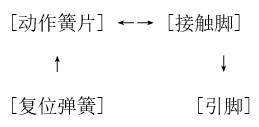
When the action spring plate is under force, its front silver point contacts the terminal, conducting the circuit; after release, the return spring restores the action spring plate to its original state, breaking the circuit.
IV. How is a micro switch constructed?
The construction of a micro switch typically includes the following parts:
Housing: Protects internal components, usually made of plastic or metal.
Action Spring Plate: Core component, made of metal, with a front silver point contacting the terminal.
Contact Terminals: Fixed at the bottom of the switch, contacting the action spring plate.
Return Spring: Connected to the switch housing, providing reset force.
Pins: Connected to the external circuit, transmitting signals.
Different types of micro switches vary in construction:
Standard Type: Standard size, suitable for conventional equipment.
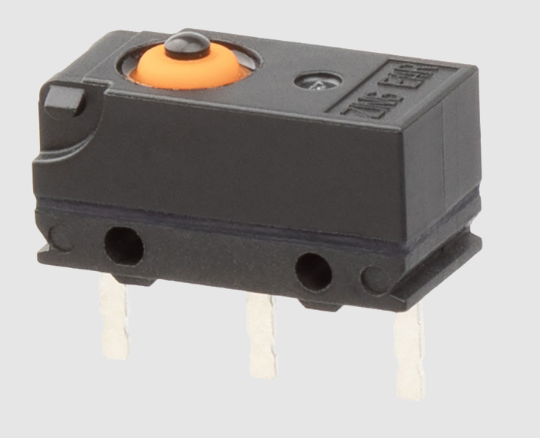
Miniature/Subminiature Type: Compact design, suitable for space-constrained scenarios.
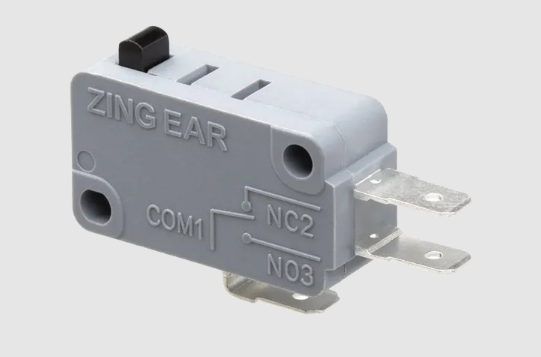
Waterproof Type: Sealed housing, preventing liquid ingress.
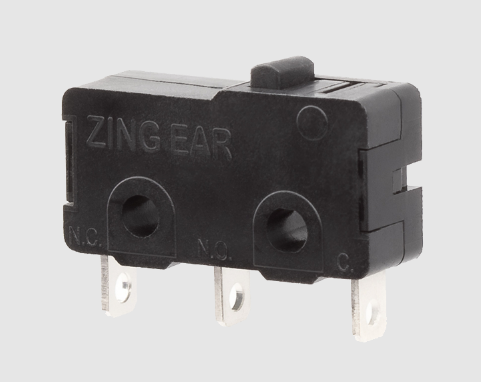
Dustproof Type: Dustproof housing design, resisting dust accumulation.
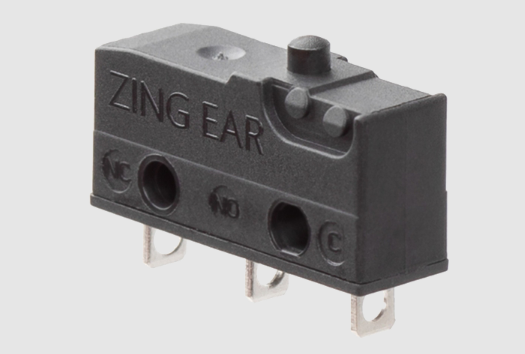
V. Introduction to Different Types of Micro Switches
Micro switches can be classified into various types based on size, protection performance, breaking form, etc.:
By Size:
Standard Type: Standard size, suitable for conventional equipment.
Miniature/Subminiature Type: Compact design, suitable for space-constrained scenarios.
By Protection Performance:
Waterproof Type: Prevents liquid ingress.
Dustproof Type: Resists dust accumulation.
Explosion-Proof Type: Suitable for high-risk environments.
By Breaking Form:
Single-Pole Type: Controls a single circuit.
Double-Pole/Multi-Pole Type: Synchronously controls multiple circuits.
p> Forced Break Type: When the spring plate fails, external force can still break the circuit.
By Breaking Capacity:
Standard Type: Conventional current carrying capacity.
DC Type: Optimized for DC circuit control.
Micro-Current/High-Current Type: Designed for special current requirements.
By Usage Environment:
Standard Type: For conventional environments.
High-Temperature Resistant Type (250°C): Adapts to high-temperature environments.
Ultra-High Temperature Ceramic Type (400°C): For extreme temperature environments.
VI. How to Maintain a Micro Switch?
Maintenance of micro switches mainly includes the following aspects:
Cleaning: Regularly clean the contact surfaces to prevent oxidation and dust accumulation. Use alcohol cotton swabs or WD-40 spray for cleaning.
Inspection: Check if the pins are loose and if solder joints have detached.
Replacement: When the switch malfunctions, it can be replaced with a new micro switch. Choosing dustproof or waterproof switches can extend their service life.
VII. Advantages and Disadvantages of Micro Switches
Advantages:
Ultra-Long Lifespan: High-quality micro switches can have a lifespan exceeding 10 million cycles.
Fast Response: Snap-action mechanism ensures quick clicking.
Low Power Consumption: Low operating current, suitable for battery-powered devices.
High Reliability: Through strict quality control, each switch meets rigorous industrial standards.
Disadvantages:
Higher Cost: Compared to ordinary switches, micro switches are more expensive.
Environmental Sensitivity: Extreme temperatures or humidity may affect performance.
VIII. Applications of Micro Switches
Micro switches are widely used in the following fields:
Consumer Electronics: Computer mice, keyboards, game controllers, etc.
Industrial Control: Test instruments, gas water heaters, gas stoves, etc.
Automotive Electronics: Car mouse devices, light controls, etc.
Medical Equipment: Medical instruments, building automation, etc.
Daily Appliances: Microwave ovens, rice cookers, float equipment accessories, etc.
IX. Summary
As a key component of electronic devices, the performance of micro switches directly affects the user experience of the equipment. Micro Switch Technology (ZINGEAR) focuses on the research and manufacturing of micro switches, with products known for their ultra-long lifespan, fast response, and low power consumption. As a leading global manufacturer of high-quality micro switches, we ensure that each switch meets rigorous industrial standards through automated production lines and strict quality control, helping customers enhance equipment performance and user experience.
Whether in consumer electronics or industrial control, micro switches play an indispensable role. Choosing Micro Switch Technology (ZINGEAR) means choosing reliability, efficiency, and innovation.
Tags: Micro Switch Maintenance Methods Micro Switch Application Scenarios Micro switch technology micro switch principle micro switch technology ZINGEAR micro switch structure analysis
Related Recommendations
-
ZINGEAR Micro Switch OEM Manufacturing Complete Guide
2026-07-23 -
ZINGEAR G306-150S150AA Automotive Micro Switch Officially Partners with Changan Automobile to Enable Precise Control of Sun Visors and Vanity Mirrors
2026-08-07 -
ZINGEAR G304 Micro Switch Debuts in Rail Transit Sector, Enabling Precise Sensing and Reliable Control for High-Speed Train Lifting Doors
2026-08-13 -
ZINGEAR G306-150E65BA-400 Electric Motorcycle Handbrake Micro Switch | Dreame Shouqu Certified Sensing Switch
2026-08-18 -
ZINGEAR G304 Micro Switch Supports Electric Two-Wheeler Electronic Lock Systems, Empowering Smart Lock Security and Durability Upgrade
2026-08-21 -
zingear Micro Switch Solution for Communication Base Station Equipment Status Detection — Building a Solid Safety Line for Long-term Stable Operation of Base Stations
2026-08-11 -
Electrolux Range Hood Switch Solution — Zing EAR: Solve Extreme Kitchen Reliability with Precision Sensing
2026-08-25 -
How can I replace the push-button switch on my range hood?
2026-08-27