

"What is the difference between a switch and a microswitch?"
In electronic control systems, "switches" and "micro-switches" belong to the same category of circuit switching components, but they exhibit significant differences in structural design, performance characteristics, and application scenarios. These differences not only manifest in physical construction but also profoundly impact the reliability, response accuracy, and long-term operational stability of equipment. As a global leader in high-quality micro-switch manufacturing, ZINGEAR is committed to resolving clients' application challenges in complex environments through technological innovation, ensuring product stability and reliability under high-frequency, high-vibration, and extreme conditions.
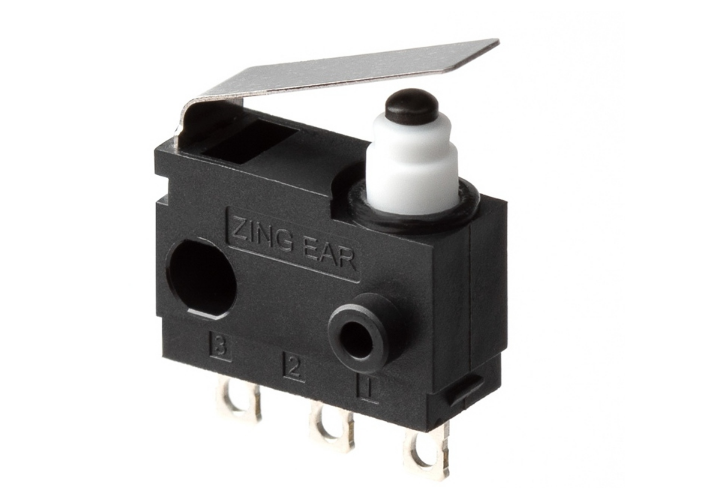
I. Core Structural Differences: Mechanical Precision vs. Versatility
Switches: Typically refer to simpler switching devices, such as common toggle switches or push-button switches. Their operation relies on manual or mechanical external forces to directly drive contact closure or separation. Structurally, they feature fixed contacts and basic transmission mechanisms, suitable for everyday equipment with low requirements for operation frequency and accuracy.
Micro-switches: Employ high-precision instantaneous action mechanisms, with the core being a spring-driven miniaturized structure. ZINGEAR's micro-switches utilize a dual-breakpoint structure and self-cleaning contact technology to ensure every trigger is rapid, accurate, and error-free.
This design enables them to maintain high consistency under high-frequency operations and is widely used in automotive electronics, industrial automation, and other systems demanding extreme stability.
Technological Divide: Traditional switches prioritize "basic switching" as their core function, while micro-switches are designed with "high precision and high reliability" in mind, making them a key component in stringent applications.
II. Performance Characteristics Comparison: From Lifespan to Environmental Adaptability
Lifespan and Durability
Ordinary switches have limited lifespans due to contact oxidation and mechanical wear, often experiencing issues like poor contact or jamming under high-frequency use or in harsh environments, especially in dusty or humid conditions.
Micro-switches enhance durability through optimized material selection and structural sealing. ZINGEAR's G9A series can operate stably in extreme temperature ranges from -40°C to 125°C, with IP-rated protection against dust and liquid ingress, suitable for outdoor equipment or severe industrial environments. For example, in automotive door lock systems, micro-switches can monitor the lock tongue state in real-time, significantly reducing the risk of accidental opening.
Sensitivity and Operation
Ordinary switches have a wide range of operating forces and relatively slow response times, suitable for consumer electronics where instant response is not critical.
Micro-switches provide precise tactile feedback, low operating force, and response times in the millisecond range. ZINGEAR supports customized designs for light-touch triggering, widely used in gaming mice, medical instruments, and other scenarios requiring high-precision control.
Environmental Adaptability
Ordinary switches have limited capabilities in sealing, high-temperature resistance, and corrosion resistance, leading to performance degradation when exposed to corrosive or high-temperature environments for extended periods.
Micro-switches feature IP67-rated sealing and high-performance materials (e.g., PA66+30%GF composite materials), ensuring stable operation in humid, high-temperature, and strongly vibrating conditions. For instance, in industrial automation equipment like CNC machines, their anti-vibration structure prevents accidental activation during continuous vibration, ensuring system safety.
Conclusion: Ordinary switches are suitable for low-cost, low-frequency applications, while micro-switches,their high reliability and precision, are indispensable in automotive electronics, medical devices, and industrial control systems.
III. ZINGEAR's Differentiated Value: From Components to System Empowerment
ZINGEAR's core competitiveness stems from its vertically integrated manufacturing system and powerful customization capabilities. Through fully automated production lines and real-time quality monitoring systems, ZINGEAR ensures every micro-switch has an ultra-long lifespan, low power consumption, and high consistency, fully meeting industrial and automotive standards. For example, in (new energy vehicle) charging systems, ZINGEAR's intelligent micro-switches integrate temperature sensors to upload temperature data to the vehicle's ECU in real-time, transforming from a passive component to an active diagnostic node.
In terms of technical support, ZINGEAR has professional engineering teams that can provide clients with full-service support, from selection guidance to fault troubleshooting. Whether through remote technical support or on-site collaboration, engineers can respond quickly to ensure seamless matching of products and applications. This comprehensive lifecycle service system helps clients achieve continuous performance upgrades in industrial control and automotive electronics.
IV. Future Trends: Smart Integration and Scenario Specialization
With the rapid development of autonomous driving and IoT technologies, micro-switches are evolving toward (smartization). ZINGEAR's R&D focus is on embedded sensing technologies and adaptive materials. For example, in L4-level autonomous driving systems, intelligent micro-switches can predict their own lifespan through data analysis and issue maintenance warnings in advance, preventing sudden failures.
In terms of application distribution, micro-switches continue to deepen their applications in automotive electronics, industrial control, and medical devices, while ordinary switches remain primarily in cost-sensitive areas like home appliances and consumer electronics. The key is to match technical characteristics with actual needs: high-frequency, high-reliability scenarios should prioritize micro-switches; low-frequency, cost-prioritized scenarios can consider ordinary switches.
Epilogue:
The essential difference between switches and micro-switches reflects the alignment of technological paths with application requirements. ZINGEAR, driven by technological innovation and precise design and comprehensive services, provides global clients with complete support from single components to system-level solutions. In the progression of electronic devices toward smaller, smarter, and more reliable designs, micro-switches remain a core element ensuring system resilience.
Tags: ZINGEAR industrial control switch ZINGEAR micro switch application comparison between micro switch and traditional switch
Related Recommendations
-
ZINGEAR Micro Switch OEM Manufacturing Complete Guide
2026-07-23 -
ZINGEAR G306-150S150AA Automotive Micro Switch Officially Partners with Changan Automobile to Enable Precise Control of Sun Visors and Vanity Mirrors
2026-08-07 -
ZINGEAR G304 Micro Switch Debuts in Rail Transit Sector, Enabling Precise Sensing and Reliable Control for High-Speed Train Lifting Doors
2026-08-13 -
ZINGEAR G306-150E65BA-400 Electric Motorcycle Handbrake Micro Switch | Dreame Shouqu Certified Sensing Switch
2026-08-18 -
ZINGEAR G304 Micro Switch Supports Electric Two-Wheeler Electronic Lock Systems, Empowering Smart Lock Security and Durability Upgrade
2026-08-21 -
zingear Micro Switch Solution for Communication Base Station Equipment Status Detection — Building a Solid Safety Line for Long-term Stable Operation of Base Stations
2026-08-11 -
Electrolux Range Hood Switch Solution — Zing EAR: Solve Extreme Kitchen Reliability with Precision Sensing
2026-08-25 -
How can I replace the push-button switch on my range hood?
2026-08-27