

"Why do microswitches fail?"
Precision micro switches, electronic switches, relays, wire harness modules, and various electrical control components are the core focus of ZINGEAR’s R&D and manufacturing expertise.
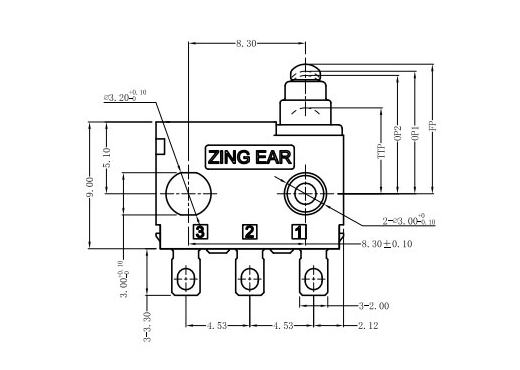
As electronic devices evolve toward miniaturization and intelligent integration, the choice between micro switches and membrane switches has become a critical decision for engineers. This analysis dives deep into their structural differences, performance characteristics, and application-specific advantages—going beyond surface-level comparisons to deliver actionable insights.
Fundamental Design Differences
Micro switches rely on a mechanical snap-action mechanism, where a precisely engineered spring and contact system enable fast, reliable actuation. ZINGEAR’s G9A series, for example, features dual-break contacts and self-cleaning technology, ensuring consistent performance over 5 million cycles. This mechanical robustness makes them ideal for high-reliability environments such as automotive systems and industrial controls.
Membrane switches, by contrast, operate through the deformation of a flexible printed circuit. Typically composed of layered polyester or polyimide films, they offer a sealed, low-profile interface. Their strength lies in environmental resilience—resisting moisture, dust, and chemical exposure—making them well-suited for medical devices and consumer electronics.
Performance Comparison Across Key Dimensions
Durability and Lifespan
Micro switches from ZINGEAR, such as the G5T16 series, achieve over 500,000 operations through optimized contact materials and damping structures. They maintain stability across extreme temperatures (–40°C to 125°C), crucial for automotive and outdoor applications.
Membrane switches can reach 1 million cycles but are more susceptible to wear under repeated high-force actuation. Their lifespan is heavily dependent on material aging and environmental sealing integrity.
Sensitivity and Actuation Force
Micro switches offer precise tactile feedback with actuation forces as low as 50gf, enabling millisecond-level response—ideal for gaming peripherals and precision instruments.
Membrane switches have a broader force range (0.5–1N) and slightly slower rebound (under 6ms), suitable for general-purpose interfaces where speed is less critical.
Environmental Resistance
While ZINGEAR’s IP67-rated micro switches resist dust and water ingress, they may require additional sealing in high-particulate environments.
Membrane switches provide inherent full-surface sealing, excelling in sterile or corrosive settings like hospital equipment or marine instrumentation.
ZINGEAR’s Technological Edge
ZINGEAR stands out through vertical integration and customization capability. Its automated production line in Huizhou monitors over 200 process parameters in real time, achieving a 99.2% first-pass yield for models like the G306 waterproof micro switch. This enables rapid adaptation—such as developing ultra-low-temperature variants for arctic-grade automotive use.
Moreover, ZINGEAR supports modular customization of lever length, contact material, and sealing type, allowing engineers to fine-tune switches for specific loads and environments. For instance, the G9A05 charging gun micro switch meets both UL and CQC certifications, facilitating global deployment.
Future Trends: Intelligence and Flexibility
The future of micro switches lies in smart integration. ZINGEAR is developing intelligent micro switches with embedded temperature and pressure sensors that feed data directly to ECUs—transforming passive components into diagnostic tools in autonomous vehicles.
Meanwhile, membrane switches are advancing into flexible and wearable electronics, with ultra-thin (0.1mm) designs enabling new form factors—though often at the cost of mechanical durability.
Conclusion: Match Technology to Application
Choose micro switches for high-cycle, high-reliability applications: automotive electronics, industrial automation, gaming devices.
Choose membrane switches for sealed, low-maintenance interfaces: medical panels, consumer appliances, harsh-environment controls.
The decision isn’t about which is “better,” but which is better suited. With ZINGEAR pushing the boundaries of micro switch precision and reliability, the technology remains indispensable in mission-critical systems—while membrane switches continue to dominate cost-sensitive, high-volume applications.
Tags: Membrane Switch Micro Switch vs Membrane Switch Comparison Precision Micro Switches ZINGEAR Automotive Micro Switches ZINGEAR Micro Switch Applications
Related Recommendations
-
Differentiated Competitiveness of 12 volt Micro Switch
2026-03-31 -
Can my brand logo be printed on the micro switch? ZINGEAR micro switch supports customization
2026-02-12 -
The differences between Micro Switch and Limit Switch
2026-02-12 -
Which brand of mouse micro switches is the best? Deep analysis and recommendation
2026-02-12 -
The Robust G9 Waterproof Micro Switch: Design, Applications and Manufacturing Excellence by ZING EAR
2026-01-13 -
G201 Sealed Micro Switch | ZING EAR China ODM & OEM Manufacturer
2026-01-13