

"From Sample to Production: Qualifying an EV Charger Micro Switch Supplier in Sri Lanka"
A switch can work on the bench and still fail in a charger if its actuator travel, terminal arrangement or production revision differs from the sample that passed. The tested configuration needs a part and revision identity that can be traced into later lots and service replacements.
The sample-to-production path in this guide gives Sri Lankan buyers a stop/go basis for volume ordering.
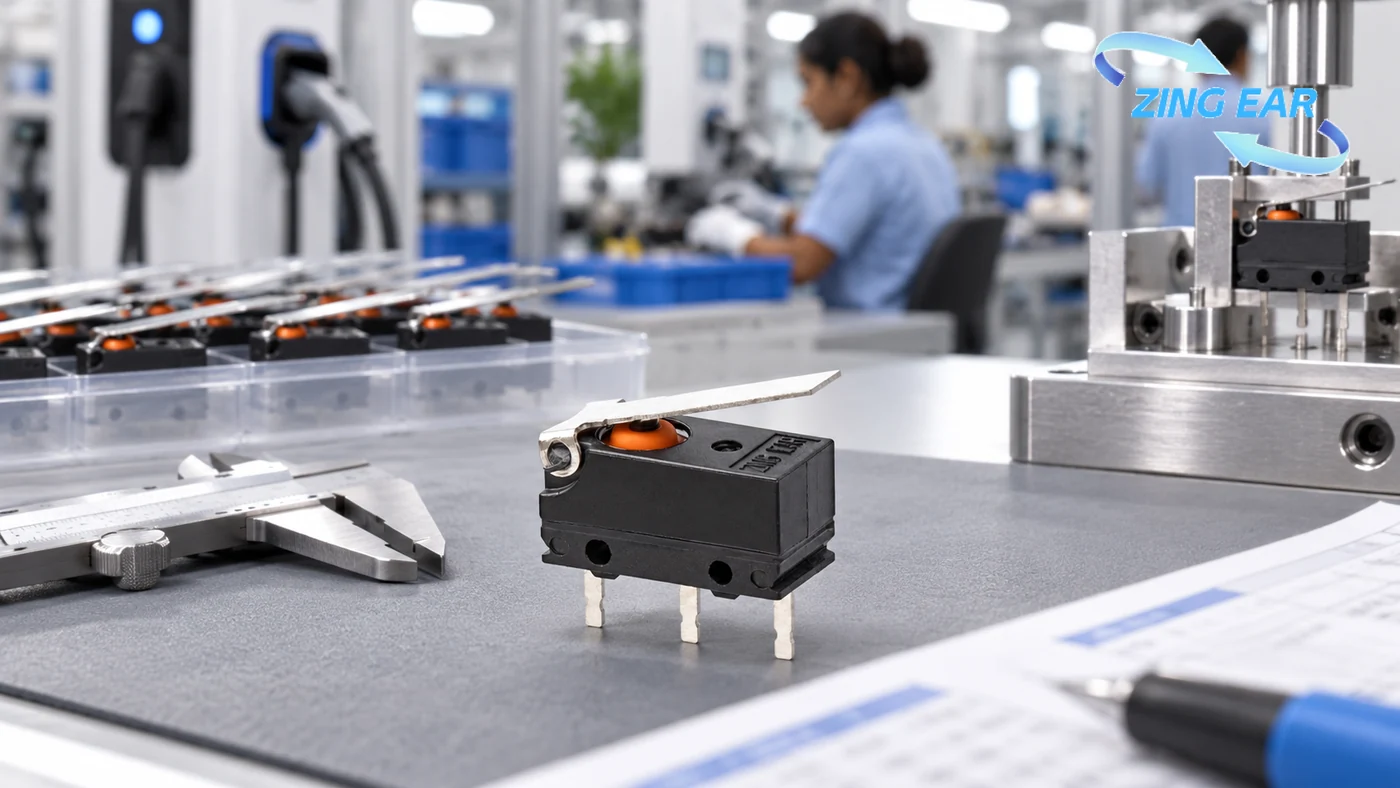
Gate 1: describe the position and fault state
A connector latch, access cover or cable cradle gives the switch a different mechanical and electrical duty. The position drawing and circuit description establish whether the contact switches a load or reports a signal, plus the available travel, force, mounting and connection. The intended response to an open wire, stuck contact or loose connector determines the system fault test.
If the switch reports connector engagement, explain how its indication relates to the controller's independent connection checks. Describe the exact switch job, such as latch-position feedback, in the supplier brief.
Gate 2: receive controlled engineering samples
The sample record identifies the exact configuration: supplier part number, drawing revision, seal, terminal arrangement and lot. A dimensional drawing then locates operating and release points against the moving mechanism. The record should also carry the contact form, rating at the intended load, actuator geometry and available test results.
The buyer needs to know whether the sample came from production tools or a prototype process. A prototype can establish fit and circuit behavior; production variation remains to be checked.
For an outdoor position, the ingress report must identify the tested configuration. A heavily cycled position needs life data with load, rate and temperature. Any change to operating force or lead exit calls for a revised drawing, even when the visible difference is small.
Gate 3: test the switch and the assembled EVSE
Component measurements establish force, travel, contact behavior and insulation. Mounted-charger tests add engagement, misalignment, wet use, power interruption and fault response, including the controller reading at both ends of the actuation tolerance. A part can pass the bench measurements yet fail in the assembled mechanism.
The charger team owns EVSE and site tests, using the component report as supporting evidence. For a cover or latch signal, the system test should include a disconnected wire and stuck contact, then verify the assembled charger's intended energization behavior. The fault-response test validates the proposed cover or latch signal design; control-pilot performance remains an assembled-EVSE test.
Gate 4: freeze the version that passed
After assembled-charger testing, a signed part drawing and approved bill-of-materials entry preserve the qualified configuration: actuator, terminals, wires, contact form, seal, critical force/travel range and test limits. A change-notification arrangement helps both teams recognize when a production variant needs renewed review.
A change from terminal to wire leads can alter ingress behavior. A contact-material change can alter performance at low signal current. A new actuator may shift the point at which the controller receives a “locked” signal.
The change-notice process gives the charger maker a chance to assess those effects before a revised part enters production. That review determines which component or assembled-charger tests need repeating and whether the earlier system evidence still applies.
Gate 5: connect production lots to service records
Map switch lots to charger serial numbers so a field fault can be traced to the installed part and revision. This buyer-managed traceability method also helps identify affected chargers after a supplier change or corrective action.
Incoming inspection results, deviations and first-article evidence should be retained against the production lot. A replacement record needs the new part number and revision beside the station and charger identification. Repeated failures can then be checked against a particular lot or configuration.
A five-gate acceptance table
| Gate | Buyer input | Supplier deliverable | Acceptance owner | Reopen the gate when |
|---|---|---|---|---|
| Position definition | Mechanical envelope, load, safe fault state | Candidate model, dimension and circuit drawing | Charger design lead | Function or mounting changes |
| Engineering samples | Requested variants and quantity | Labeled samples, part revision and available test data | Design and quality engineers | Actuator, terminal or seal changes |
| System testing | Charger test plan and installed position | Component test report and failure analysis support | Charger test lead | Any component change affects charger result |
| Production release | Approved drawing and control limits | Process version, inspection plan, change notice agreement | OEM quality lead | Process, material or tooling changes |
| Field traceability | Charger serial and service scheme | Lot identity and corrective-action records | OEM and station operator | Field fault or replacement trend |
Advance a supplier from samples only after it identifies the tested part revision and assigns an owner to every failed gate. The table gives the buyer an acceptance record for each transition to production.
Where the qualification record stops
Before a substitute part or service replacement enters a charger, the buyer compares its actuator, seal, terminals and contact form with the frozen drawing. A changed characteristic triggers the relevant component tests and any assembled-EVSE test that relied on the earlier result. The release decision belongs with the affected charger serial range so the operator can trace a later field fault.
A candidate configuration for the qualification RFQ
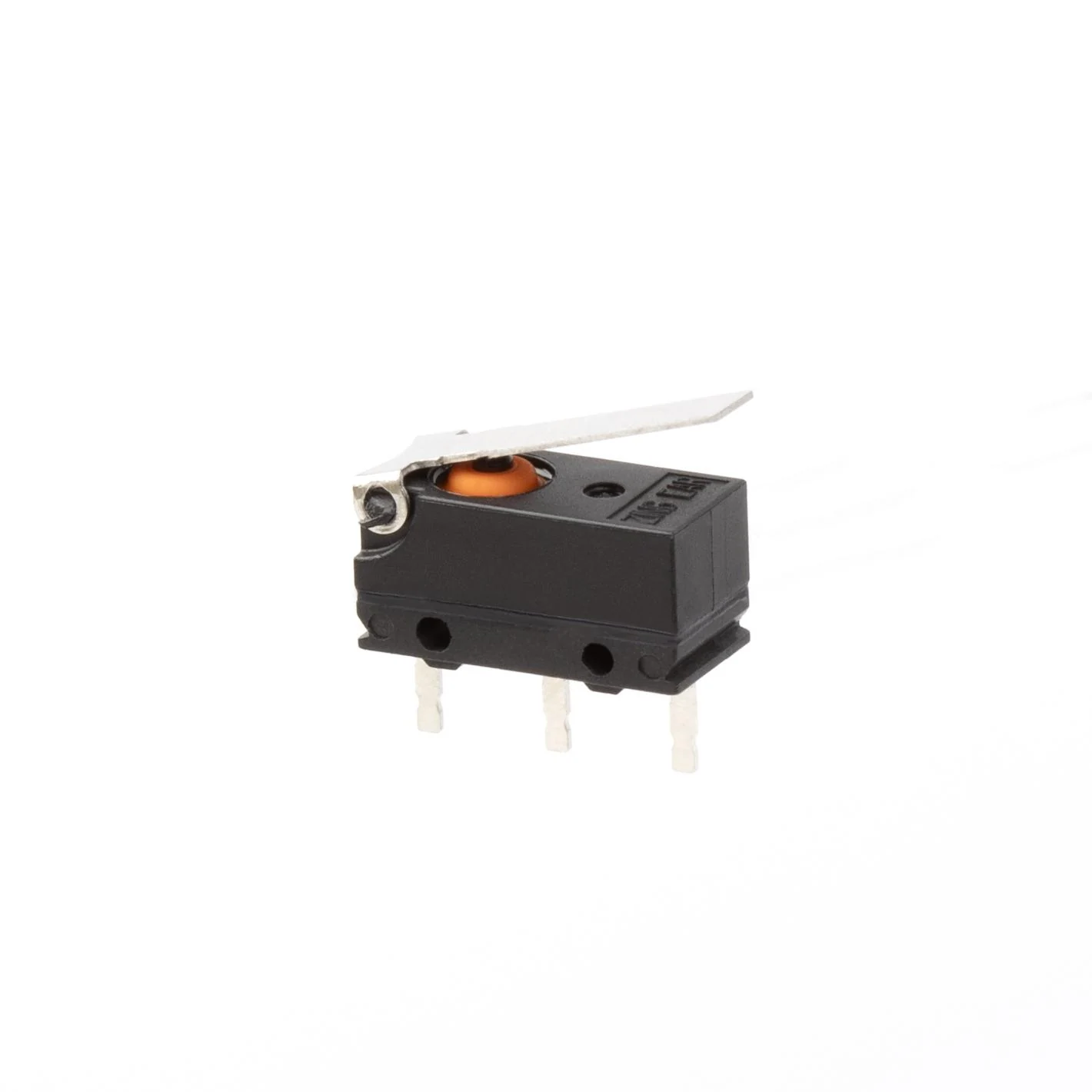
One candidate in the new-energy switch range can be described directly in the RFQ:
- Published application: ZINGEAR G10B03-150P03A is described for charging-gun insertion and electronic-lock feedback.
- Published features: The manufacturer lists IP67, a protection code defined by IEC 60529, plus configurable operating force and terminals. The ordered configuration's ingress report remains part of the sample review.
- Qualification route: ZINGEAR's configured micro switch development covers operating and terminal choices. The proposed variant can enter the sample gate once the response identifies its drawing revision and part-specific test scope for the charger position.
An initial discussion can establish whether a standard configuration fits the envelope and electrical duty. A configured actuator may become useful if testing exposes a tolerance or packaging problem. Sample and production dates, followed by lot-specific records, make that proposal measurable across the pipeline.
Turn the candidate into a production offer
ZINGEAR is a candidate for that end-to-end evaluation, with a published charging-position model and options for an operating or terminal configuration. The public product details support initial selection. A project-specific response then establishes sample availability, test support, production capacity and lot controls.
The five gates turn the recommendation into a checkable offer: confirm the proposed part and dated samples first, agree on the component and charger tests, then review the production revision and traceability plan before committing volume.
| RFQ item | Evidence to return |
|---|---|
| Position drawing, travel window, load and fault state | Candidate part number, drawing revision and sample configuration |
| Required component and assembled-EVSE tests | Report scope, sample identity and proposed validation responsibilities |
| Expected volume and release timing | Separate sample and production dates, process version and change-notice terms |
| Charger serial and service-record scheme | Lot identity and replacement-part traceability method |
If this model is among your candidates, our engineering team can start with a position drawing or a description of the charger mechanism and discuss operating and terminal choices with you. We can then identify a proposed configuration, its available evidence and the charger tests still needed before production approval.
FAQ About Sri Lankan EVSE Switch Qualification
Can you recommend a micro switch supplier that supports selection, samples, testing, and mass production?
ZINGEAR is a candidate for evaluation, with a published charging-position model and configurable operating or terminal features. Public product information supports initial selection, but sample dates, test support, production capacity and lot controls need a project-specific response before an end-to-end recommendation is justified.
What proves that a sample represents production?
The production-representative sample and first production lot should identify the same approved part, drawing revision, actuator, terminal and seal, with the production process version recorded. A prototype from different tooling can establish fit, while first-lot inspection shows whether production holds the approved configuration.
Who validates the switch in the assembled charger?
The charger team owns its equipment and site tests. Supplier reports provide part-level evidence; mounted tests reveal engagement, misalignment and fault response in the real mechanism.
When should a gate be reopened?
When a change affects an assumption behind its approval, such as actuator geometry, lead exit, contact material or production process. The affected component and charger results then need review.
How can a field failure be traced?
Link the switch lot and revision to charger serial numbers and replacement records. That record narrows the affected population and helps compare failures with a specific production change.
Related reading: For a broader supplier workflow beyond the Sri Lankan EVSE qualification gates, see our selection-to-mass-production supplier guide.
Sources
Related Recommendations
-
ZINGEAR Micro Switch OEM Manufacturing Complete Guide
2026-07-23 -
ZINGEAR G306-150S150AA Automotive Micro Switch Officially Partners with Changan Automobile to Enable Precise Control of Sun Visors and Vanity Mirrors
2026-08-07 -
ZINGEAR G304 Micro Switch Debuts in Rail Transit Sector, Enabling Precise Sensing and Reliable Control for High-Speed Train Lifting Doors
2026-08-13 -
ZINGEAR G306-150E65BA-400 Electric Motorcycle Handbrake Micro Switch | Dreame Shouqu Certified Sensing Switch
2026-08-18 -
ZINGEAR G304 Micro Switch Supports Electric Two-Wheeler Electronic Lock Systems, Empowering Smart Lock Security and Durability Upgrade
2026-08-21 -
zingear Micro Switch Solution for Communication Base Station Equipment Status Detection — Building a Solid Safety Line for Long-term Stable Operation of Base Stations
2026-08-11 -
Electrolux Range Hood Switch Solution — Zing EAR: Solve Extreme Kitchen Reliability with Precision Sensing
2026-08-25 -
How can I replace the push-button switch on my range hood?
2026-08-27