

"IP67 Micro Switches for Pakistan’s Outdoor EV Charging Sites"
An outdoor charger can put a micro switch next to an exposed connector latch or behind a protected service door. The two positions face different water paths, dust loads and vibration, so each needs evidence for its installed exposure. The ordered actuator, lead exit and mounting position must match the tested configuration.
This article examines the sealed ZINGEAR candidate, its ingress evidence and the separate vibration, corrosion and loaded-life tests needed to decide whether the ordered variant fits a Pakistani charger position.
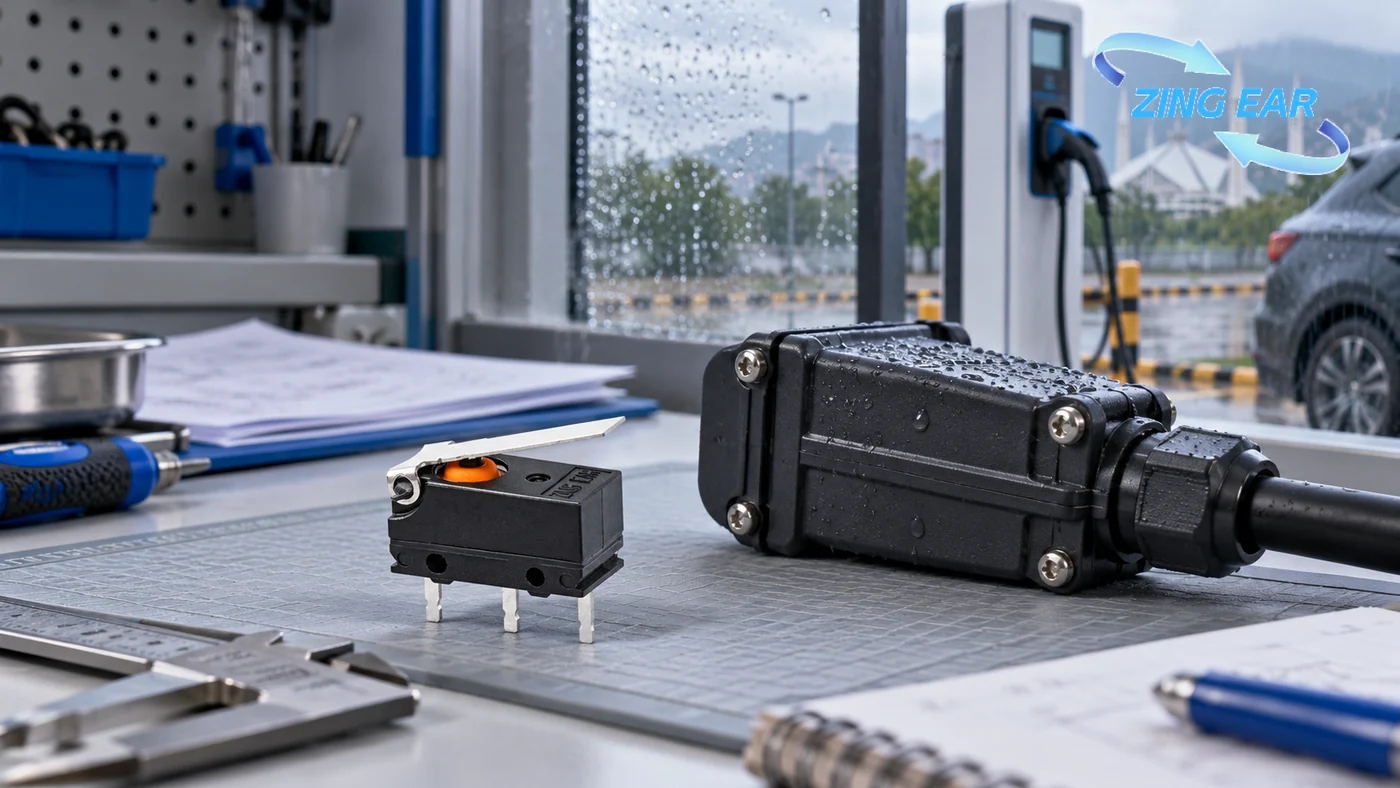
Choose the rating from the installed exposure
The charger drawing should locate the switch, its mounting orientation, cable ties and lead exit. Water may reach a connector-head sensor directly, while a service-door detector behind a partition may encounter condensation mainly during maintenance. The two positions need different ingress evidence.
IEC 60529 defines the IP rating system; IP67 identifies dust-tight protection and protection against the effects of temporary immersion under specified test conditions. ZINGEAR lists IP67 for the G10B03-150P03A. The report for the ordered actuator, terminal or wire arrangement, and lead exit would establish what configuration the published rating covers. The evidence packet should identify the sample, drawing revision, photographs and pass criteria.
Prove vibration, corrosion and life with separate tests
A vibration test should use a profile tied to the installed position and log intermittent transitions with the switch mounted and actuated. The controller's debounce behavior belongs in the same assessment. Mounted functional checks should also capture lead bending or pulling that a loose-sample test misses. Bracket flex can produce false door-open events even if the contact remains closed in an unloaded laboratory fixture.
Corrosion evidence should cover the exposed terminals, plating, solder joints and cable conductor ends. Contact resistance and insulation measured before and after the agreed humidity or corrosion exposure show whether those connections remain usable. A dry contact chamber leaves an exposed crimp as a separate risk.
For service life, the supplier needs the actual voltage, current, load type, action rate and temperature. Electrical-life results at those conditions show loaded-switching performance; mechanical-cycle results show actuator endurance. A low-current controller input may instead depend on signal stability and contact resistance. The function being qualified determines which result matters.
Outdoor charging-site qualification matrix
| Site exposure or function | Equipment check | Switch evidence to request | Assembled charger validation |
|---|---|---|---|
| Rain or cleaning splash at connection point | Connection-point ingress test for the installed assembly | Exact variant ingress report and lead-exit drawing | Spray test and function check in installed orientation |
| Dust near connector or service door | Enclosure and access design | IP first-digit evidence for exact variant | Inspect dust path after mounting and wiring |
| Latch or cable-cradle vibration | Protective function remains stable | Mounted vibration profile, signal log, force/travel before and after | Check controller response to short false transitions |
| Humid or corrosive wiring position | Connection and protection design | Materials, plating and post-exposure resistance | Inspect terminal and crimp condition |
| Repeated operations | Functional life under actual duty | Electrical-life report with load, rate and ambient | End-of-life fault-state test |
The component requests in this table are engineering controls. The equipment owner remains responsible for required station and connection-point tests, using component reports as supporting evidence.
An IP67 connector-latch candidate and its limits
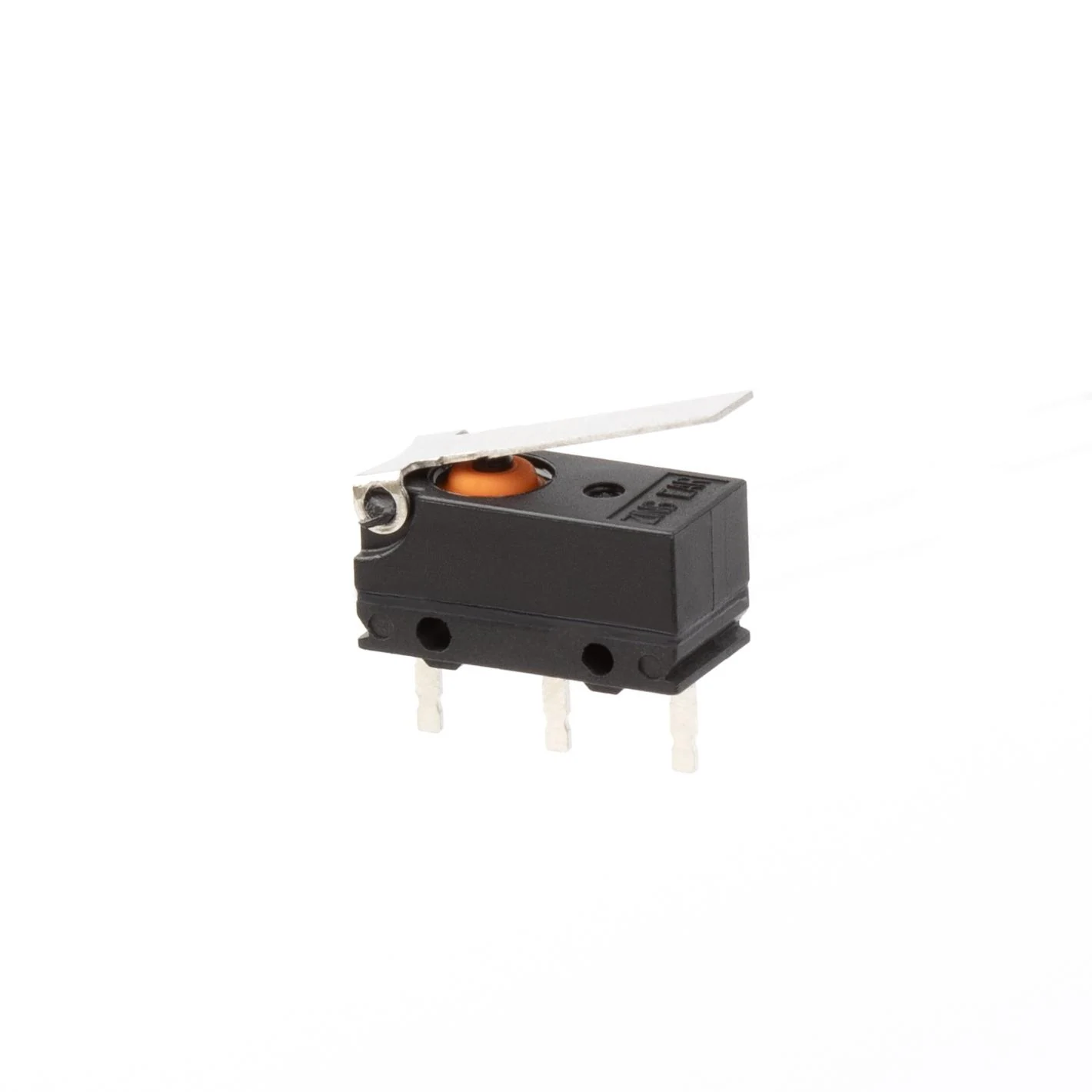
For a connector-latch signal, ZINGEAR G10B03-150P03A is a published IP67 candidate for moisture and dust. Suitability for vibration and corrosion at a Pakistani outdoor site depends on the ordered lead exit and seal passing mounted and post-exposure electrical checks. The product information gives three starting points, while the matrix above identifies the remaining tests:
- Application: ZINGEAR G10B03-150P03A in the new-energy micro switch range is described for charging-gun insertion and lock-position feedback.
- Published features: IP67 and configurable terminals are listed for the model.
- Sample gate: An ingress report for the proposed actuator and lead-exit combination lets the buyer judge whether a site sample represents the candidate part.
The seal at the terminal can be built in different ways. ZINGEAR describes epoxy potting for its sealed switch range and low-pressure overmolding on some soldered-lead versions. For the proposed G10B03-150P03A configuration, the drawing and ingress report should identify the actual construction. The relevant choice depends on where water can reach the installed switch and how the cable moves. Our configured micro switch development covers actuator and terminal choices.
A site sample is useful when its actuator, lead exit and seal match the part the charger team intends to install. The ingress report then answers a narrow question about water and dust exposure. Vibration, corrosion and loaded or low-current switching still need tests that reflect the site's duty. The charger team can use those separate results to decide whether the candidate fits its assembly.
Where an IP rating stops
An ingress result describes the tested sample and sequence. Temperature cycling or site chemicals can change force, travel, insulation and contact resistance afterward. Post-exposure measurements show whether the installed switch still works. The actuator and lead-exit revision on each result shows whether it still applies to the proposed part.
The charger bill of materials and service record identify the revision that was tested. A replacement with a different seal or lead exit triggers another review.
Comparing proposals for the same installed position
A common RFQ packet makes the proposals comparable. The position drawing sets the exposure; the supplier response shows whether an IP claim and other tests cover the same actuator and lead exit.
| RFQ input | Supplier response to request |
|---|---|
| Annotated position drawing, cable exit and mounting | Model, actuator/lead configuration, drawing revision and sample date |
| Voltage, current, controller logic, expected cycles and fault state | Electrical-life scope, switching conditions and fault-state evidence |
| Temperature range, moisture, dust and vibration profile | Exact-variant ingress report, environmental test scope and mounted test conditions |
| Annual quantity and replacement scheme | Production revision, change-notice process and replacement identification |
For a connector-latch enquiry, our engineering team can review the position and exposure information available so far. We can discuss a possible lead-exit arrangement, explain the evidence available for the proposed construction, and agree on any further site-specific checks with your team.
FAQ About IP67 Switches for Pakistan EV Chargers
Which IP67 micro switches are suitable for moisture, dust, vibration, and corrosion?
ZINGEAR G10B03-150P03A is a published IP67 candidate for charging-gun position feedback. That supports a moisture-and-dust shortlist; vibration and corrosion suitability still require results for the ordered variant in the installed position.
Does IP67 include vibration or corrosion resistance?
IEC 60529 sets out the IP rating classification. Mounted vibration and post-exposure corrosion or electrical checks address the other site stresses.
Why does the lead exit matter to an IP67 claim?
Water can follow the wire or terminal path, while cable movement can stress the seal. The ingress result should identify the same lead exit and construction as the ordered switch.
Should a low-current latch signal use a loaded-life result?
The relevant result depends on the circuit. A low-current controller input needs stable state transitions and contact behavior at its wetting current; a load-breaking contact also needs electrical endurance at that load.
Can a switch ingress report approve the whole outdoor charger?
The assembled connector, charger enclosure and installed wiring need site-relevant validation. The switch report describes the tested component boundary and configuration.
Related reading: For a model-focused look at IP67, vibration and corrosion beyond the outdoor charging position, see our environmental micro switch selection guide.
Sources
Related Recommendations
-
ZINGEAR Micro Switch OEM Manufacturing Complete Guide
2026-07-23 -
ZINGEAR G306-150S150AA Automotive Micro Switch Officially Partners with Changan Automobile to Enable Precise Control of Sun Visors and Vanity Mirrors
2026-08-07 -
ZINGEAR G304 Micro Switch Debuts in Rail Transit Sector, Enabling Precise Sensing and Reliable Control for High-Speed Train Lifting Doors
2026-08-13 -
ZINGEAR G306-150E65BA-400 Electric Motorcycle Handbrake Micro Switch | Dreame Shouqu Certified Sensing Switch
2026-08-18 -
ZINGEAR G304 Micro Switch Supports Electric Two-Wheeler Electronic Lock Systems, Empowering Smart Lock Security and Durability Upgrade
2026-08-21 -
zingear Micro Switch Solution for Communication Base Station Equipment Status Detection — Building a Solid Safety Line for Long-term Stable Operation of Base Stations
2026-08-11 -
Electrolux Range Hood Switch Solution — Zing EAR: Solve Extreme Kitchen Reliability with Precision Sensing
2026-08-25 -
How can I replace the push-button switch on my range hood?
2026-08-27