

"Standard or Custom Micro Switches for Great Britain Appliance Projects"
A longer actuator can shift an appliance door's switching point even when the replacement switch carries the same electrical rating. For covered equipment in Great Britain, the Electrical Equipment (Safety) Regulations 2016 have applied since 8 December 2016 and require manufacturers to keep the finished product and its technical documentation aligned with production changes. A standard-to-custom switch substitution therefore needs both a fit test and a recorded equipment-file decision.
The standard-versus-custom comparison in this article clarifies which ZINGEAR switch version fits a GB appliance and what the release record must contain.
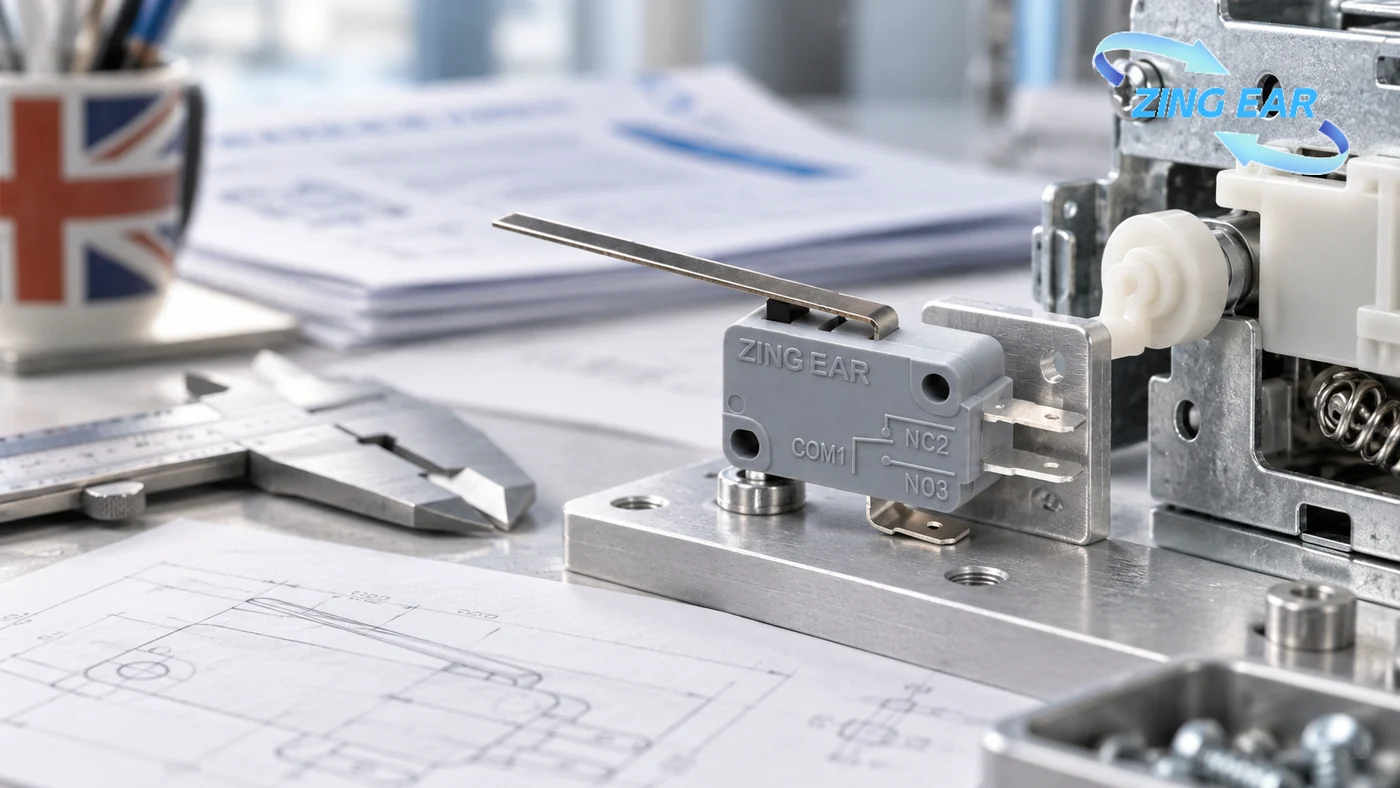
Define the equipment scope and switch duty before the RFQ
The GB Electrical Equipment (Safety) Regulations 2016 cover electrical equipment designed or adapted for use at 50 to 1,000 V AC or 75 to 1,500 V DC, with listed exclusions. The appliance's design voltage and the listed exclusions determine whether this route applies. The micro switch's electrical rating is selected separately for the load it actually switches. The Office for Product Safety and Standards guide explains the scope and manufacturer duties.
A switch change can alter a safety result that the finished appliance relies on. A longer actuator may shift when a door interlock opens; a different contact or terminal may change load interruption or temperature rise. The appliance maker therefore checks whether the earlier appliance tests and technical file still describe the revised configuration. A supplier's switch certificate or datasheet supports that check. The appliance maker remains responsible for finished-equipment conformity.
The evidence depends on the switch's actual job. A motor interlock needs ratings and tests for the load it interrupts, including starting current. A position sensor may instead need reliable contact behavior at a small controller current. The standard-versus-custom decision begins with the actual circuit and mounted switching point, then checks the rating against that duty.
The appliance maker must review its file after a switch change
For covered equipment, the GB manufacturer remains responsible for the finished appliance it places on the market. After a switch change, the manufacturer reviews the technical documentation, conformity assessment and declaration against the revised configuration. Recording the approved switch revision and its test evidence makes that decision traceable during later production changes.
The change decision is which earlier evidence still applies to the revised switch. Series production must remain in conformity as designs or relevant specifications change. The equipment maker records that decision and updates the affected appliance tests, technical file or declaration when the change calls for it.
A micro switch supplier supports this file with evidence. The appliance manufacturer makes the conformity decision, using supplier quality records as supporting evidence. The supplier certificate describes the management system, the datasheet describes a part, and the appliance report describes the finished application. A substitution or custom revision may change one, two or all three records.
Assess a switch substitution before release
Before approving a substitute, the appliance team checks which safety assumptions change: actuation point, load, wiring, contact material or manufacturing source. The GB Regulations require continued conformity of the finished equipment. The appliance risk assessment determines which switch and equipment tests need repeating.
| Change trigger | Standard-part route | Custom-part route | Effect on the appliance file | Release owner |
|---|---|---|---|---|
| Initial selection | Controlled datasheet, drawing and exact suffix | Approved drawing and agreed configuration record | Record why the part suits the electrical and mechanical duty | Design engineer |
| Actuator or force change | Select a published variant and compare deltas | New drawing revision, force/travel tolerance and samples | Revisit interlock timing, mounting tolerance and abnormal-use assessment | Mechanical engineer |
| Terminal or lead change | Verify catalog termination and wiring | Define material, lead exit, crimp/solder and strain relief | Update wiring, temperature rise and assembly evidence as relevant | Electrical engineer |
| Contact or rating change | Match the full rating and load type | Approve contact choice and load-specific test | Reassess switching performance and the equipment test plan | Safety engineer |
| Factory process or material change | Require part-revision notification | Require signed change notice and requalification trigger | Decide whether prior equipment evidence remains representative | Supplier quality |
| Production release | Incoming check to fixed part number | Golden sample, revision lock and first-lot inspection | Link the production bill of materials to the approved file | Manufacturing quality |
A documented change assessment explains which safety assumption changed, which earlier result still applies and which finished-appliance test needs repeating. The same discipline is useful when switching between two nominally equivalent catalog parts.
Require part and revision evidence before choosing a manufacturer
A standard-part route begins with the exact catalog suffix, contact form, actuator, termination and published rating. The part drawing and load data must match the appliance duty. Where the published configuration fits, its controlled data can make the procurement route simpler.
A changed actuator, mounting arrangement or electrical duty calls for an engineering response. The published ZINGEAR range can be screened through these items:
- Configurable product features: ZINGEAR's product range describes travel, operating force, terminal type and actuator choices.
- Proposed GB variant: A marked drawing and sample plan identify the exact appliance version under consideration.
- Production evidence: A revision-specific test record and written change procedure show which actuator, mold or material changes need fresh validation.
A useful capability check gives the engineering team one defined change, such as an actuation-point tolerance while keeping the electrical duty fixed. The engineering reply should identify the tooling, materials, tests and documentation affected before a sample date is accepted.
Validate the application, then freeze the variant
The sample build should use the exact switch revision in the appliance. At mounting extremes, engineers can measure operating and release points, overtravel and the force from a misaligned door or lid. Electrical endurance then needs the real load and duty cycle; a wet or greasy position also calls for an assembled-seal and lead-exit test after relevant exposure. The part-number life record should state load, operation rate and ambient conditions.
The ZINGEAR home appliance switch range can supply a candidate, subject to part-specific checks:
- Application test: The proposed variant needs an in-appliance test tied to its approved drawing, sample results and lot-identification method.
- Material and construction: ZINGEAR's usual contact material is silver; silver-alloy contacts are available as a customer-requested configuration.
- Release evidence: Material, seal and life records belong to the exact part number and stated test conditions.
At production release, the appliance bill of materials lists each accepted suffix and drawing revision. Purchase terms set the notice period and approval route for a supplier process, material, plant or tooling change. Accepted samples and test conditions remain accessible to the safety and purchasing teams. A later supplier substitution triggers a documented equivalence assessment and an updated purchasing description.
The following records show how each candidate would support the exact part it proposes.
| Purchase request item | Supplier response needed |
|---|---|
| Standard reference and custom changes | Starting part number, exact suffix and marked changes |
| Controlled drawing | Revision owner and approval route |
| Samples and tests | Sample plan, test conditions and acceptance criteria |
| Production records | First-article evidence, serial-production controls and change notice |
An identified change-approval owner makes the returned documents useful after release, when a material or process revision is proposed.
For a GB appliance project, a standard model may fit the duty as published; a custom version may help when travel, force or termination differs. We can review your current design, suggest a starting model and explain which changes would need a new drawing or test. Your finished-equipment team makes the conformity decision using the proposed revision and its supporting evidence.
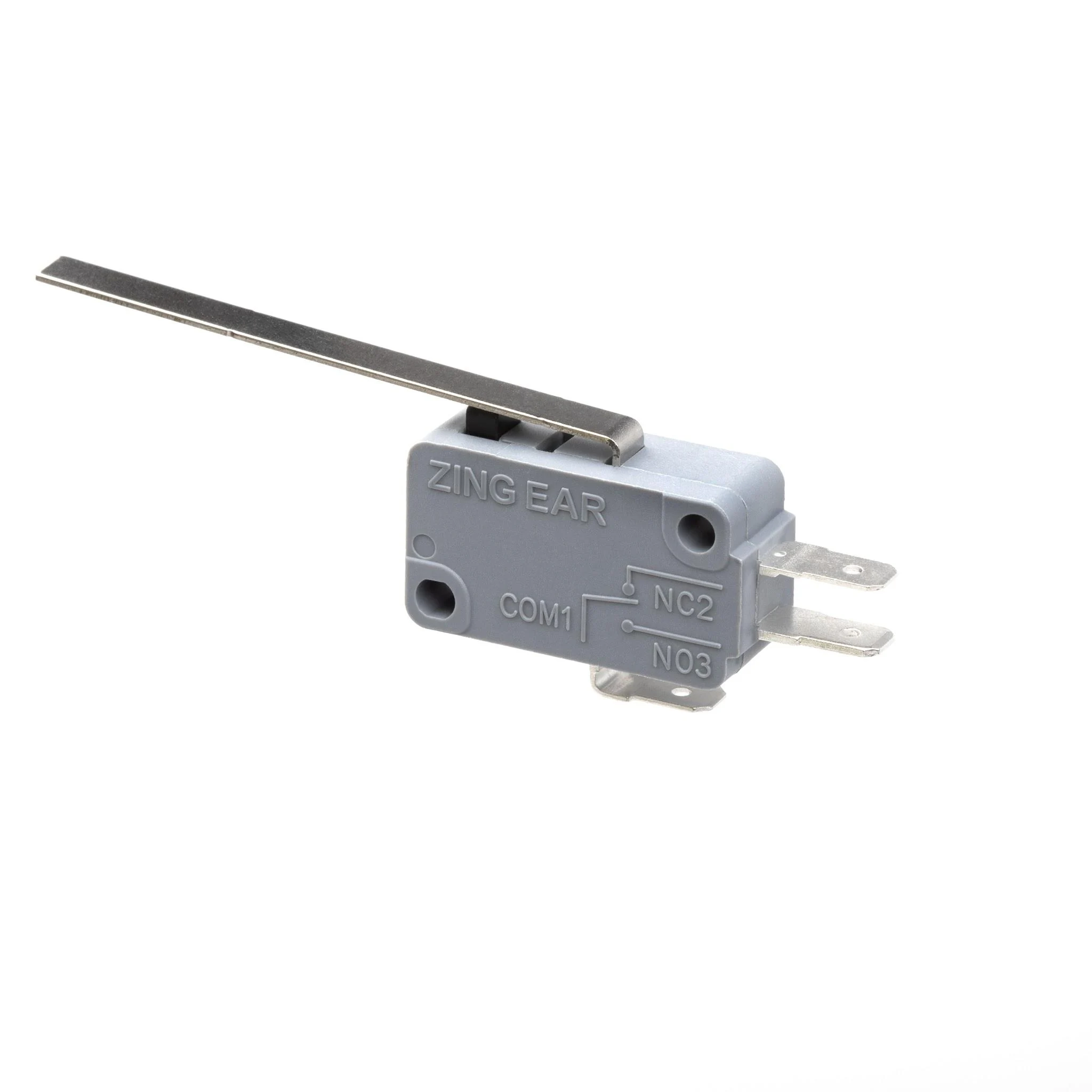
FAQ About Standard and Custom Switches for GB Appliances
Which micro switch manufacturers support both standard models and full customization?
ZINGEAR is one manufacturer with published appliance models and stated travel, force, terminal and actuator options. The published configuration choices cover those features. Other requested materials, ratings or geometries call for a feasibility review; a multi-manufacturer comparison would require separate evidence.
When is a standard model preferable?
When its exact suffix already fits the appliance’s travel, force, circuit, mounting and environment. Its controlled drawing and part-level test data then give the appliance maker a clear starting record.
When does a custom version need new testing?
When the change can alter a relied-on safety or functional result, such as interlock timing, load interruption, temperature rise or sealing. The appliance maker decides which earlier equipment tests still apply.
Does a switch certificate establish conformity of the appliance?
The appliance manufacturer assesses finished-equipment conformity under the applicable GB rules. A switch certificate supports component identity or its stated component claim.
How is a catalog substitute reviewed before release?
The appliance maker compares the exact contact, actuator, lead and test conditions with the approved configuration. If those characteristics differ, the affected appliance evidence needs review before release.
Related reading: For a wider view of standard models and customization beyond the GB equipment file, see our standard-and-custom micro switch guide.
Sources
Related Recommendations
-
ZINGEAR Micro Switch OEM Manufacturing Complete Guide
2026-07-23 -
ZINGEAR G306-150S150AA Automotive Micro Switch Officially Partners with Changan Automobile to Enable Precise Control of Sun Visors and Vanity Mirrors
2026-08-07 -
ZINGEAR G304 Micro Switch Debuts in Rail Transit Sector, Enabling Precise Sensing and Reliable Control for High-Speed Train Lifting Doors
2026-08-13 -
ZINGEAR G306-150E65BA-400 Electric Motorcycle Handbrake Micro Switch | Dreame Shouqu Certified Sensing Switch
2026-08-18 -
ZINGEAR G304 Micro Switch Supports Electric Two-Wheeler Electronic Lock Systems, Empowering Smart Lock Security and Durability Upgrade
2026-08-21 -
zingear Micro Switch Solution for Communication Base Station Equipment Status Detection — Building a Solid Safety Line for Long-term Stable Operation of Base Stations
2026-08-11 -
Electrolux Range Hood Switch Solution — Zing EAR: Solve Extreme Kitchen Reliability with Precision Sensing
2026-08-25 -
How can I replace the push-button switch on my range hood?
2026-08-27