

"Which Micro Switches Provide High Sensitivity and Repeatable Operation?"
A micro switch with a small differential travel, the distance between the trip point and the reset point, is the part commonly recommended for high sensitivity and repeatable operation. Sensitivity comes from a low operating force and a short pretravel, repeatable operation comes from an operating position held to a tight tolerance, and the differential travel is a separate value matched to the equipment the switch controls. Published datasheets from several switch series give each parameter a worked reading, and each reading leads to a question to send a supplier before a part number goes on the drawing.
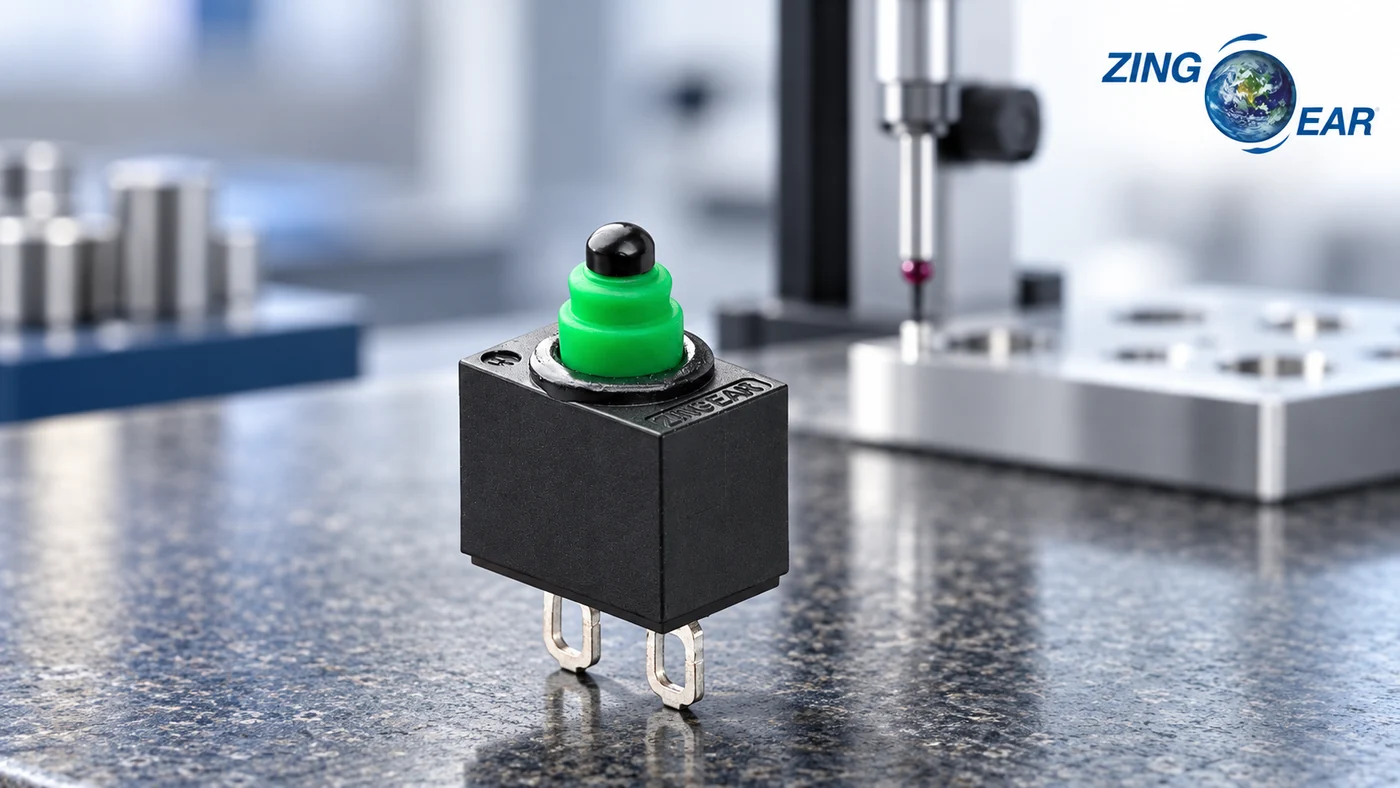
In short
A shortlist for high sensitivity starts with the series whose datasheets give a low operating force and a short pretravel for the actuator you'll fit, converted into one unit. Repeatable operation shows up as an operating position printed with a ± tolerance, and over a long run as the same figures measured again after a life test. Differential travel (MD) is sized to the equipment, close for a temperature control and wider for a pump that needs time between starts. A series that publishes operating force alone gets the other three figures from the supplier against a part number.
Sensitivity, repeatable operation and differential travel sit on separate datasheet lines
Operating force and pretravel answer the sensitivity question, the operating position and its tolerance answer the repeatability question, and differential travel sits beside them as a setting of its own.
Operating force
Operating force is the push the actuator needs before the contacts change over, and a lower figure means a lighter touch trips the switch. Datasheets give it in grams-force, ounces or newtons, so two series only compare once they're in one unit: 1 N is about 102 gf, and 1 oz is about 28.35 gf. A figure marked max. is the ceiling for every part in that listing. A range such as 0.04 to 2 oz on a series page spans several listings, and the part you order sits somewhere inside it.
Pretravel
Pretravel is the distance the actuator moves from rest to the operating position, and a short pretravel lets a small movement of the part being sensed reach the contacts. Pretravel and operating force move together once a lever is fitted. A longer lever lowers the force needed at its tip and lengthens the travel to the trip point, which is why a lever version carries its own line on the datasheet. Where a datasheet gives the rest position and the operating position, the gap between them is the pretravel for that version.
Operating position tolerance
The operating position is the trip point as a datasheet prints it, the point in the actuator's travel where the contacts change over, and the tolerance beside it is the spread from one part to the next. Crouzet's V3 83161 datasheet lists the standard-force version at 14.7 mm ±0.3 mm, so any part from that group trips within 0.3 mm either side of the nominal point. On a sensing position, that band is how much the bracket and the part being detected have to allow for when one switch is swapped for another.
Repeatable operation over the life of one switch is a second measurement, and series pages tend to describe it in words. The phrases on official pages are qualitative, "high repeat accuracy" on Omron's Z series page and "high precision and repeatability" on Honeywell's SM page. What shows whether a switch still trips at the same point after many thousand cycles is the operating force and the operating position measured again at the end of a life test, at your load and actuation rate.
Differential travel (MD)
Differential travel is the distance between the trip point and the reset point, and the equipment the switch controls decides how much of it a position wants. A temperature control keeps its on and off points as close as possible, with differential travel as low as 0.0001 in. A liquid level pump goes the other way: with the points too close, the make-up pump starts and stops too often and its service life shortens. The Crouzet 83161 family offers differential travel from 0.1 mm max. up to 0.8 mm max. across its versions, which treats the figure as a choice made for the application. A small differential travel brings the reset point near the trip point, and the operating position tolerance says where the trip point itself falls.
The snap mechanism, the actuator and the mounting decide whether the operating position holds
The snap-action mechanism inside a micro switch changes the contacts over at a set point in the actuator's travel, whatever speed the actuator arrives at. Datasheets put a lower limit on that speed: the Crouzet 83161 datasheet describes operation without a balance point even at extremely slow actuating speed and gives 0.001 mm/s as the recommended minimum. A slow cam or a creeping door edge belongs inside the range a datasheet states.
A lever adds its own tolerances on top of the switch's. Hinge play, lever length and the angle the lever meets the cam all shift where the trip point lands, so the operating position tolerance for a lever version is read from that version's line and from the base switch's line only as a starting point. A pin plunger pressed along its own axis keeps the trip point close to the value on the datasheet, while side load on a plunger or a roller adds friction that can move the trip point from one cycle to the next.
Mounting finishes the chain. The operating position is measured from a reference on the datasheet drawing, so the bracket, the fixing holes and the screw torque become part of the tolerance the sensing position sees.
Series datasheets and the figures they publish
The operating position tolerance is the line where published datasheets differ most, and a lever version needs that line for itself.
| Series | Operating force | Pretravel | Operating position tolerance | Differential travel |
|---|---|---|---|---|
| Honeywell SM (series page) | 0.04 to 2 oz (about 1 to 57 gf) | 0.76 mm | Not published | 0.1016 mm |
| Crouzet V3 83161 (datasheet) | 0.8 N standard, 3 N high force, 0.5 N low force, all max. (about 82, 306 and 51 gf) | Not published | ±0.3 mm standard, ±0.4 mm high and low force, on 14.7 mm | 0.35 mm max. |
| Omron D2F-01F (datasheet) | 0.74 N max. (75 gf) | 0.5 mm max. | ±0.3 mm on 5.5 mm | 0.12 mm max. |
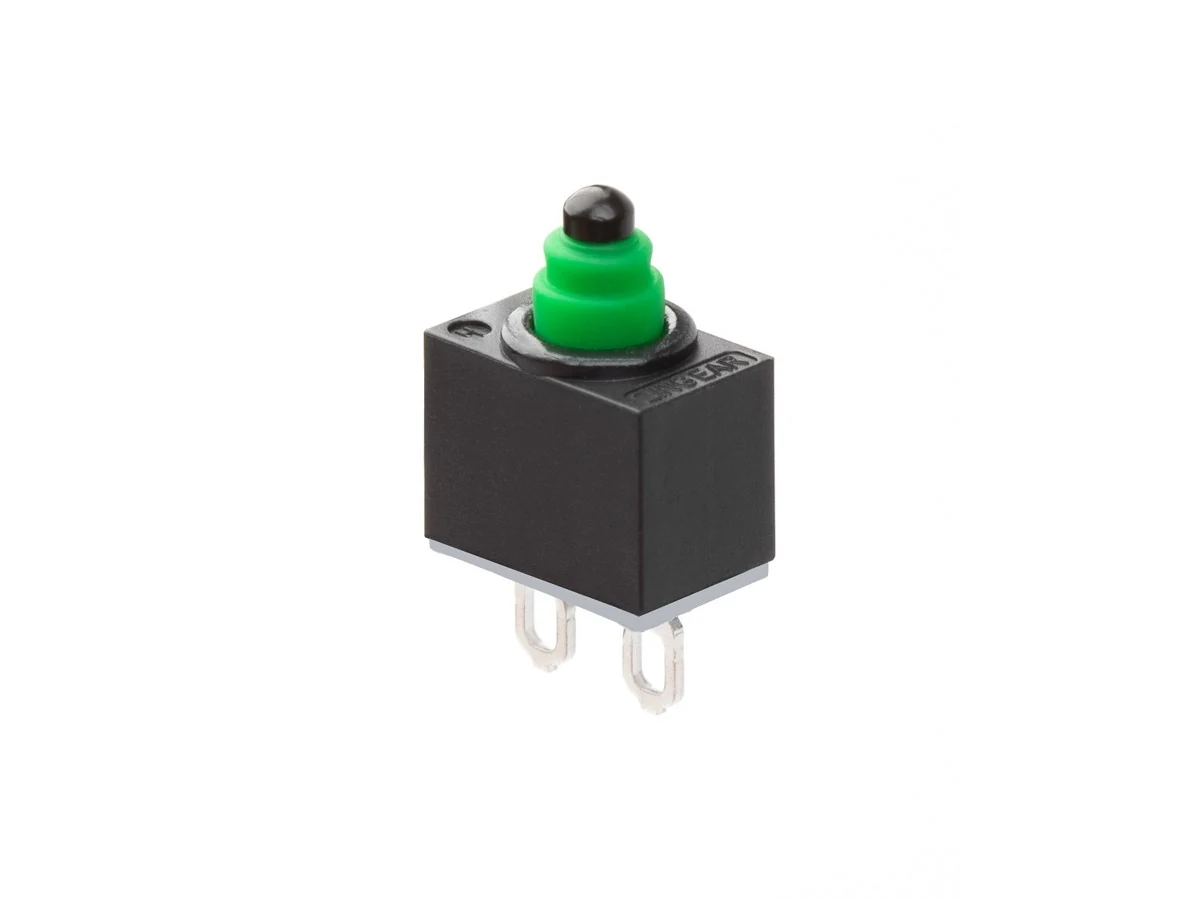
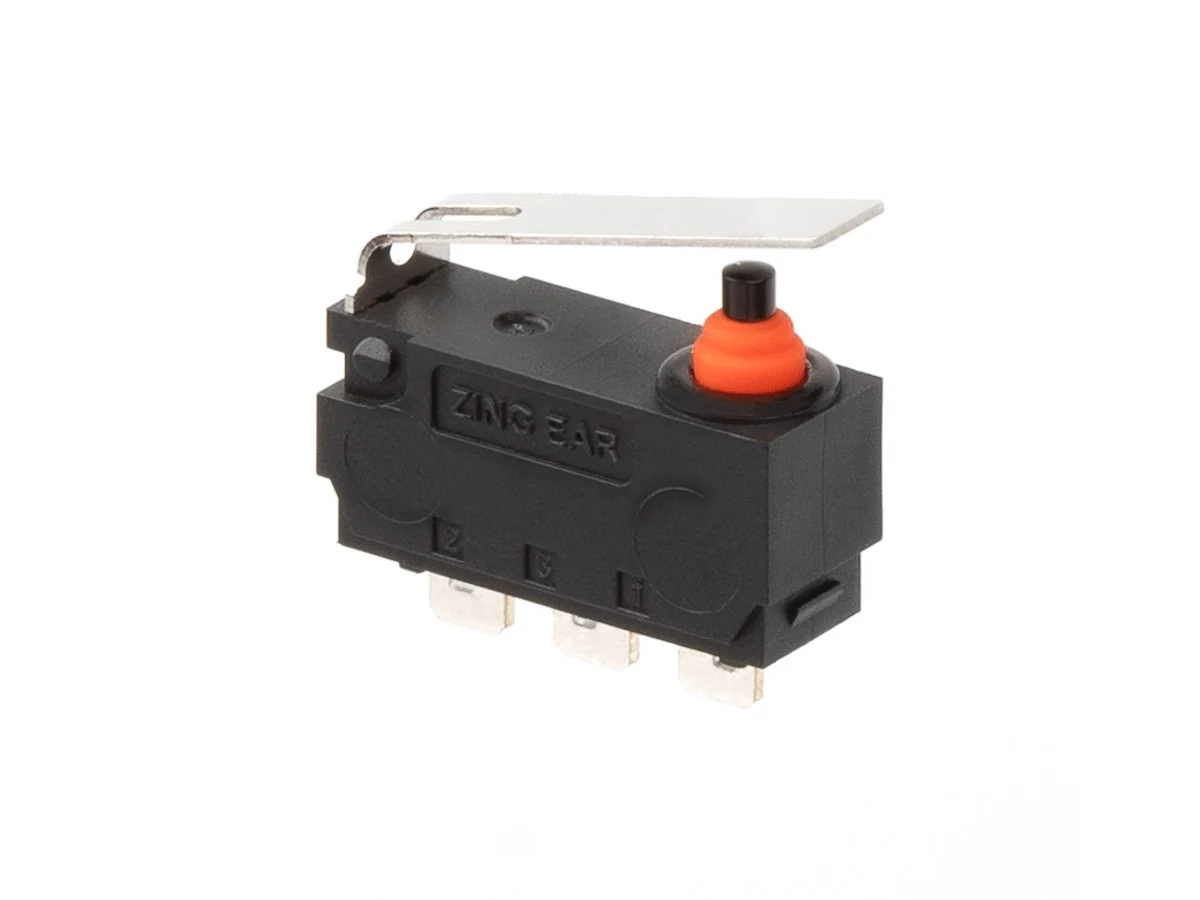
| ZINGEAR G304-150V00B1 | 150 gf max. (about 1.47 N) | Set per part number | Set per part number | Set per part number |
| ZINGEAR G303-130P00A53 | 180 gf max. (about 1.77 N) | Set per part number | Set per part number | Set per part number |
Crouzet's datasheet lists the operating position tolerance and the differential travel on separate lines, ±0.3 mm around 14.7 mm against 0.35 mm max., so the difference between the two figures is visible on one page. Omron's D2F datasheet gives all four figures for one part number: the D2F-01F, the 30 V DC 0.1 A low-force version with gold-alloy contacts, operates at 5.5 mm ±0.3 mm with 0.12 mm max. differential travel. The Honeywell SM page gives pretravel and differential travel as single values against an operating force range that covers the whole listing.
The bottom two rows publish operating force as a ceiling for vehicle positions. The door lock part switches a signal-level load, 0.1 A or 50 μA at 12 V DC or 5 V DC, and also serves seat position calibration. The 3 A part's 180 gf is set so that a knock or vibration leaves the contacts where they are, which makes the published force a margin against vibration as much as a measure of touch. Door lock and seat lock positions of this kind are described under automotive industry solutions.
The Honeywell SM page also publishes a contact choice, silver or gold, with gold offered for low-energy switching, and that line belongs beside the force figures whenever the position carries a signal of a few milliamps.
A series datasheet describes a family of parts
Crouzet splits 83161 into standard, high-force and low-force groups with different force limits, and the 0.04 to 2 oz on the Honeywell SM page spans the whole listing. A sensing position takes one part from that family, with one value for each of the four figures, and the actuator, the bracket and the load decide which value fits. A series figure narrows the field, and it's at the part number that force, pretravel, operating position and differential travel become fixed numbers.
Operating force and travel are parameters of the part number at ZINGEAR, set alongside terminal type, wire exit, sealing grade and electrical rating. Narrowing the family to that one part is settled during configured micro switch development, with the actuator and mounting of the position in view.
Figures to send with a sample request for a sensing position
A sample request that carries the position's inputs comes back as values for a part number.
| Item | Why the position needs it |
|---|---|
| Electrical load: voltage, current, AC or DC | Sets the contact material and the series whose rating covers the load |
| Operating environment: temperature range, dust, moisture | Narrows the housing and sealing options before force and travel are set |
| Space and mounting: body size, fixing points, bracket drawing | Places the operating position against the reference the datasheet uses |
| Actuator: pin plunger, lever or roller lever, with lever length | Changes force, pretravel and the operating position tolerance together |
| Target operating force and pretravel | Defines how light a touch and how small a movement the position has to detect |
| Operating position and the tolerance the bracket allows | Defines how much part-to-part spread the position absorbs |
| Differential travel range | Close switching points for a control, more room for equipment that cycles |
| Operating force and operating position after the life test | Shows whether the trip point stays put at the actuation rate and load you run, on top of the cycle count covered in comparing life ratings between suppliers |
Life ratings at ZINGEAR, 300,000 mechanical cycles and 200,000 electrical cycles, are generated in its own product laboratory, with the load, actuation rate and ambient behind either figure quoted per part number, so the after-test measurement runs under conditions already on record for the part.
Against the filled-in list, the ZINGEAR engineering team returns the operating force and travel set for your part number, with the test conditions behind its life figures, before the first sample is built.
FAQ About High-Sensitivity, Repeatable Micro Switches
Why are the contacts of a micro switch spring loaded?
A spring holds the contacts in one state until the actuator reaches the operating position, then snaps them across. The snap is why a micro switch has an operating position to print on a datasheet at all, and why the changeover point stays the same at slow and fast actuator speeds within the stated range.
How do gf, oz and N convert on a micro switch datasheet?
1 N is about 102 gf, 1 oz is about 28.35 gf, and 1 N is about 3.6 oz. A 0.5 N max. part works out at about 51 gf or 1.8 oz, so a datasheet in newtons and a datasheet in ounces can sit in the same comparison.
What type of micro switch suits a frequently operated position?
A frequently operated position calls for a switch whose operating force and operating position have been measured again after a life test at a comparable load and actuation rate. Differential travel matters here too, since equipment that cycles often, such as a pump, needs enough room between trip and reset to hold a steady interval between starts.
Does a lighter operating force make a micro switch easier to trip by mistake?
A lighter force leaves a smaller margin between the push the actuator gives and the push a knock or vibration gives. On a vehicle or a machine frame, operating force is picked with that margin in mind, and the lightest figure on a datasheet suits positions where the part being sensed is the only thing touching the actuator.
How is a snap-action micro switch different from a precision positioning touch switch?
Precision positioning touch switches for metrology are rated for repeatability in micrometres and have no hysteresis, which suits locating a workpiece. A snap-action micro switch carries a differential travel by design and switches a circuit at a set point, which suits detecting a door, a lever or a limit. Limit switches, inertial MEMS switches and tactile buttons share the same search terms and, like touch switches, are rated on datasheets of their own, so the four figures in this guide belong to the snap-action micro switch.
How can I tell whether a supplier has run a position like mine before?
Ask for a part number already supplied into a comparable position, with its operating force and operating position, and for the life test conditions behind it. A supplier that has built for that kind of position can name the actuator and the force it chose there. Carrying a comparable part through samples, testing and production shows the same figures at each stage, and the companion guide on suppliers that support selection, samples, testing and mass production covers what to see at each handoff.
Related Recommendations
-
ZINGEAR Micro Switch OEM Manufacturing Complete Guide
2026-07-23 -
ZINGEAR G306-150S150AA Automotive Micro Switch Officially Partners with Changan Automobile to Enable Precise Control of Sun Visors and Vanity Mirrors
2026-08-07 -
ZINGEAR G304 Micro Switch Debuts in Rail Transit Sector, Enabling Precise Sensing and Reliable Control for High-Speed Train Lifting Doors
2026-08-13 -
ZINGEAR G306-150E65BA-400 Electric Motorcycle Handbrake Micro Switch | Dreame Shouqu Certified Sensing Switch
2026-08-18 -
ZINGEAR G304 Micro Switch Supports Electric Two-Wheeler Electronic Lock Systems, Empowering Smart Lock Security and Durability Upgrade
2026-08-21 -
zingear Micro Switch Solution for Communication Base Station Equipment Status Detection — Building a Solid Safety Line for Long-term Stable Operation of Base Stations
2026-08-11 -
Electrolux Range Hood Switch Solution — Zing EAR: Solve Extreme Kitchen Reliability with Precision Sensing
2026-08-25 -
How can I replace the push-button switch on my range hood?
2026-08-27