

"Top Micro Switch Manufacturers Using Low-Pressure Molding for Waterproof Sealing in 2026: Where Molding Meets Potting"
Wired into a harness for a wet position, a micro switch can get a waterproof seal and strain relief on the leads from low-pressure molding, which injects a hot-melt polyamide or polyolefin at low pressure. Soldered wire exits, where the leads join the terminals and leave the housing, are sealing points separate from the terminal cavity inside the switch body. On a micro switch that uses potting and molding together, epoxy potting is the seal for the terminal cavity and low-pressure molding is the seal for the soldered wire exit. Potting and molding are then matched to the manufacturers that publish each process, with the sealing point each covers and the questions to send with a request for quotation for the switch on the harness.
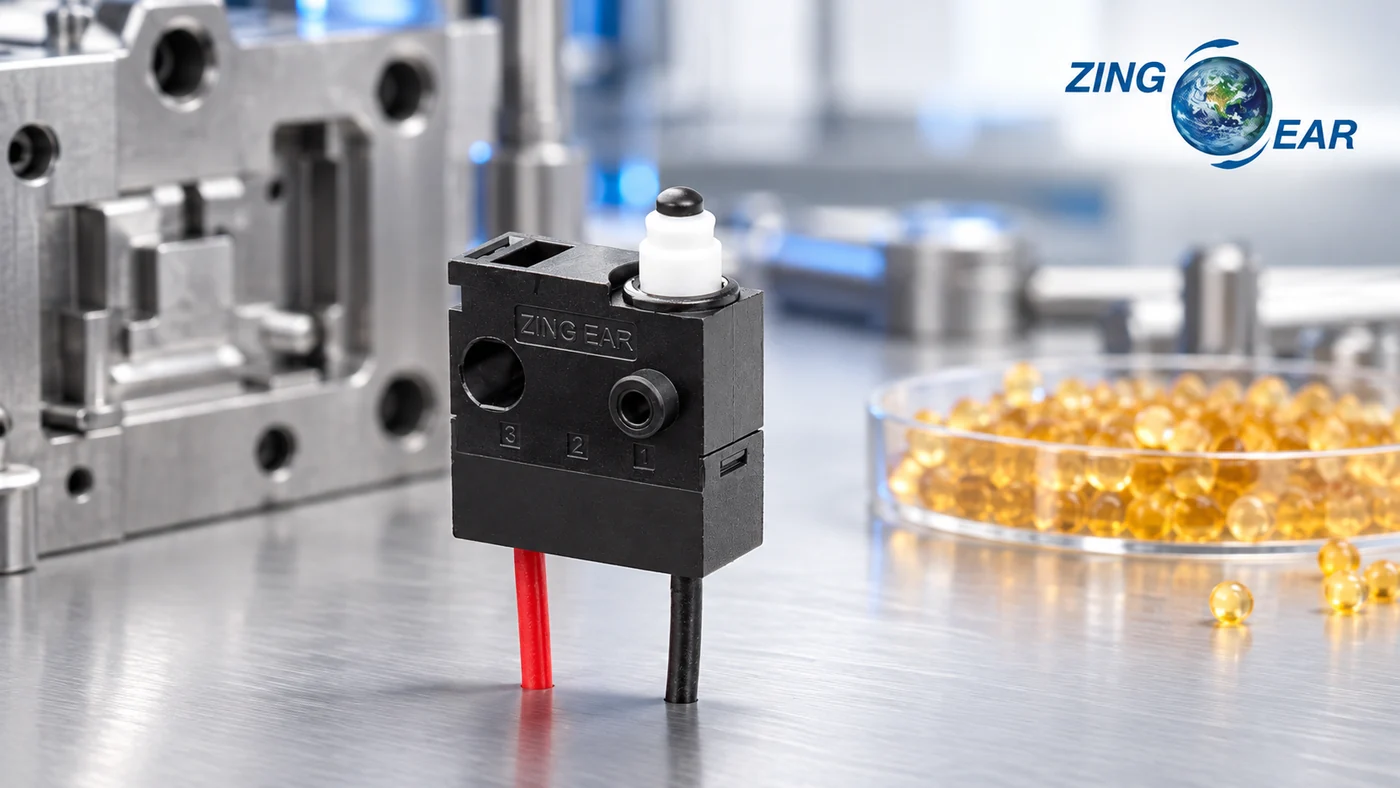
Where potting and molding sit on a wired micro switch
The base of a micro switch wired into a harness holds the terminal connections, and water that reaches the contacts often gets there along the leads and into that base. Epoxy potting seals the terminal cavity by filling the bottom of the housing with resin around the terminal connections, closing the path water would follow along the terminals into the contacts.
The soldered wire exit sits just outside the cavity, at the joint where the leads are soldered to the terminals and leave the housing. Makers seal this joint with low-pressure molding, epoxy potting or a waterproof sleeve, so the process here varies from one maker to the next. Low-pressure molding sits at this joint on switches sold with their leads already attached, and on switches built into an automotive wire harness or an appliance sub-assembly.
The switch and its attached wires go into a mold, and the molding compound is shot around the joint at low pressure and low temperature, so the same shot seals the exit and relieves strain on the solder joint. Injection molding the switch housing is an earlier step that shapes the plastic body, and plastic-bodied switches go through it as a matter of course, so a maker that molds its own housings still has the wire exit question to answer.
The plunger is the remaining opening on the switch that needs a seal. A flexible rubber or silicone boot, or a sealing ring, seals the plunger, because resin poured or molded over a moving part would lock the mechanism.
The weakest sealing point on a wired switch sets how long its IP67 rating holds
The IP67 rating on a wired switch's datasheet comes from a test defined in IEC 60529, run once on a new sample for dust and for immersion in water. An IP67 rating shows that a new sample kept water out, and the sealing point that ages first, whether the terminal cavity, the soldered wire exit or the plunger, sets how long the rating holds in your position. Whether the terminals sit inside the rating at all varies by manufacturer, and that matters here because the terminal cavity is one of the points that can let water in first; the companion shortlist of IP67 waterproof micro switch suppliers sorts it out for each supplier.
The same IP67 can come from different constructions, and how sealing construction decides how long an IP67 rating holds compares them across harsh positions. On a wired switch, a potted cavity with a molded exit and a potted cavity with a sleeved exit carry the same rating and can still age differently at the exit. To tell them apart, ask how each sealing point was built and whether the rating was tested again after thermal cycling, because a year of heating and cooling in service comes after the single test on a new part.
The sealing process and sealing point each manufacturer publishes
The switch on your harness has a terminal cavity and a soldered wire exit, and this shortlist starts from micro switch manufacturers whose public pages name a sealing process together with the point on the switch where it's used.
| Manufacturer | Sealing process published | Sealing point | Models named |
|---|---|---|---|
| Toneluck | Epoxy potting | Wire exit | Not named on public pages |
| Unionwell | Epoxy resin or silicone potting; injection molding or a waterproof sleeve; low-pressure molding described for micro switches | Terminal cavity (potting); wire exit (molding or sleeve) | Not named on public pages |
| ZINGEAR | Epoxy potting as the standard method; low-pressure molding on the soldered terminal of a smaller number of models; the two used together | Terminal cavity (potting); soldered wire exit (low-pressure molding) | Models built with soldered leads |
Unionwell and ZINGEAR name both processes, and Toneluck names potting at the wire exit. Which part number carries which process is the question that goes to the supplier with the quotation request.
Each manufacturer's published sealing at the terminal cavity and the soldered wire exit
At the terminal cavity the published methods line up closely, and at the soldered wire exit each manufacturer names a different method.
Terminal cavity: potting inside the switch body
At the terminal cavity, the published method is potting with epoxy resin, with silicone named as an alternative fill.
Unionwell's page on the internal structure of a waterproof micro switch describes the bottom of the switch, "especially the internal contacts and terminal connections," as "typically potted with epoxy resin or silicone," and adds that the fill raises shock and corrosion resistance as well as keeping moisture out.
ZINGEAR pots the terminal cavity with epoxy as its standard method on waterproof micro switches. On the models it builds with soldered leads, the potting stays in the cavity and low-pressure molding is added at the exit, which is the combination described under the next heading.

Soldered wire exit: low-pressure molding, potting or a sleeve
The soldered wire exit is where the published methods diverge, between low-pressure molding, epoxy potting and a waterproof sleeve.
Toneluck's guide to the differences between basic and waterproof micro switches notes that a waterproof housing is "useless if water wicks through the wires," and says high-end waterproof switches "often use epoxy potting at the wire exit to ensure the seal is 360-degree."
Unionwell's structure page names injection molding or an added waterproof sleeve at the wire exit, to hold the cable tight against the housing. A separate Unionwell article on the low-pressure molding process describes the process as "widely used in micro-switches and waterproof connectors," run at "1.5~40bar." The same article puts the compound "generally below 100 degrees when contacting the component" and has the part released after "a few seconds to several tens of seconds."
On the smaller number of models it builds with soldered leads, ZINGEAR encloses the soldered terminal with low-pressure molding, and the epoxy potting in the terminal cavity stays as the standard seal behind it, so the two processes work together on one part. Which of those soldered-lead models fits a given position, and how its terminal cavity and wire exit are each sealed, comes back from the ZINGEAR engineering team against the lead length and the position you describe, before any price is quoted.
Bare terminals, soldered leads and overmolded harnesses start the shortlist at different sealing points
The form in which the switch reaches your harness moves a different sealing point to the top of the list:
- Bare-terminal switch you wire yourself. The terminal cavity is the seal you're buying, because the joint you solder or crimp sits on your side of the order. Unionwell and ZINGEAR both describe epoxy potting in the cavity. Terminal type, which sets how you'll join the leads to the switch, is settled during configured micro switch development, before the cavity seal is specified.
- Switch supplied with soldered leads. The switch maker now seals the soldered wire exit, so the process at the exit comes first. Toneluck publishes epoxy potting there, Unionwell injection molding or a sleeve, and ZINGEAR low-pressure molding on its soldered-lead models. On an in-vehicle position such as a charging port cover, which has to keep out dust and rain, the wire exit is the point that sits in the wet, and projects of that kind are listed under automotive industry solutions.
- Harness overmolded as an assembly. The harness maker or a contract overmolding shop molds over the whole section on its own low-pressure equipment, so the wire exit is covered from outside. The switch still brings its terminal cavity and plunger seals into that molding, and those questions still go to the switch maker.
Sealing questions for the request for quotation on a wired switch
A request for quotation for a wired switch gets a usable answer on sealing when each question names a sealing point.
| Question | What the answer should name |
|---|---|
| Standalone switch or wired switch | Whether the leads come soldered from the plant, and at what length |
| IP67 rating and the position | The rating, plus the water exposure, temperature range and any cleaning the position sees |
| Terminal cavity | The fill, epoxy resin or silicone, on the part number quoted |
| Soldered wire exit | Low-pressure molding, potting or a sleeve, and the material |
| Plunger | Boot or sealing ring, and its material |
| After thermal cycling | Whether the rating was tested again after heating and cooling, and on which part number |
| Part numbers | Which part numbers use each process |
Answers given per part number can be compared across suppliers, because each one describes the switch you're about to order. A supplier who answers for the terminal cavity and the wire exit separately has shown you where potting and molding sit on that part. Which suppliers can re-test a rating after thermal cycling in their own laboratory is compared in the companion shortlist of suppliers with in-house life, waterproof and environmental test systems.
FAQ About Low-Pressure Molding and Potting on Micro Switches
Does an IP68 rating change which sealing point matters on a wired switch?
The sealing points stay the same, and the water test gets harder. IEC 60529 leaves the IPX8 immersion conditions to be agreed between the manufacturer and the user, set beyond the IPX7 test, so an IP68 quotation should state the depth and the duration it was tested to.
Does low-pressure molding give a micro switch an IP67 rating on its own?
An IP67 rating comes from a test on the switch, so it reflects whichever seals were on the tested sample. For a molded wire exit to count, the sample has to be tested with its leads attached, which is worth confirming on the test report.
Is a harness overmolding house a micro switch manufacturer?
An overmolding house molds over a switch and leads that a switch maker built. The overmold seals the harness section from outside, and the terminal cavity and plunger seals come from the switch maker.
Which materials does low-pressure molding use on a micro switch?
Hot-melt polyamide or polyolefin. The material is injected around the soldered joint at low pressure and at a temperature the switch body can take, and it sets in the mold within a short cycle.
How can I tell whether a supplier has run a position like mine before?
Ask for a part number already supplied into a similar wet position, with the way its terminal cavity and wire exit were sealed. A supplier that names both for a real part is describing a construction it has already built.
Sources
International Electrotechnical Commission. IEC 60529:1989+AMD1:1999+AMD2:2013, Degrees of protection provided by enclosures (IP Code): IEC 60529
All sources checked 13 October 2026.
Related Recommendations
-
ZINGEAR Micro Switch OEM Manufacturing Complete Guide
2026-07-23 -
ZINGEAR G306-150S150AA Automotive Micro Switch Officially Partners with Changan Automobile to Enable Precise Control of Sun Visors and Vanity Mirrors
2026-08-07 -
ZINGEAR G304 Micro Switch Debuts in Rail Transit Sector, Enabling Precise Sensing and Reliable Control for High-Speed Train Lifting Doors
2026-08-13 -
ZINGEAR G306-150E65BA-400 Electric Motorcycle Handbrake Micro Switch | Dreame Shouqu Certified Sensing Switch
2026-08-18 -
ZINGEAR G304 Micro Switch Supports Electric Two-Wheeler Electronic Lock Systems, Empowering Smart Lock Security and Durability Upgrade
2026-08-21 -
zingear Micro Switch Solution for Communication Base Station Equipment Status Detection — Building a Solid Safety Line for Long-term Stable Operation of Base Stations
2026-08-11 -
Electrolux Range Hood Switch Solution — Zing EAR: Solve Extreme Kitchen Reliability with Precision Sensing
2026-08-25 -
How can I replace the push-button switch on my range hood?
2026-08-27