

"Top Micro Switch Manufacturers That Build the Resistor Into the Switch in 2026: Diagnostic and Current-Limiting Versions Compared"
A micro switch with a built-in resistor is usually described as limiting the current through the contacts and as letting a controller tell an open contact from a cut wire or a short circuit. Can a single switch with a built-in resistor do the current limiting and the fault reporting at the same time? The diagnostic version and the current-limiting version are separate parts with separate specifications, so the choice of version comes before the choice of supplier. The manufacturers below line up by the kind of resistor each one builds into the housing and by the published series, ahead of the wiring and controller details to send with a request for quotation.
Diagnostic version or current-limiting version: what the controller needs to read
The resistor you're taking off the board is already doing one of two jobs, and that job is what the switch has to take over.
A diagnostic version is a switch whose internal resistors give the controller a different voltage for each state: contact closed, contact open, cut wire and short circuit. With the resistors outside the switch, a break or a short in the wiring between the switch and the resistors reads the same as a normal state, so moving the resistors inside is what brings that stretch of wiring under detection. How the resistors are wired decides which states come out separate. With a single resistor in the loop, for example, an open circuit and an open contact give the same reading, which is why the circuit diagram on the datasheet is the page to hold against your controller's input.
A current-limiting version is a switch with one resistor in series, sized to hold the current through the contacts to a set value. On its datasheet the lines to read are the resistance and the current rating of the switch, and the controller sees a plain on and off.
Resistor switch manufacturers compared
Diagnostic versions come from more than one manufacturer on this table, and the current-limiting version comes from one.
| Manufacturer | Resistor version(s) published | Catalogue series | Resistance set to your circuit | Sealed body option |
|---|---|---|---|---|
| Omron Components (ARATAS Americas) | Diagnostic | D2AW-R, D2EW-R | Catalogue part numbers | Sealed; water resistance equivalent to IP67 on the D2EW |
| Alps Alpine | Diagnostic | SPVQ8, SPVQ6 (detector switches) | Part number set by the two resistor values, accommodated individually | IP6K7 |
| ZINGEAR | Diagnostic and current-limiting | ZINGEAR G306A | Set to your circuit | IP67 rating |
Sealing on this table is stated three ways, as water resistance equivalent to IP67, as IP6K7 and as an IP67 rating, so your requirement needs to name the standard it's written against. Two standards sit behind those codes: the IP67 rating is defined in IEC 60529, and IP6K7 is written to ISO 20653, the protection code for road vehicles.
Manufacturers with a diagnostic version
The entries run from resistance fixed in a catalogue part number to resistance set to your circuit.
1. Omron Components (ARATAS Americas)
Catalogue diagnostic switches with the resistors already fitted.
The D2AW-R and D2EW-R are sealed ultra subminiature basic switches with integrated resistors, and both series output four states: switch on, switch off, short circuit and open circuit. Omron rates the water resistance of the D2EW family as equivalent to IP67. On a catalogue part the resistance arrives with the part number.
Best for: A new design whose controller can be set around a catalogue resistance.
Resistance source: Catalogue part numbers listed as in production, in D2AW-R1 and D2AW-R5 variants and in D2EW-R1 and D2EW-R5 variants.
Strengths
Four states output on both series.
Lever, stroke and terminal variants on the D2AW-R, and side operation without a lever on the D2EW-R.
Limitations
Published resistor-integrated range covers the diagnostic version.
2. Alps Alpine
Detector switches with two chip resistors inside and the part number set by their values.
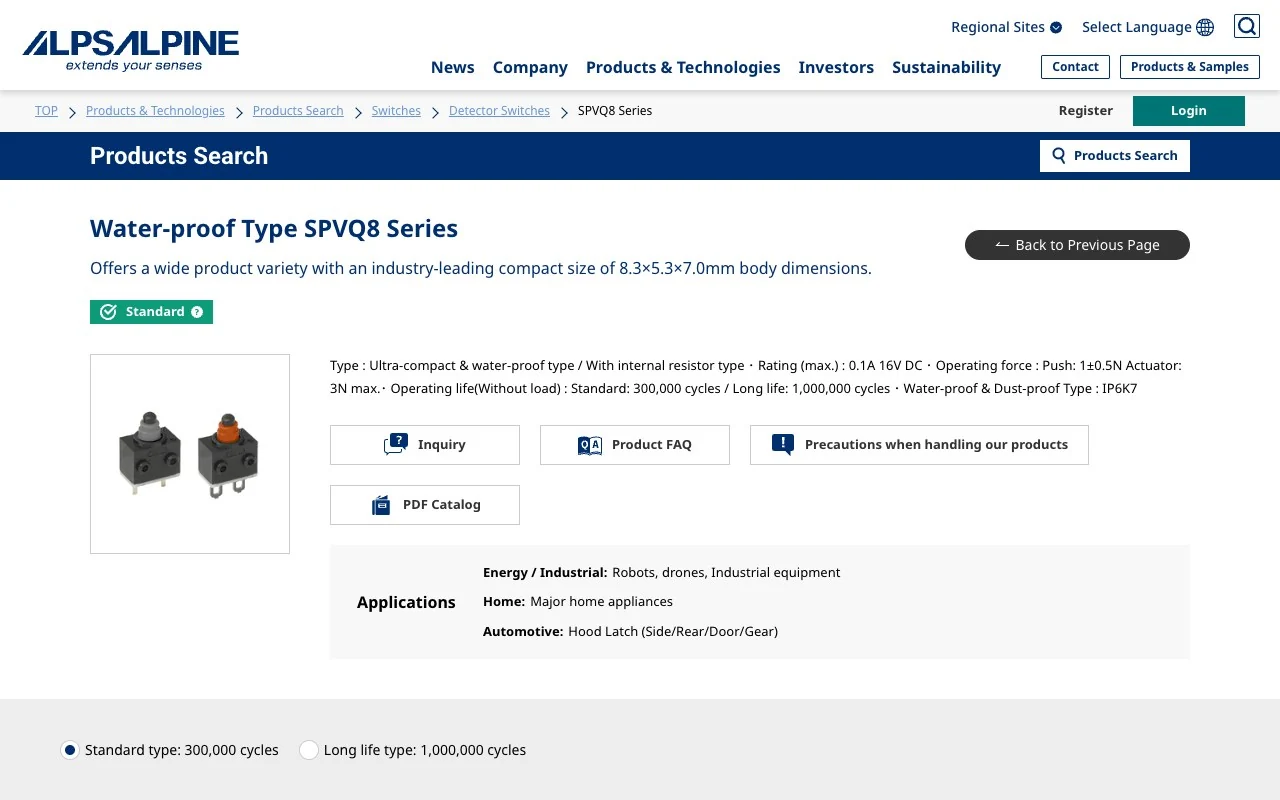
The SPVQ8 and SPVQ6 are detector switches of the internal resistor type. Two chip resistors inside give a different output voltage for switch off and for a circuit break, and for switch on and for a short circuit. Part numbers follow the values of the two resistors, and Alps Alpine accommodates resistance values individually, so a controller that already has its thresholds can keep them. Alps Alpine lists each series as IP6K7.
Best for: A detector switch footprint feeding a controller that already has fixed thresholds.
Resistance source: Part number set by the two resistor values, with values accommodated individually.
Strengths
Two chip resistors at a standard tolerance of ±1%.
Maximum chip resistor rated power of 0.33W.
Limitations
Resistance values are agreed through an Alps Alpine sales representative.
3. ZINGEAR
A sealed IP67 micro switch built in a diagnostic version and a current-limiting version.
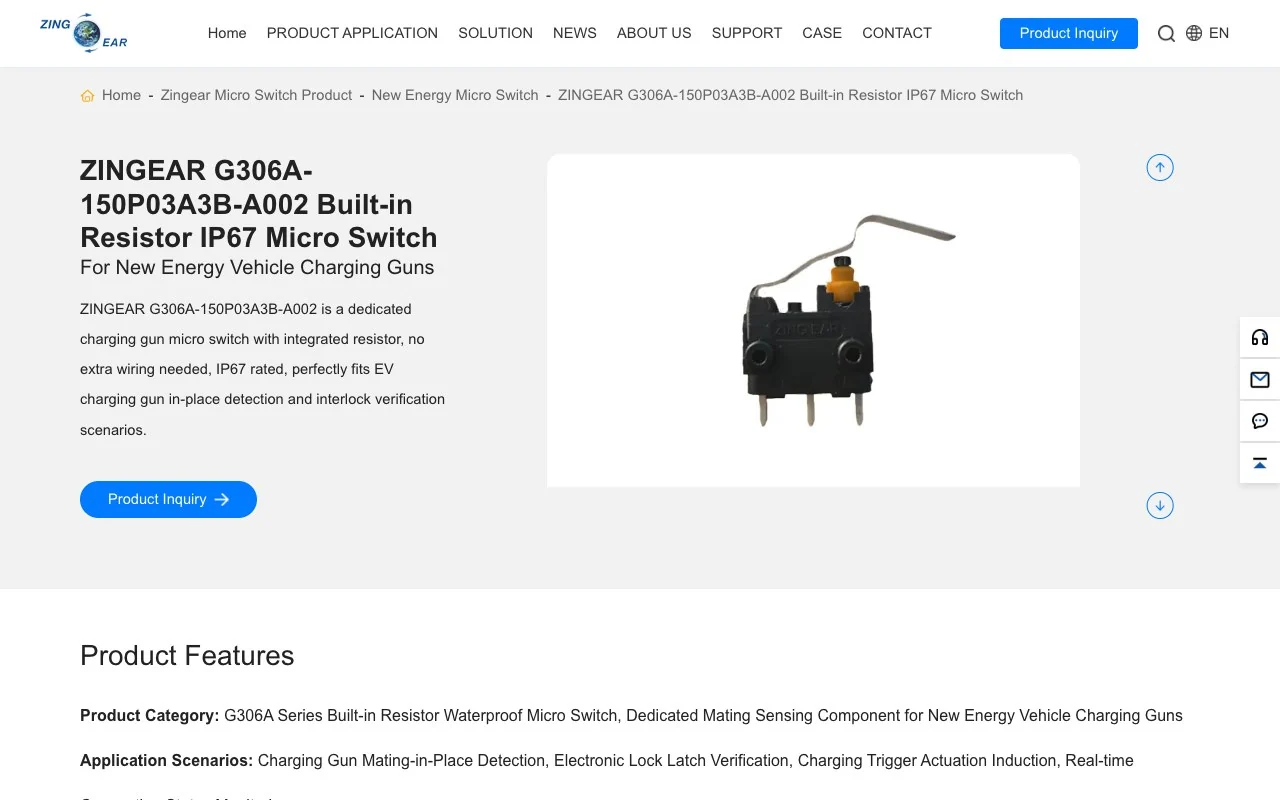
The ZINGEAR G306A is sealed to IP67 and sits in the new energy range, on positions such as charging gun insertion detection, energy storage cabinet door interlocks and charging port cover detection. In the diagnostic version the resistors inside work with the controller to pick out a short circuit or an open wire alongside the on and off states, and the circuit diagram on its datasheet shows which of those states come out separate. With built-in resistor integration, the resistor sits inside the sealed cavity alongside the contacts. Series resistance is set to the customer's circuit, so the value your board runs today goes into the switch unchanged.
Best for: Moving a resistor value already proven on your board into a sealed switch, in either version.
Resistance source: Set to your circuit, on the diagnostic version and on the current-limiting version.
Strengths
IP67 sealing with the resistor inside the sealed cavity.
Diagnostic and current-limiting versions in the same series.
Current-limiting version: part number, resistance and current rating
A board resistor whose only job is holding down the current through the contacts needs a current-limiting version, and the checks below show whether a quoted part does that job.
The part number names the current-limiting version
A series that ships in both versions carries two specifications under one series name, and the version shows up in the part number. The part number on the quotation is where the current-limiting version gets named, so that's the line to check before you approve samples.
The resistance comes from your supply voltage and target current
The value on your board was chosen from the supply voltage and the current you allow through the contacts, and that same pair sets the resistor inside the switch. Bring the value and its tolerance into the request, along with the supply voltage, so the resistor is sized for your circuit. On the ZINGEAR G306A, electrical parameters are configurable alongside travel, operating force, terminal type, lead exit and sealing grade, so the resistance is settled during configured micro switch development before samples are built.
The current rating covers the load the resistor sets
The resistor fixes the steady current, and the switch's current rating has to cover that current at your supply voltage. The ZINGEAR G306A is rated 3A to 15A, so the check is whether the current your resistor allows sits inside that range.
The job your board resistor does today picks the version
Read alongside the controller's input logic, the schematic already shows which job the board resistor does.
- Two or more resistors at the switch, with input logic that sorts the reading into separate voltage bands for the fault states, point to the diagnostic version. Its datasheet circuit diagram is then matched to the bands your firmware already reads.
- A single resistor in series with the contacts, sized from the supply voltage, with input logic that reads two levels, points to the current-limiting version. Its resistance and current rating are then matched to the resistor on your board.
The resistor's job on the board decides the version, and the version decides which manufacturers stay on your shortlist. While the value is still changing between prototype builds, whether the resistor belongs inside the switch yet is the earlier decision.
Your circuit details bring back the right version and resistance in a quotation
Your existing circuit already holds every value a quotation needs.
| Detail from your circuit | Why it goes in the request | Diagnostic version | Current-limiting version |
|---|---|---|---|
| Supply voltage | Sets the resistor value and the current through the contacts | Needed for each state's output voltage | Needed to size the resistor |
| Resistor value and tolerance on the board today | Gives the value the switch has to match | Every resistor in the network | The series resistor |
| How the resistors are wired | Decides which states the controller can separate | Series, parallel or both, as drawn | Series |
| Controller input | Shows which voltage bands the controller reads as each state | Threshold for each state | On and off level |
| Current through the contacts | Checks the switch's current rating | Signal level | The value the resistor allows |
| Sealing | Places the resistor inside or outside a sealed body | IP67 or unsealed | IP67 or unsealed |
| Actuator style | Fixes the mechanical interface | Pin plunger, leaf lever or other | Pin plunger, leaf lever or other |
| Signal type | Confirms what the switch is interfacing with | Analogue voltage at the controller input | Digital on and off |
A current-limiting version and resistance set to your circuit are the two items the comparison table shows on one entry, and the ZINGEAR engineering team answers this list with the matching version and resistance named against your circuit before samples are built.
The version narrows the field before the datasheet does
A catalogue resistance means your controller's thresholds are retuned to a new value and taken through your test plan again. A switch built to the resistance already on your board keeps the thresholds and the test results you have. Once the version is chosen, the request for quotation goes to the manufacturer whose resistance route matches how much of that validation you're prepared to repeat.
FAQ About Micro Switches With Built-in Resistors
Can a switch be a resistor?
A switch can carry resistors inside its housing, and the switch still does the switching. The resistors set what the controller reads, either a separate voltage for each fault state in a diagnostic version or a capped current through the contacts in a current-limiting version.
How much resistance should a built-in resistor have?
Values come from your circuit. On a current-limiting version the value comes from the supply voltage and the current you allow through the contacts. On a diagnostic version the values are chosen so that each state lands in its own voltage band at the controller input, which is why the resistor values and their tolerance belong in the request.
How is a micro switch with a built-in resistor wired on a 12V circuit?
The switch connects through its terminals as usual, and the resistors are already wired inside. The circuit diagram on the datasheet shows where the resistors sit relative to the contacts, and at 12V the current that results has to sit inside the switch's current rating.
How do you test a micro switch with a built-in resistor?
A meter across the terminals reads the internal resistance in each state, so the check is against the values the datasheet gives for on and off. On a diagnostic version, opening and shorting the wiring on the bench shows whether the controller reports each fault as its own state.
Which certifications cover a sealed resistor switch?
Certificates such as UL or ENEC are issued either to a part or to a factory, so the certificate is checked against the part number you order. An IP67 rating sits on the part and a factory certificate covers the site that builds it, so each answers a different question about the same switch. Coverage part number by part number is set out in the article on certified waterproof micro switches with built-in resistors.
Which built-in resistor switches suit automotive sensing?
A vehicle position whose control unit has to report a cut wire or a short circuit takes the diagnostic version, in a sealed body, with the current at the control unit input inside the switch's rating. Door, hood, tailgate and charging port cover positions each set their own sealing and temperature conditions on top of that. Series for each of those positions are compared in the article on IP67 built-in resistor micro switches for automotive sensing.
Sources
Standards
International Electrotechnical Commission. IEC 60529:1989+AMD1:1999+AMD2:2013, Degrees of protection provided by enclosures (IP Code): IEC 60529
International Organization for Standardization. ISO 20653:2023, Road vehicles, Degrees of protection (IP code): ISO 20653
All figures checked 12 October 2026.
Related Recommendations
-
ZINGEAR Micro Switch OEM Manufacturing Complete Guide
2026-07-23 -
ZINGEAR G306-150S150AA Automotive Micro Switch Officially Partners with Changan Automobile to Enable Precise Control of Sun Visors and Vanity Mirrors
2026-08-07 -
ZINGEAR G304 Micro Switch Debuts in Rail Transit Sector, Enabling Precise Sensing and Reliable Control for High-Speed Train Lifting Doors
2026-08-13 -
ZINGEAR G306-150E65BA-400 Electric Motorcycle Handbrake Micro Switch | Dreame Shouqu Certified Sensing Switch
2026-08-18 -
ZINGEAR G304 Micro Switch Supports Electric Two-Wheeler Electronic Lock Systems, Empowering Smart Lock Security and Durability Upgrade
2026-08-21 -
zingear Micro Switch Solution for Communication Base Station Equipment Status Detection — Building a Solid Safety Line for Long-term Stable Operation of Base Stations
2026-08-11 -
Electrolux Range Hood Switch Solution — Zing EAR: Solve Extreme Kitchen Reliability with Precision Sensing
2026-08-25 -
How can I replace the push-button switch on my range hood?
2026-08-27