

"Top IP67 Built-in Resistor Micro Switch Series for Automotive Sensing in 2026: Matched to Door, Hood, Tailgate and Charge Port Positions"
An IP67 micro switch with a built-in resistor suits the door latch, the hood latch, the tailgate latch and the charge port cover, because the seal keeps rain out and the resistor lets the control unit detect a broken or shorted wire. Which series then goes on which position? The series that fits a position is the one whose resistor wiring separates the wire faults the circuit flags, whose current rating carries the circuit load, and whose sealing and temperature range covers the conditions at the position. Each series below lines up with the position where the series fits, so the candidates for any one position sit side by side.
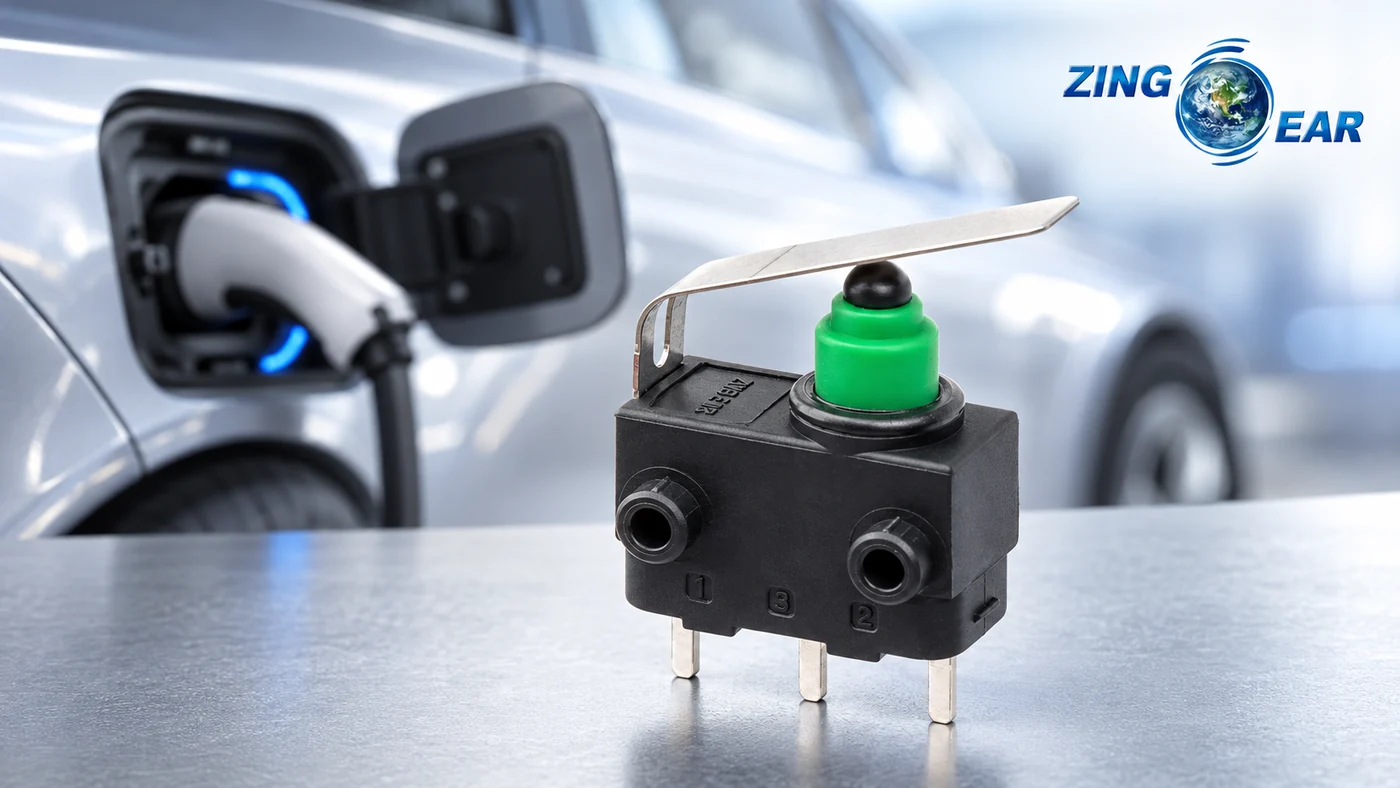
How a vehicle position decides which switch fits
A switch on a latch or a cover reports to a control unit, and the control unit reads each state of the switch as a voltage the resistors inside it set. Closed, open, a broken wire and a shorted wire each need a voltage of their own before the control unit can report them as four different things. The resistor wiring is what decides how many of those four states a switch can separate, so the circuit diagram on the datasheet is the first page to read for any position.
Every position in this comparison calls for the diagnostic version of the built-in resistor, because the diagnostic version is the one that reports states to the control unit. The difference between the current-limiting and diagnostic versions is worth checking before you compare part numbers, since both versions can sit under the same series name.
Rated current comes next. You'll want the figure on the datasheet to carry whatever your circuit puts through the switch at that position, and the series here run from tens of milliamps up to several amps. One series carries your circuit with room to spare while the next may sit right at its limit, so read each rating against your own circuit.
Sealing and temperature depend on where the latch sits on your vehicle. A datasheet that quotes IP67 is citing IEC 60529; one that quotes IP6K7 is citing ISO 20653, the protection standard written for road vehicles, and each standard sets its own dust and immersion conditions. The temperature range then has to cover the coldest and hottest your latch location gets, and that figure comes from your own position data.
Published wiring, ratings and sealing by series
A series whose maker publishes the wiring, the rating and the sealing in one place is the first to go on the shortlist for a vehicle position.
| Series | Vehicle position | Resistor network and states detected | Rated current at voltage | IP rating and temperature range |
|---|---|---|---|---|
| Alps Alpine SPVQ8 / SPVQ6 | Hood latch, door | Two chip resistors (R1, R2); separates an open switch from a circuit break and a closed switch from a short circuit | 0.1 A at 16 VDC (SPVQ8); 0.1 A at 12 VDC (SPVQ6) | IP6K7; temperature not published |
| Omron Components (ARATAS Americas) D2EW-R / D2AW-R | Door latch (D2EW) | Integrated resistors; four states output: switch ON, switch OFF, short circuit, open circuit | Not published | Water resistance equivalent to IP67 (D2EW); temperature not published |
| Panasonic Turquoise Stroke Mini Switch, Resistor installed type | Door opening and closing | Built-in resistor; detection of disconnection and short circuit of wiring | Not published | IP67; temperature not published |
| Toneluck MQS-6 with resistor | Door lock, engine hood, trunk lock | Listed as a switch with a resistor; wiring and states detected not published | 10 to 50 mA at 12 to 24 VDC | IP67; -40°C to +85°C |
| ZINGEAR G306A, diagnostic version | Charge port cover | Fixed-value resistor in the housing; normally closed, normally open and fault states read as different voltages, with short and open circuits identified by the control unit | 3A to 15A | IP67; -40°C to +85°C |
A row with figures in all three of the last columns is a series that can go straight to samples. A row that names the resistor and leaves out the wiring is a series to ask its maker about first, since the wiring is the column the control unit design depends on.
Series matched to door, hood, tailgate and charge port positions
Within each position, the series whose maker publishes the most about its resistor wiring and the states it detects comes first.
Door latch
The door latch is the position named by the most series in this comparison, so the choice there turns on how much each maker publishes about the wiring. Alps Alpine, Omron and Panasonic list door positions, and Toneluck lists the door lock.
Alps Alpine SPVQ8 / SPVQ6
Detector switches with two internal chip resistors, listed by Alps Alpine for hood latch and door positions.
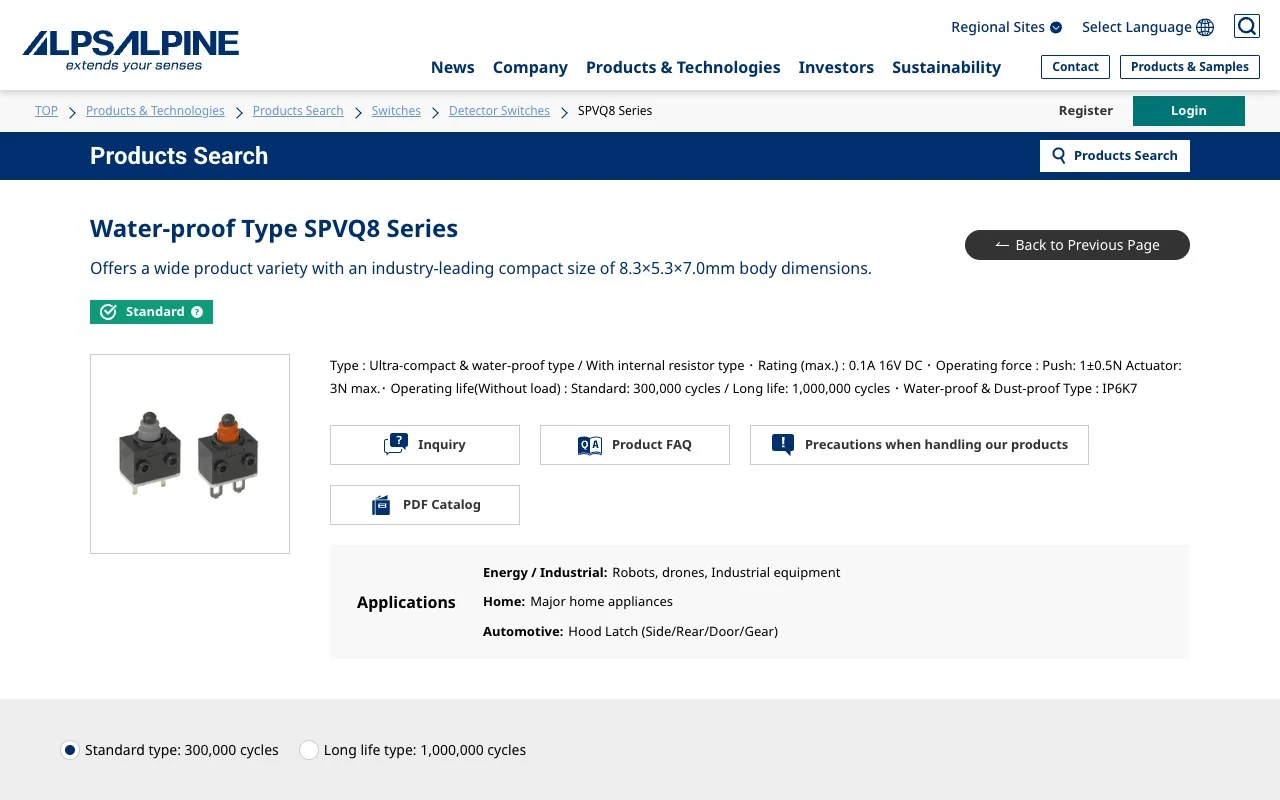
Alps Alpine builds two chip resistors, R1 and R2, into the SPVQ8 and SPVQ6 detector switches, with a standard resistor tolerance of ±1%, and sets each part number by the two resistance values. Alps Alpine states that wiring the resistors into the switch circuit gives different output voltages for switch off and a circuit break, and for switch on and a short circuit. Two resistors with values fixed in the part number make the SPVQ8 and SPVQ6 a door latch candidate whose state voltages you can work out from the datasheet alone.
Best for: Door and hood latch positions where the control unit has to tell a cut wire apart from an open switch and a short apart from a closed switch.
Rating and sealing: 0.1 A at 16 VDC (SPVQ8) or 0.1 A at 12 VDC (SPVQ6), sealed to IP6K7.
Strengths
Two resistors per switch, with R1 and R2 values carried in the part number
Resistance values and control design accommodated individually through Alps Alpine sales
Limitations
Temperature range given in the formal delivery specifications
Sealing stated as IP6K7 under ISO 20653, so a specification written as IP67 needs the two codes compared
Omron Components (ARATAS Americas) D2EW-R / D2AW-R
Sealed ultra subminiature switches with integrated resistors, from a D2EW line Omron first developed for automotive door latches.
Omron's D2EW was originally developed for automotive door latches, with water resistance equivalent to IP67, and the D2EW-R and D2AW-R are the integrated-resistor versions of the D2EW and D2AW sealed switches. The D2EW-R and D2AW-R each output four states: switch ON, switch OFF, short circuit and open circuit. Omron's explanation of resistor-integrated switches sets out why: with a single resistor, "the output values for open circuit and switch OFF are the same, so they cannot be distinguished." Four separate output values let the control unit report a cut wire and a short as two separate faults.
Best for: Door latch positions whose control unit is designed around four output states.
Size: 8.3 x 7.0 x 5.3 mm for the D2EW-R, operated from the side without a lever; the D2AW-R has the same dimensions as the D2AW.
Strengths
Four output states named on both product pages
D2AW-R and D2EW-R part numbers listed as in production
Limitations
Rated current and temperature range given in the datasheet
Water resistance stated as equivalent to IP67
Panasonic Turquoise Stroke Mini Switch, Resistor installed type
A small sealed switch Panasonic lists for door opening and closing detection, with a resistor for wiring failure detection.
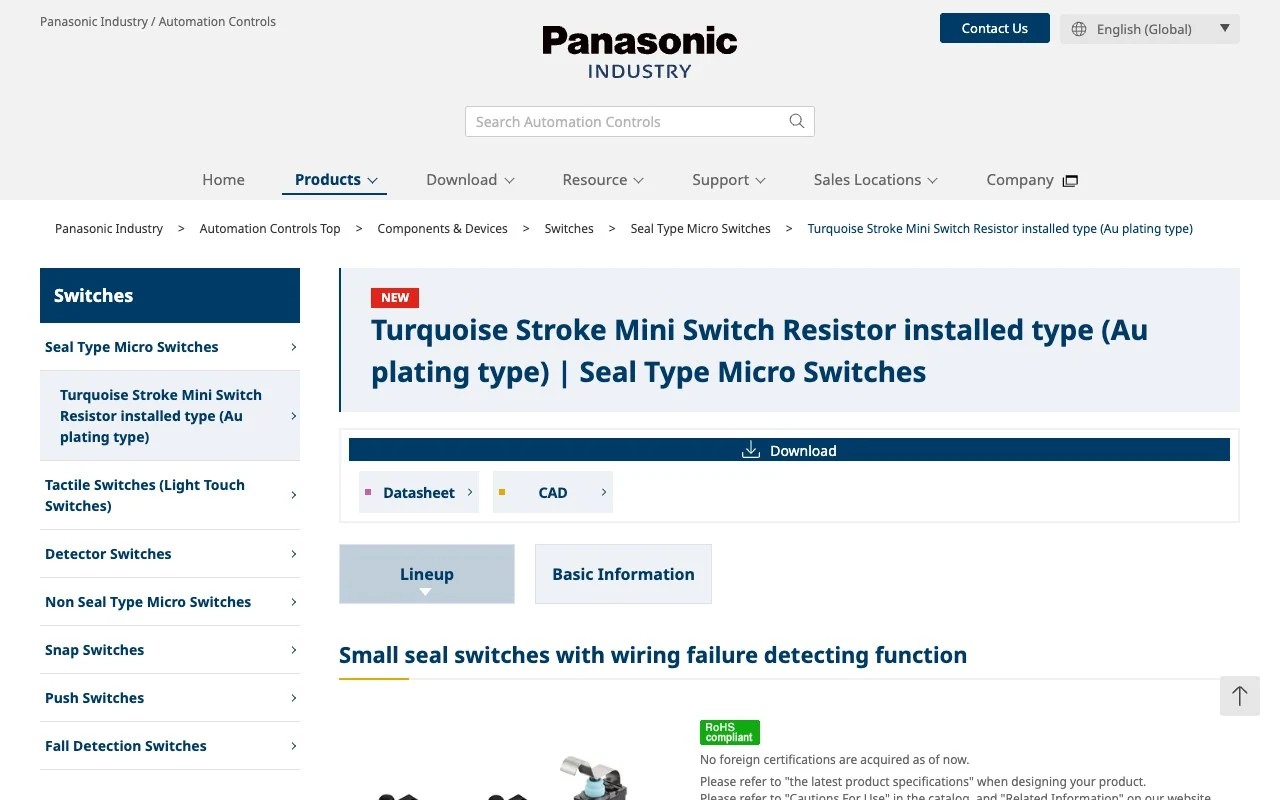
Panasonic describes the series as small seal switches with a wiring failure detecting function, sealed to IP67, and lists automobile door opening and closing among its typical applications, with 1 Form A or 1 Form B contacts built for low-level switching loads. The function Panasonic publishes is detection of disconnection and short circuit of the wiring, so the resistor values the control unit needs come from Panasonic's catalogue or sales team.
Best for: Door opening and closing detection at signal-level loads.
Contact form: 1 Form A or 1 Form B, with sliding contacts.
Strengths
IP67 sealing on a small body with a lever option
Operation by metal cams and other moving parts
Limitations
Rated current, temperature range and resistor values given in the catalogue
Changeover (1 Form C) contacts replaced by 1 Form A or 1 Form B to reach the small size
Toneluck MQS-6 with resistor
A sealed MQS-6 subminiature switch that Toneluck lists for car door locks, engine hoods and trunk locks.
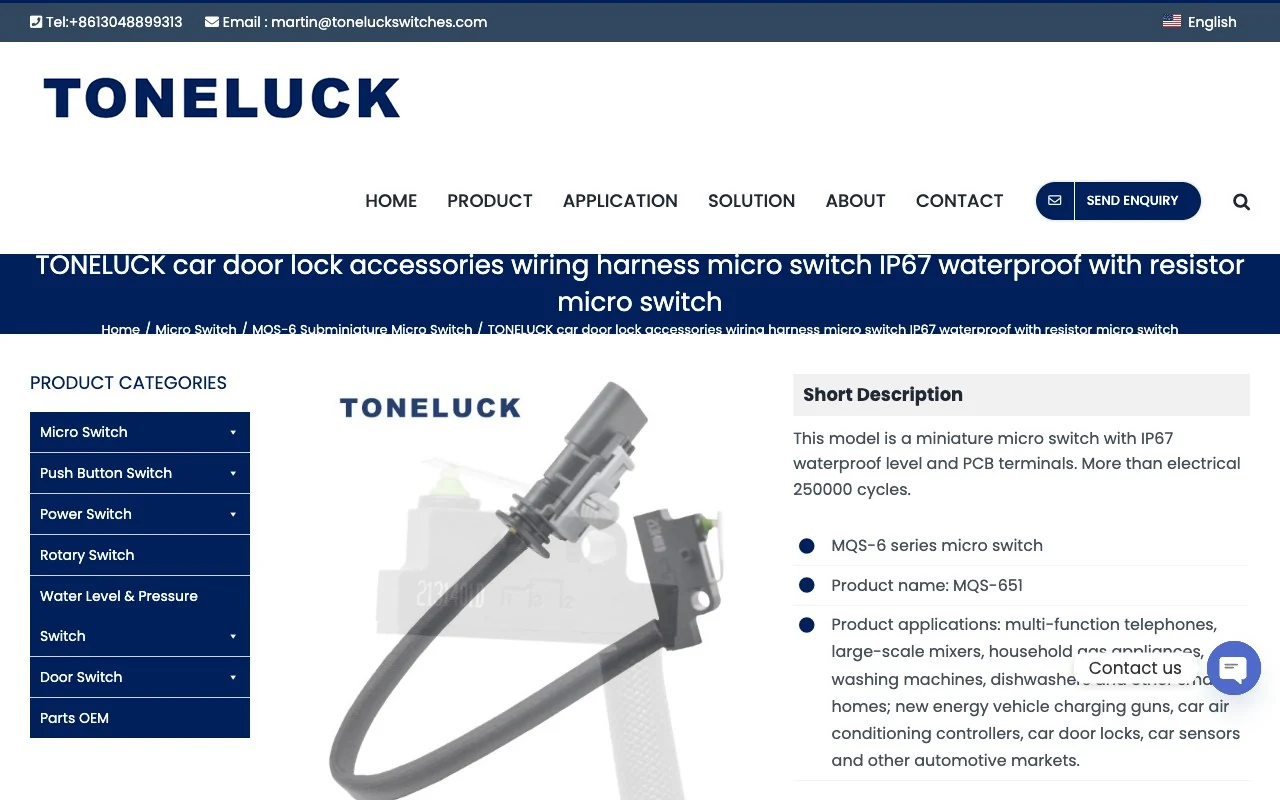
Toneluck's MQS-621NC00-A2 is rated 10 to 50 mA at 12 to 24 VDC, sealed to IP67 and rated from -40°C to +85°C, and its product page lists car door locks among the uses. Toneluck lists the same MQS-6 platform on its door lock, engine hood and trunk lock pages, which makes it the one series in this comparison named for all three latches.
Best for: Door, hood and trunk lock positions running signal-level current.
Rating: 10 to 50 mA at 12 to 24 VDC.
Strengths
Temperature range and IP67 published on the product page
One platform across door lock, engine hood and trunk lock listings
Limitations
Product page calls the part a switch with a resistor; the wiring and the states it can report are details to confirm with Toneluck
Hood latch
A hood latch has two candidates in this comparison, both covered with the door latch candidates, and each maker's own hood listing is what puts them on this shortlist. Alps Alpine puts the hood latch first among the automotive applications for the SPVQ8 and SPVQ6, and Toneluck publishes a separate engine hood page for the MQS-561, rated 10 to 50 mA at 12 to 24 VDC and -40°C to +85°C. Toneluck's hood page gives the same -40°C to +85°C as its door lock page, and Alps Alpine refers the range to its delivery specifications, so the hood latch temperature is checked against the figure measured at the latch on your vehicle.
Tailgate latch
The tailgate latch has one series in this comparison: Toneluck's MQS-6, which Toneluck lists for car trunk locks and tail box locks. Toneluck's engine hood page describes the company as specializing in car trunk locks with resistance micro switches, on the same 10 to 50 mA, -40°C to +85°C platform described with the door latch candidates. Where the tailgate latch reports to the same kind of control unit input as the door latch, it's worth asking the makers of the door latch series whether those series are released for tailgate use.
Charge port cover
A charge port cover switch sits at an exterior opening on the vehicle body, and its control unit has to know whether the cover is open, closed or jammed, and whether the wire to the switch has been cut. The cover keeps dust, rain and impact away from the charging interface, so the switch behind it needs latch-grade sealing, plus a resistor network that reports a cut wire as a fault. Among the series in this comparison, the one named for the charge port cover is the diagnostic version below.
ZINGEAR G306A, diagnostic version
A New Energy range switch with a fixed-value resistor sealed inside its IP67 housing, used for charge port cover detection.
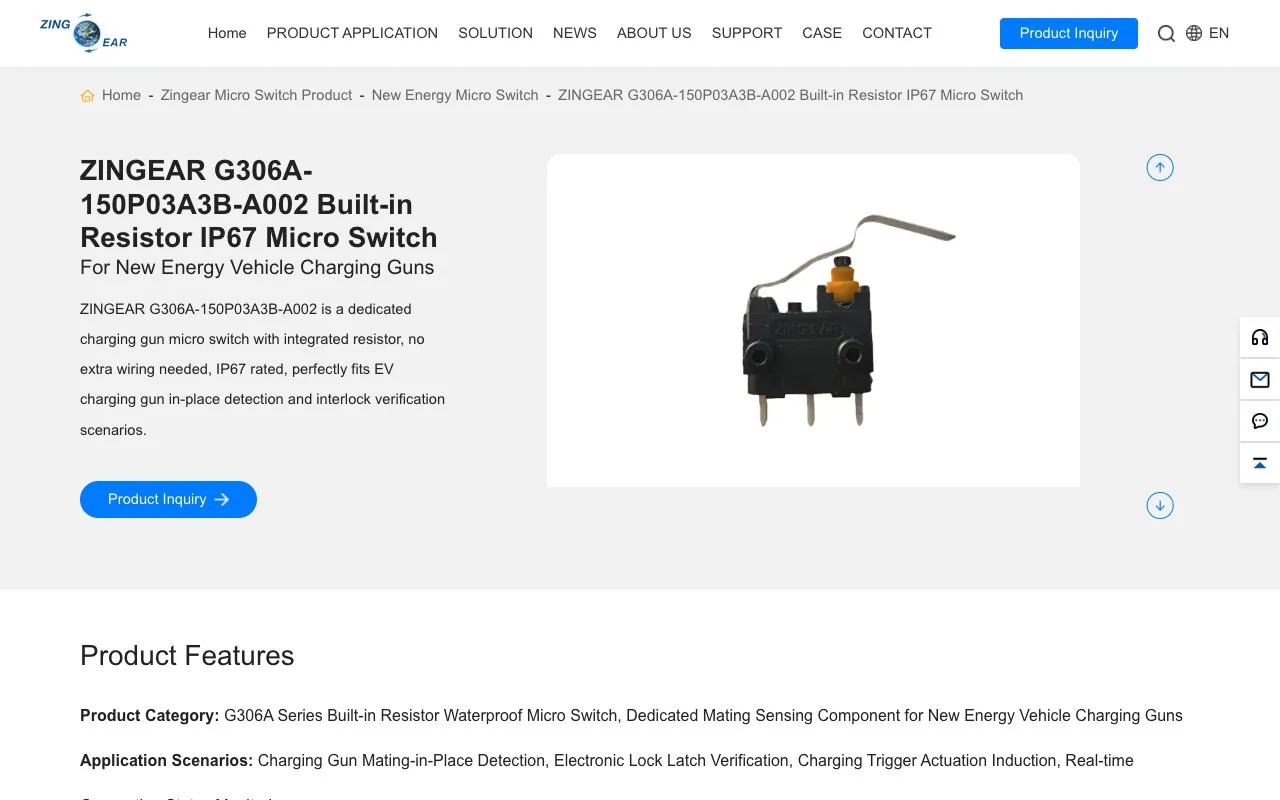
The ZINGEAR G306A integrates a fixed-value resistor into the circuit inside the switch housing, so the control unit reads different voltages for the normally closed, normally open and fault states and identifies short circuits and open circuits on the wiring. A charge port cover needs exactly that multi-state readback to catch an accidentally jammed cover or an intentionally cut wire. Sealing is IP67, the temperature range is -40°C to +85°C and the rating is 3A to 15A. With the resistor inside the sealed cavity, the switch and its resistor form one sealed part, and the charge port cover harness has one joint fewer than it would with an external resistor.
Under the built-in resistor integration used on this switch, the series resistance is set to the customer's circuit. Charge port cover work for vehicle programmes, including a BYD charge port cover project, is described under automotive industry solutions.
Best for: Charge port cover positions where the control unit has to catch a jammed cover or a cut wire.
Rating and sealing: 3A to 15A, IP67, -40°C to +85°C.
Strengths
Resistor sealed inside the IP67 cavity with the switch contacts
Series resistance set to the customer's circuit
Matching a series to the control unit and the harness
Candidates for one position split on what the control unit reports and how much current the harness carries.
- The control unit has to report a cut wire and a short as separate faults. Start from the series whose pages name all four states, the Omron D2EW-R and D2AW-R and the Alps Alpine SPVQ8 and SPVQ6, and check the circuit diagram on each datasheet against the input.
- The control unit thresholds are already fixed by an existing harness. Alps Alpine fixes R1 and R2 in the part number, so you pick the part number whose values fit. The ZINGEAR G306A takes its resistor values from your thresholds during configured micro switch development.
- The circuit puts more than signal-level current through the switch. Toneluck's 10 to 50 mA and Alps Alpine's 0.1 A ratings sit at signal level, while the ZINGEAR G306A's 3A to 15A rating carries a heavier load on the same switch.
What to check on the samples at the position
Samples prove the wiring, the rating and the sealing once they're fitted to the latch or cover, wired to the real harness and read by the control unit:
| Check | Why it matters | Where the reading comes from |
|---|---|---|
| Voltage at the control unit input for closed, open, cut wire and short | The four voltages set the thresholds the control unit uses to report each fault | Your control unit measurement, read against the resistor values on the datasheet |
| The same four voltages at the cold and hot ends of the rated range | A voltage band that keeps the states apart at room temperature has to keep them apart at both ends of the position's range | A temperature chamber run on the fitted sample |
| A cut lead and a shorted pair at the harness connector | The control unit has to report each one as the fault the wiring is meant to separate | A deliberate break and short on the sample harness |
| Sealing at the terminals and lead exit after mounting | Some sealed switches state IP67 for the body with the terminal area outside the rating, and mounting loads the seal | The maker's sealing statement and an immersion check on the mounted part |
With the control unit thresholds attached to an engineering sample request, the samples come back with the series resistance set to those thresholds, ready for the voltage checks in the first row of the table.
A shortlist set by position, a part number set by the control unit
Where a position has several candidates, as the door latch does, your control unit thresholds and harness current narrow them to one before samples go out. Where a position has a single candidate, as the tailgate latch and the charge port cover do, the samples mounted on the position carry the whole decision, so every row of the sample check is worth running on that part.
FAQ About IP67 Built-in Resistor Micro Switches for Vehicle Positions
Is -40°C to +85°C enough for a hood latch?
A -40°C to +85°C range is enough when the temperature measured at your hood latch stays inside it across your test profile. Running the state voltages at both ends of that range on a mounted sample shows whether the margin holds at the latch.
What do IP67 and IP6K7 each test on a sealed switch?
IP67 and IP6K7 each cover dust and immersion, and they come from different standards. IP67 is an IEC 60529 code, while IP6K7 is an ISO 20653 code written for electrical equipment on road vehicles. Your vehicle specification names one code or the other, and that's the code a series has to match.
Does a switch need two resistors to tell a broken wire from a short?
The resistor wiring decides which states the control unit can separate, and the circuit diagram on the datasheet shows it. Where the resistors sit matters as well: with resistors fitted outside the switch, an open or short on the wire between the switch and those resistors stays out of the control unit's reach, and resistors inside the housing bring that stretch of wire into the diagnosis.
Which manufacturers build the resistor into the switch body?
A maker that builds the resistor into the body names it on the product page as an integrated, internal or installed resistor type, and the circuit diagram shows which version it is, diagnostic or current-limiting. The companion comparison of micro switch manufacturers that build the resistor into the switch lists the makers by version.
Which certifications cover a sealed resistor switch?
The IP67 rating is stated against the part itself, while safety approvals such as UL or ENEC are often held for the factory or the product family. The companion comparison of certified waterproof micro switch suppliers with built-in resistors sets out which approvals apply to the part and which apply to the factory.
How can I tell whether a supplier has already supplied a switch for a vehicle position like mine?
Ask for the vehicle positions the series is already fitted to and the control unit input it was matched against. A supplier that has supplied your kind of position can name the latch or cover, the state voltages and the temperature range the switch was validated at.
Sources
Related Recommendations
-
ZINGEAR Micro Switch OEM Manufacturing Complete Guide
2026-07-23 -
ZINGEAR G306-150S150AA Automotive Micro Switch Officially Partners with Changan Automobile to Enable Precise Control of Sun Visors and Vanity Mirrors
2026-08-07 -
ZINGEAR G304 Micro Switch Debuts in Rail Transit Sector, Enabling Precise Sensing and Reliable Control for High-Speed Train Lifting Doors
2026-08-13 -
ZINGEAR G306-150E65BA-400 Electric Motorcycle Handbrake Micro Switch | Dreame Shouqu Certified Sensing Switch
2026-08-18 -
ZINGEAR G304 Micro Switch Supports Electric Two-Wheeler Electronic Lock Systems, Empowering Smart Lock Security and Durability Upgrade
2026-08-21 -
zingear Micro Switch Solution for Communication Base Station Equipment Status Detection — Building a Solid Safety Line for Long-term Stable Operation of Base Stations
2026-08-11 -
Electrolux Range Hood Switch Solution — Zing EAR: Solve Extreme Kitchen Reliability with Precision Sensing
2026-08-25 -
How can I replace the push-button switch on my range hood?
2026-08-27