

"Top 7 Automotive Micro Switch Manufacturers in 2026: Certification, Sealing, and Customization Compared"
A door lock, a charge port cover, a hood latch and a seat adjuster each need a micro switch, and the shortlist for all four usually gets made on the datasheet.
Does a switch that meets every figure on the datasheet also pass a vehicle programme?
Not always, because a vehicle programme also turns on which market the certificate covers, how the seal was made, and whether a change to your specification is a parameter change or new tooling.
Seven manufacturers below handle the certificate, the seal and the tooling differently, and each entry gives the vehicle positions and the other industries a manufacturer supplies.
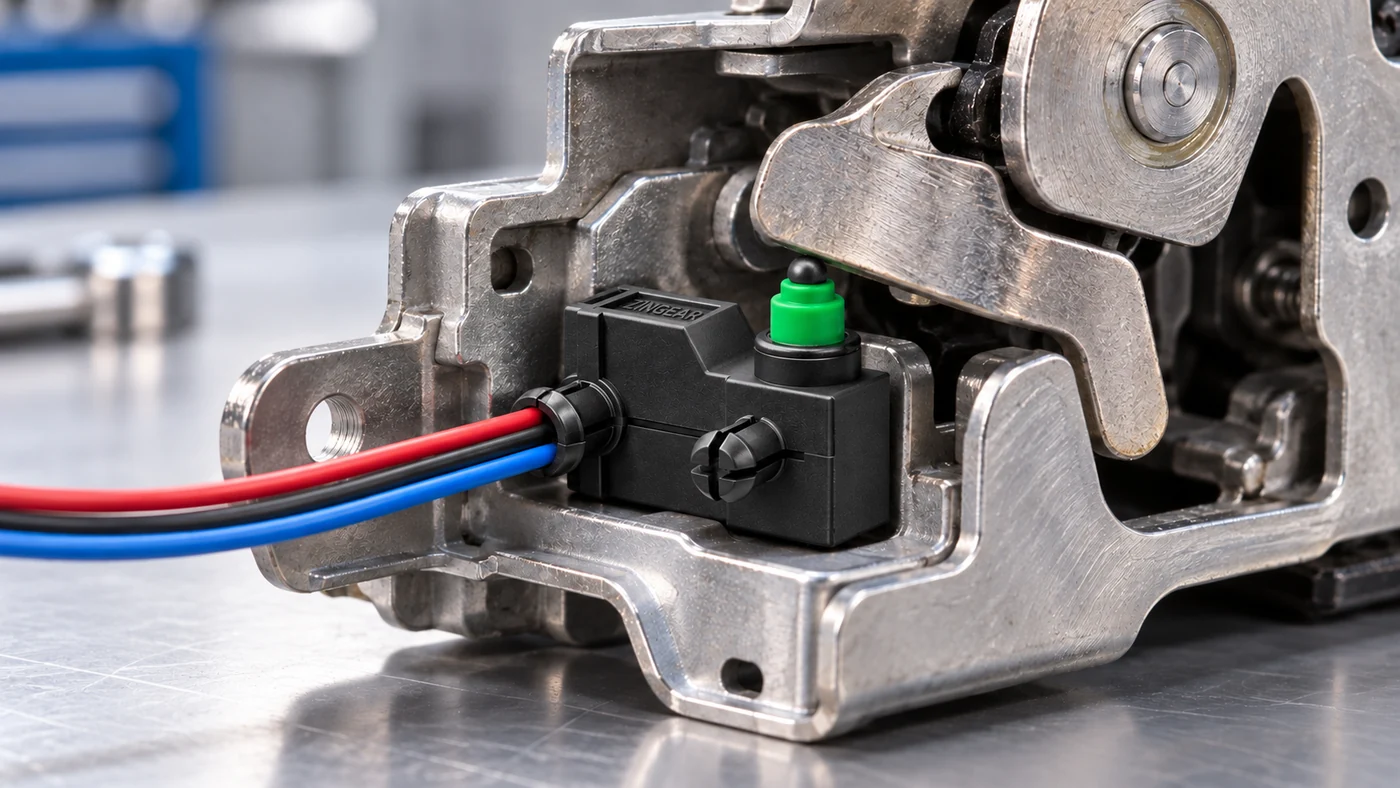
What a vehicle programme asks beyond the datasheet
A datasheet answers the electrical and mechanical questions. It states a life figure, a current rating, an IP rating and a temperature range, which together decide whether a part physically belongs in the aperture you have.
Which market each certificate covers. A certificate is issued to a site for a scope. IATF 16949 puts a quality system around in-vehicle production, while UL and cUL sit on the end product in North America, ENEC (European Norms Electrical Certification) and CB Scheme (IECEE Certification Body Scheme) sit on it in Europe, and CQC sits on it in China. A supplier holding the vehicle standard is not automatically holding the end-product approvals, and the destination market list decides which ones have to sit on the switch as well as on the vehicle.
How the seal was made. IP67 is what a test returns, and several constructions reach it. Epoxy potting in the terminal cavity, low-pressure moulding over a soldered joint and an O-ring at the plunger all reach the same rating, and they age differently once thermal cycling starts. The rating is measured on a new sample, so construction is what carries it through year two. The three are set out side by side, with how each one ages, under IP67 micro switch sealing construction.
What a specification change costs. Travel, operating force, terminal type, lead exit, sealing grade and electrical rating are parameters on some suppliers and geometry on others. Where they are parameters, a change comes back as samples in weeks under the same qualification. Where they are geometry, a change means a new cavity, an NRE (non-recurring engineering) line and a re-qualification.
📌 On reading a life figure: A mechanical life figure measured with no load and an electrical life figure measured at your load are two different tests. Ask which one the number came from before comparing it with anyone else's.
Certification, sealing and change cost, supplier by supplier
| Supplier | Certificate covers | Sealing and temperature | A change comes back as |
|---|---|---|---|
| Omron | IATF 16949; UL, cUL, ENEC, CB, CQC | Resin-filled cavity, plunger O-ring; IP67; -40°C to +85°C | A different catalogue part number |
| Honeywell | IATF 16949; UL, cUL, ENEC, CB | Sealed housing, glass-to-metal on heavy-duty; IP67 and above | A different part number, or an engineering project |
| ZF (Cherry) | IATF 16949; UL, cUL, ENEC, CB | Sealed housing with plunger boot; IP67; -40°C to +85°C | A different part number, or a tailored-actuation project |
| Unionwell | IATF 16949, ISO 9001, ISO 14001; UL, cUL, ENEC, CB, CQC | Sealed construction; IP67; -40°C to +85°C | Not published per parameter |
| DONGNAN | IATF 16949; UL, VDE, ENEC | Sealed construction; IP67 | Not published per parameter |
| TONELUCK | ISO/TS 16949 stated; UL | Sealed construction; IP67; to 220°C on the high-temperature range | Not published per parameter |
| ZINGEAR | IATF 16949, ISO 9001:2015, ISO 14001; UL, cUL, ENEC, CB, CQC | Epoxy potting, low-pressure moulding on soldered leads; IP67; -40°C to +85°C; air tightness checked in line | Samples in weeks on a parameter change, on a line built for the series |
TONELUCK publishes ISO/TS 16949, which the IATF replaced in 2016, so a programme specifying IATF will ask for the transition certificate. The third column is the one that separates the list: three suppliers answer a change with a different part number, three do not publish an answer, and one answers with a sample.
The seven automotive micro switch manufacturers
Position decides which of the seven comes first, and the section after this one maps four common vehicle positions onto the three questions.
1. Omron
The catalogue reference for sealed subminiature detection.
The sealed ultra subminiature category originates here, and the D2AW-R publishes 10,000,000 operations minimum at 60 operations a minute with no load. A catalogue figure measured with no load and a configured figure measured at a stated load are not two points on the same scale, so the number is a ceiling for the design rather than a prediction for your position.
Best for: A replacement on a frozen drawing, at any volume, where the part already exists.
Vehicle positions: Detection duty across door, latch and cabin positions.
Certification: IATF 16949, with UL, cUL, ENEC, CB and CQC on end products.
Change route: A different catalogue part number.
Strengths
Test conditions published per part number on the datasheet.
Global distribution stock, so lead time on a catalogue part is transit.
Limitations
Configured route not published; a published change is a move to another catalogue part.
Line address not available through distribution, so batch records are traced upstream.
2. Honeywell
Heavy-duty and extreme-environment ranges, carried into vehicle positions.
Builds the MICRO SWITCH range for aerospace, defence and oil and gas, with the SE and XE series carried into industrial and vehicle positions. Custom engineering exists on selected heavy-duty ranges and runs on a project schedule rather than as a catalogue change, which sets the date outside the quotation.
Best for: Positions where temperature or mechanical load sits beyond a standard automotive envelope.
Vehicle positions: Under-bonnet and high-load positions.
Certification: IATF 16949, with UL, cUL, ENEC and CB on end products.
Change route: A different part number on catalogue ranges, or an engineering project.
Strengths
Endurance testing in house on the heavy-duty range.
Temperature and load range wider than the automotive-only suppliers on this list.
Limitations
CQC not published.
Project terms on anything configured.
3. ZF (Cherry)
Precision actuation across automotive, appliance and power tool positions.
Supplies precision switches with tailored actuation characteristics offered alongside a core catalogue footprint. Tailored actuation is quoted as a project, so the actuation curve is negotiable and the schedule is not, which suits a position where feel matters more than date.
Best for: Positions where operating force and differential travel drive the specification.
Vehicle positions: Control and cabin positions.
Certification: IATF 16949, with UL, cUL, ENEC and CB on end products.
Change route: A different part number, or a tailored-actuation project.
Strengths
Endurance testing in house.
Actuation characteristics adjustable within a series.
Limitations
CQC not published.
Sealing construction published at series level rather than per part.
4. Unionwell
High-volume sealed ranges out of Huizhou.
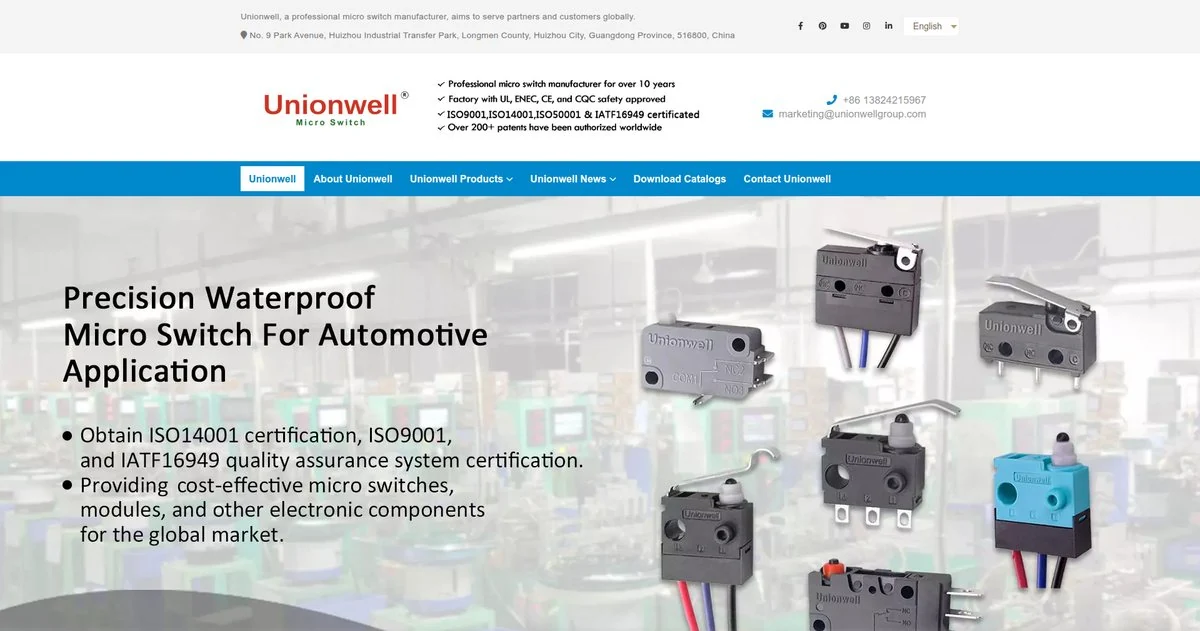
Publishes 350 million pieces a year with 80 percent of processes automated, and holds IATF 16949, ISO 9001 and ISO 14001 alongside UL, cUL, ENEC, CB and CQC. Sealed ranges are published for car door locks, charging guns and seat controls, and customisation is stated at category level rather than per parameter, which leaves the change route to the enquiry.
Best for: Volume on a published series, where the catalogue part already fits.
Vehicle positions: Door locks, charging guns, seat controls.
Certification: IATF 16949, ISO 9001, ISO 14001, with UL, cUL, ENEC, CB and CQC.
Change route: Not published per parameter.
Strengths
350 million pieces a year, with 80 percent of processes automated.
Full approval set across all four destination markets.
Limitations
Sample lead time and change route not published.
Contact material not published per model.
5. DONGNAN
Listed Yueqing manufacturer with a UL witness laboratory on site.
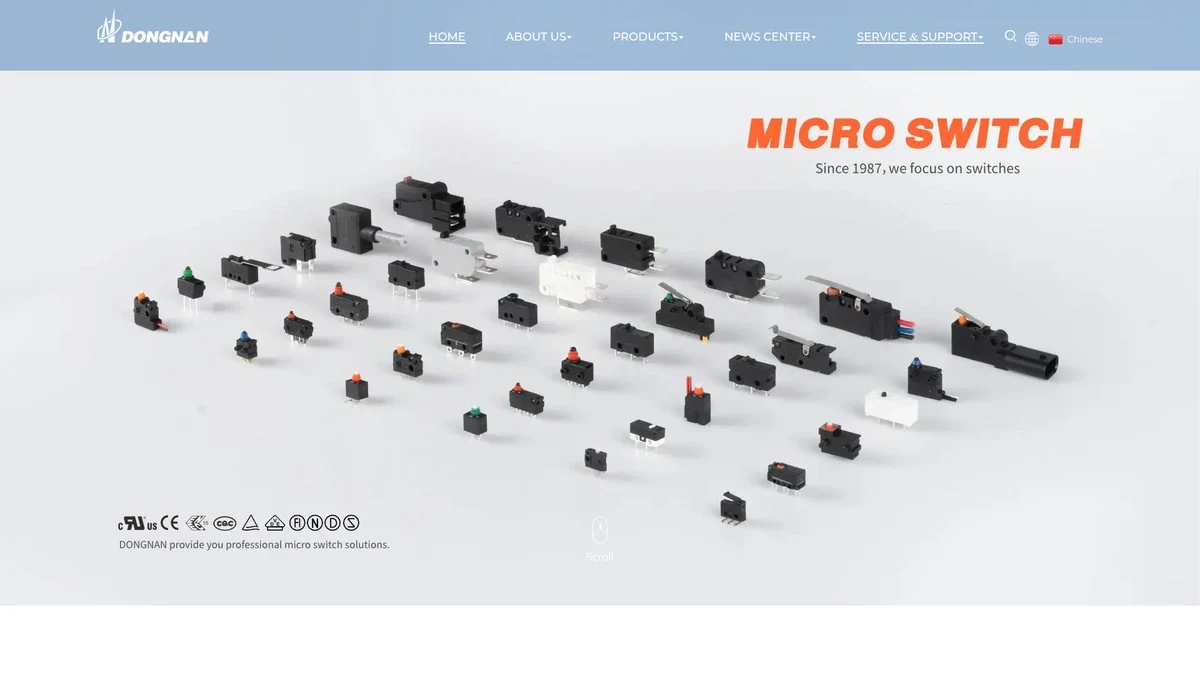
Founded in 1987, publishes over 200 million pieces a year and exports to more than 40 countries, with more than 80 patents. A UL witness laboratory on site means part of the safety testing is scheduled inside the plant, which is the one block of a qualification timeline it controls directly.
Best for: General-purpose and waterproof series at volume, where UL is the governing approval.
Vehicle positions: General waterproof and automotive detection positions.
Certification: IATF 16949, with UL, VDE and ENEC on end products.
Change route: Not published per parameter.
Strengths
UL witness laboratory on site.
Over 200 million pieces a year, exports to more than 40 countries, more than 80 patents.
Limitations
Current range published as 0.1A signal parts up to 5A at 250 VAC.
Operating temperature not published per model.
6. TONELUCK
Hong Kong owned group, vertically integrated from tooling through to quality control.
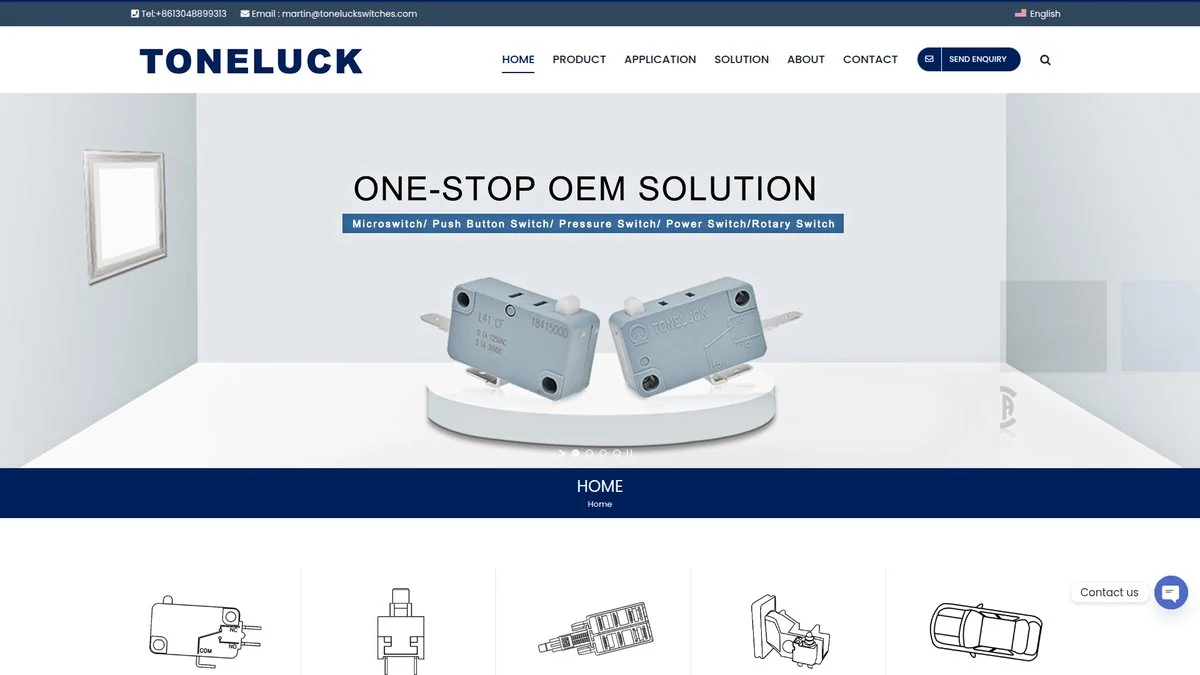
Builds automotive electrical parts, gas appliance controls and high-end appliance switches, with published experience on door locks and air conditioning controllers, and states supply to Toyota, Ford, GE and Whirlpool. Tooling, injection and over-moulding, metal parts and electroplating all sit inside the group, so geometry changes do not cross a company boundary.
Best for: Positions needing new geometry, or temperature and current beyond the standard envelope.
Vehicle positions: Door locks and air conditioning controls.
Certification: ISO/TS 16949 stated, with UL on end products.
Change route: Not published per parameter; tooling in house.
Strengths
Precision moulds, injection and over-moulding, metal parts fabrication and electroplating in house.
Publishes a high-temperature range to 220°C and a load range to 22A.
Limitations
ISO/TS 16949 published in place of IATF 16949.
ENEC, CB and CQC not published.
7. ZINGEAR
Configured sealed switches out of Huizhou, with the design held as parameters.
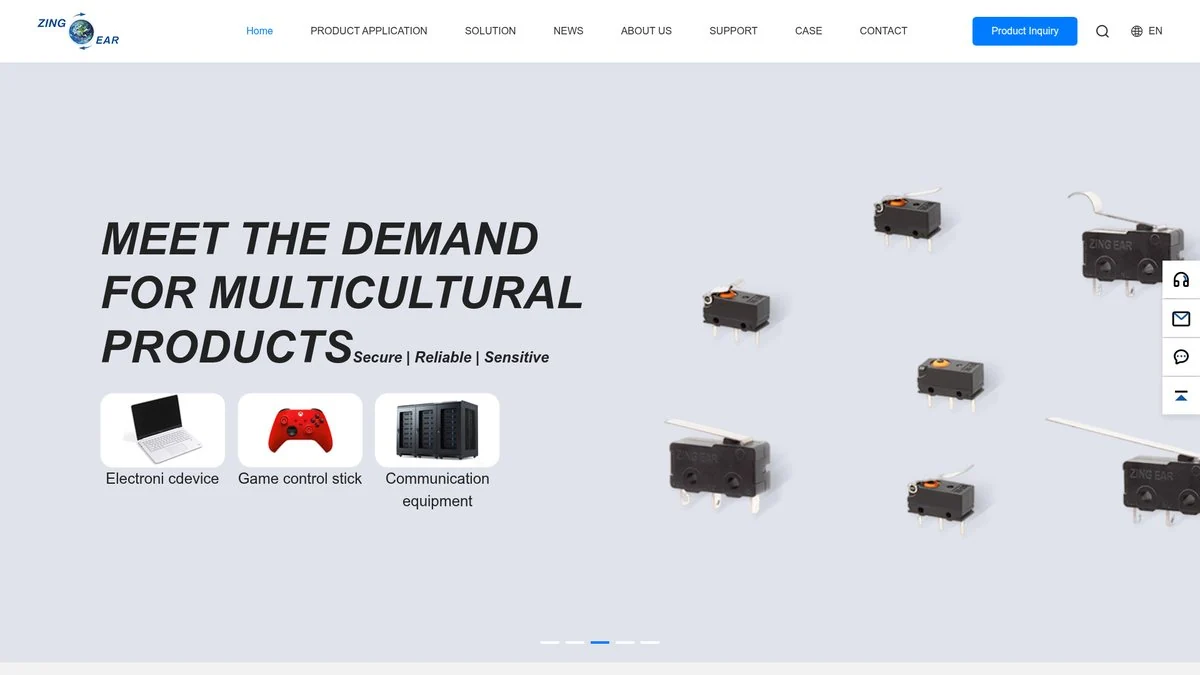
Reaches IP67 by potting the terminal cavity with epoxy as standard, with low-pressure moulding over the joint on soldered-lead models, and rates its automotive range from -40°C to +85°C. Standard models are rated for 300,000 mechanical cycles and 200,000 electrical cycles, both generated in ZINGEAR's own product laboratory, with the load, actuation rate and ambient behind either figure quoted per part number. Travel, operating force, terminal type, lead exit, sealing grade and electrical rating are held as parameters in a design model, so a change to any of the six returns as samples in weeks under the original qualification rather than as a new cavity. Production has run in Huizhou since 1995, at over 20 million units a year on named customer programmes.
Best for: A position where the aperture is fixed and the catalogue part does not quite fit.
Vehicle positions: Door locks, hood latches, tailgate locks, seat adjusters (ZINGEAR G303); charge port covers, charging gun insertion detection (ZINGEAR G306A, ZINGEAR G10B03).
Certification: IATF 16949, ISO 9001:2015, ISO 14001, with UL, cUL, ENEC, CB, CQC, RoHS and CE.
Change route: Parameter change returns samples in weeks; sealing grade and actuator geometry take a new part number.
Current range: 3A to 15A across five product lines; the ZINGEAR G303 automotive range is published from 0.1A to 5A, at 12VDC, 48VDC, 125V or 250VAC by part number.
Strengths
Sealing is verified on the line rather than by sampling: the ZINGEAR G306 and ZINGEAR G303 A2 assembly lines carry air tightness, vision and electrical checks in sequence, and outgoing defect rate runs below 0.1 percent.
Life, sealing and environmental testing in the in-house product laboratory, so the load and actuation rate behind a figure are quoted against a part number.
Named vehicle programmes: a charging port cover on BYD vehicles, a seat lock on the Mercedes C-Class, a hood latch developed for a Nissan global platform, vanity mirror cover detection on Chrysler vehicles.
Matching a position to a manufacturer
Vibration, weather, heat and cycle count each dominate one of the four positions below.
A door lock or tailgate latch runs on vibration and cycle count, so the deciding evidence is a life figure with its load and actuation rate attached, plus a vibration profile quoted against a part number rather than a series.
A charge port cover sits outdoors and takes rain, road spray and knocks, so sealing construction outranks current rating. Vibration and corrosion sit outside what an IP rating measures at all, and matching a series to the worst stressor on a position covers both. The switch runs detection duty rather than load duty.
A hood latch sits under a bonnet that stays hot after the engine stops, so continuous housing temperature matters more than peak.
A seat adjuster or vanity mirror position runs low current at high cycle count inside the cabin, where the deciding factor is usually mechanical life and packaging.
The position sets which of the three questions decides the choice, which is why one vehicle can end with different suppliers on different positions. A door lock settled on vibration data and a charge port cover settled on sealing construction are two different shortlists, even when the aperture and the circuit type match.
Where the shortlist stops
The gap between a shortlist and an approved part is PPAP (Production Part Approval Process), and what a submission asks for beyond the certificate is set out under IATF 16949 project requirements.
Sealing grade and lead exit move inside a design model on some of this list and inside a mould on others, which is the difference between a change costing weeks and a change costing months.
What to confirm before you ask for a quote
| Item to settle | What to ask for | What a controlled answer looks like |
|---|---|---|
| Which plant builds the part | The certificate, plus the address of the line being quoted | Two addresses that match, and a scope covering moulding and assembly |
| Certificate status | Number, scope and validity date | A live entry in the certification body's register |
| Destination markets | Which approvals sit on the switch as well as the vehicle | A named list, settled before samples |
| Mechanical life | The figure, with load, actuation rate and ambient | All three arriving together |
| Electrical life | The figure, with load type | A figure measured on your load, not a catalogue load |
| Sealing | Construction, and whether the rating was re-verified after thermal cycling | A construction named, and a re-test record that can be produced |
| Contact and terminal materials | Contact material and terminal plating | Both named, with salt spray hours for any position exposed to road salt |
| Change route | Which parameters change without new tooling | A list of parameters, each with a sample lead time attached |
| Testing location | Which tests run in house | A split, with subcontracted tests named |
Three of the seven suppliers publish no change route per parameter. The ZINGEAR engineering team publishes one per parameter, and an incumbent part number with the position it sits in gets sealing grade and mechanical interface confirmed before pricing. Positions already running on named vehicle programmes are set out under automotive industry solutions.
FAQ About Choosing an Automotive Micro Switch Manufacturer
Is IATF 16949 enough to call a supplier automotive grade?
It covers the quality system at an audited site. Whether your part number has been through PPAP, and which safety approvals the end product needs in your destination markets, are separate submissions with their own evidence.
How do I compare two life figures?
Get the conditions first. A mechanical figure measured with no load at 60 operations a minute and an electrical figure measured at 5A resistive are different tests, and the larger number is usually the one measured under the lighter condition.
Does IP67 mean the seal will last?
IP67 is measured on a new sample. Ask which construction produced it and whether the rating was verified again after thermal cycling.
Which changes avoid new tooling?
Travel, operating force, terminal type, lead exit, sealing grade and electrical rating sit inside a parameterised design model on some suppliers, which is where a change comes back as samples rather than as a new cavity. Actuator shape, mounting hole position and body height almost always need new geometry.
How can I tell whether a supplier has run a position like mine before?
A named vehicle programme is the closest thing to evidence, because a position that has already been through a programme has survived the qualification a certificate only predicts.
Sources
Standards and certification bodies
International Automotive Task Force. IATF 16949:2016. Distributed by the Automotive Industry Action Group: IATF 16949:2016
International Electrotechnical Commission. IEC 60529:1989+AMD1:1999+AMD2:2013, Degrees of protection provided by enclosures (IP Code): IEC 60529
Third-party datasheets
Omron Corporation. D2AW-R sealed ultra subminiature basic switch datasheet: Omron
All figures checked 28 September 2026.
Related Recommendations
-
ZINGEAR Micro Switch OEM Manufacturing Complete Guide
2026-07-23 -
ZINGEAR G306-150S150AA Automotive Micro Switch Officially Partners with Changan Automobile to Enable Precise Control of Sun Visors and Vanity Mirrors
2026-08-07 -
ZINGEAR G304 Micro Switch Debuts in Rail Transit Sector, Enabling Precise Sensing and Reliable Control for High-Speed Train Lifting Doors
2026-08-13 -
ZINGEAR G306-150E65BA-400 Electric Motorcycle Handbrake Micro Switch | Dreame Shouqu Certified Sensing Switch
2026-08-18 -
ZINGEAR G304 Micro Switch Supports Electric Two-Wheeler Electronic Lock Systems, Empowering Smart Lock Security and Durability Upgrade
2026-08-21 -
zingear Micro Switch Solution for Communication Base Station Equipment Status Detection — Building a Solid Safety Line for Long-term Stable Operation of Base Stations
2026-08-11 -
Electrolux Range Hood Switch Solution — Zing EAR: Solve Extreme Kitchen Reliability with Precision Sensing
2026-08-25 -
How can I replace the push-button switch on my range hood?
2026-08-27