

"Which Suppliers Offer IP67 Micro Switches with Customizable Built-in Resistors?"
The same IP67 micro switch with a customizable built-in resistor takes a different resistance value on the latch of an electric vehicle charging plug, on a loop wired to an alarm panel and on a circuit read by an in-house controller. The value is set by the side the switch connects to, namely the charging plug standard, the alarm panel or the thresholds in your own controller, so your request for quotation carries the number the connected side fixes. Starting from where the resistance value comes from in each application, the article is written so buyers can put the right value on the request for quotation and pick an IP67 supplier able to build it into the switch.
In short
A charging plug built to SAE J1772 reads 150 Ω at rest and 480 Ω with the latch pressed, an alarm loop reads the end-of-line value its panel accepts, and an in-house controller reads whatever value its thresholds were written around. Suppliers that accept a customer value then split on the parts around the resistor: whether the contact form, the leads and connector, and the actuator and housing can change as well.
The side the switch connects to sets the resistance value
The number on your request for quotation already exists before the first sample is built, and where it's written decides how much of it you can choose.
EV charging plugs: the value is in the standard
On a North American AC charging plug, the resistance is fixed by SAE J1772. The standard links switch S3 to the latch release: with the latch at rest the proximity loop reads 150 Ω through R6, and pressing the release adds a 330 Ω R7, so the vehicle reads 480 Ω (SAE J1772 overview). A TE Connectivity drawing for a J1772 plug carries the same pair as "150ohm resistance will increase to 480ohm when latch is depressed". On a charging plug the nominal values belong to the standard, so what you specify is the tolerance around them and how the resistor sits in the switch. A supplier quoting this position is matching a published number, and the tolerance line is where two quotations differ.
Alarm panels: the panel lists the value
On a security loop, the end-of-line (EOL) resistor value comes from the alarm panel the loop is wired to. Central Security Distribution's CSD-WEB200, a panic button with integrated end-of-line resistors, offers a "wide range of selectable EOL resistor values to suit most alarm panels", from 0 to 7.9k on one part number. On an alarm loop the panel sets the value, so a switch for door, window or tamper monitoring is ordered at the value that panel expects.
Industrial safety and in-house controllers: your thresholds set the value
Emergency stops, actuator failure detection and other positions read by a controller you design take their value from your own thresholds. When the controller is yours, the resistance value is yours to choose, and it's chosen together with the voltage windows your firmware reads. On a vehicle, the control unit's thresholds set the value in the same way for the door, hood, tailgate and charge port positions. Catalogue resistor switches carry a value fixed in the part number, and catalogue resistance values fit only when they already land inside your thresholds; otherwise the thresholds get retuned and tested again.
The contact form decides what the controller reads at each value
Once the number is set, the contact it sits beside decides when the controller sees it. In the J1772 plug, R7 sits across the S3 contact: with the latch at rest the closed contact bypasses the 330 Ω, and pressing the latch opens S3 and adds it in series. A normally open contact works the other way round, because closing it puts a second resistor in parallel with the first and the reading falls when the switch operates.
The same resistance value reads differently on a normally closed contact and a normally open one, so the request for quotation names the contact form and the series or parallel wiring next to the value. Tolerance belongs on the same line, since a value held loosely on either contact form can drift out of the window the vehicle or the panel reads, and tolerance and drift across the temperature range decide how far it moves once the switch is in service.
With the value, the contact form and the tolerance on one line, the supplier's own page is where to confirm that all three can be built together. A page that states a resistance accuracy beside the contact types on offer lets you check both lines of the request before the first sample is ordered. The ZINGEAR G306A publishes both for its built-in resistor configuration, and its entry among the suppliers below gives the accuracy figure together with the contact types it is built in.
IP67 suppliers that build a customer resistance value into the switch
ZINGEAR, ITW EBA, KANGERLE (KEL) and Unionwell each state on an official page that a customer resistance value can be built into an IP67 micro switch. Around the resistor, each supplier opens a different set of changes, from contact form and wiring to leads, connector, actuator and housing.
| Supplier | IP67 series accepting a customer value | Value sources named on the official page | Contact form and wiring | Leads and connector | Actuator and housing |
|---|---|---|---|---|---|
| ZINGEAR | ZINGEAR G306A, current-limiting or diagnostic version | Charging gun anti-pinch matching; controller-read positions | SPDT, NO or NC; customer-set series resistance within ±1.5% | Soldered S-type and PCB terminals; several cable exit directions | 150 g actuator up to a 15.5 mm stroke arm |
| ITW EBA | SWA | EV charging gate and port | SPDT; resistors on PCB circuitry, customized | Wire leads with connector, customized | General and lever types |
| KANGERLE (KEL) | Waterproof switches with internal resistor | Charging guns | Not listed on the official page | PCB mount; IP67 "after wiring" | Several lever options |
| Unionwell | Unionwell G303R | Charging guns and piles | SPDT | Molded leads; custom terminals | Custom levers; housing with mounting hole |
Catalogue resistor switches such as Omron's D2AW-R and Panasonic's ASQMR are ordered from the published range and follow the catalogue route described above.
Each supplier also words its sealing differently, so which parts an IP67 rating covers after wiring is worth checking against your lead and terminal layout, as is which approvals cover the part once the resistor version has its own part number.
ZINGEAR G306A
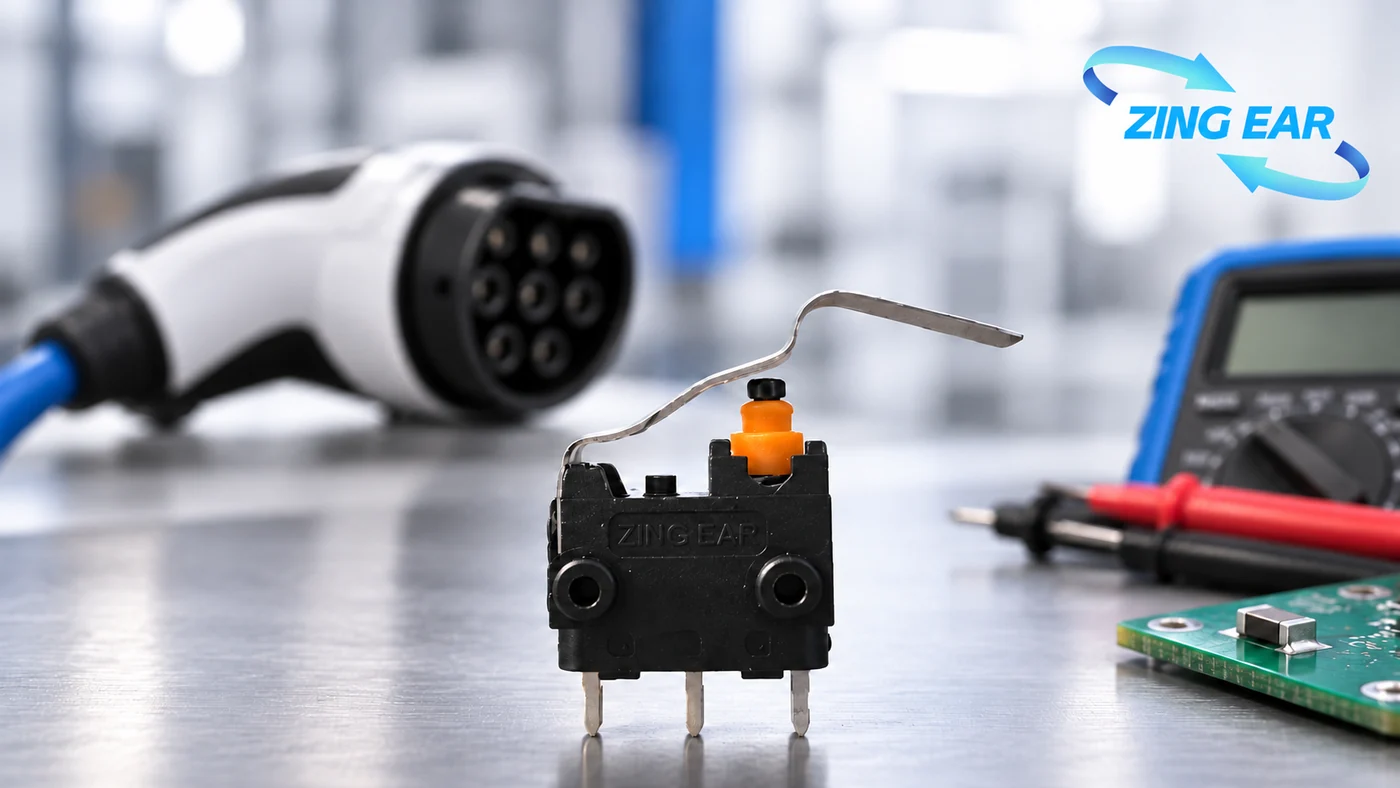
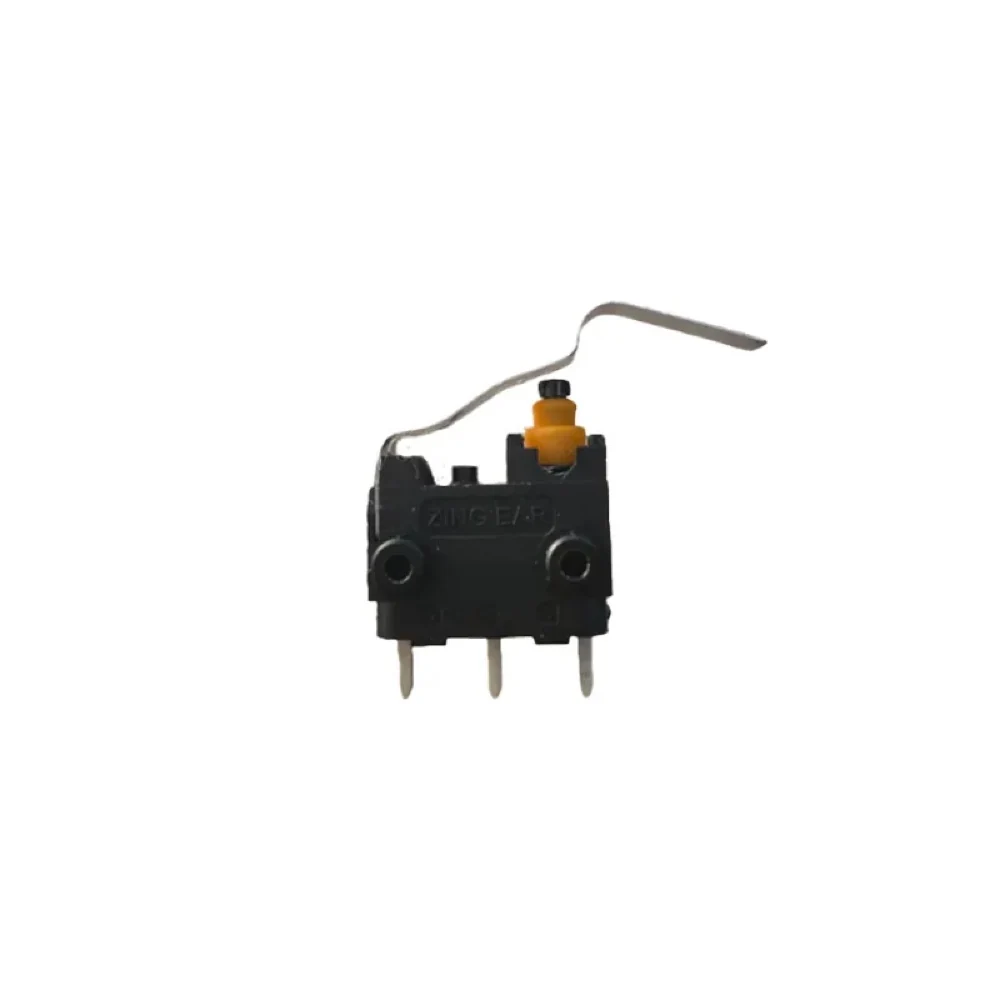
The ZINGEAR G306A is an IP67 rated micro switch with an integrated resistor, built as a dedicated charging gun switch that needs no extra wiring. ZINGEAR supplies the built-in resistor in a current-limiting version or a diagnostic version, rated 3A to 15A, so the version is stated together with the value. Per the built-in resistor integration overview, the built-in resistor lets your controller identify short circuits and open circuits, and the customer-customized series resistance is held within ±1.5%, so a tolerance line can be checked against that figure. Contacts come in SPDT, NO or NC form, with soldered S-type or PCB terminals.
ITW EBA SWA series
ITW EBA's SWA is an IP67 micro switch for automotive applications with SPDT contacts in 1 NO, 1 NC or 1 NO+1 NC form. ITW EBA lists "PCB circuitry with SMD resisters and wire leads with connector" as customized features, so a quotation for the SWA covers the circuit, leads and connector together.
KANGERLE (KEL) waterproof micro switches
KANGERLE's waterproof micro switches with an internal resistor mount directly on the PCB. The KANGERLE charging gun page states the value "can be customized according to the different specifications of the charging guns" and IP67 applies "after wiring", so the sealing check belongs on a sample wired the way your plug is built.
Unionwell G303R
Unionwell's G303R is "designed for water and dust tight (IP67)" with a built-in resistance whose value can be customized. Custom terminal and lever designs and a new housing with a mounting hole are listed as options, so the housing can change along with the resistor.
A resistance value sealed into the switch stays with the part number
A resistor potted inside the housing can't be reached after build, so a new value means a new part number and a new round of approval. Each source can still move the value later: a standard value changes with a revision of the standard, a panel value changes with the panel, and your own thresholds can shift with a firmware release. The resistance value is safest to fix at the same time as the controller thresholds, before samples are built, because every later change to it reaches the part number.
What to put on a request for quotation for a resistor built into an IP67 switch
Fixed before samples, the value sits at the top of a specification that also covers the wiring, the leads and the sealed zone.
| Item | Where the figure comes from |
|---|---|
| Resistance value and its source | The charging plug standard, the alarm panel, or your controller thresholds |
| Tolerance | The reading window on the side the switch connects to |
| Contact form and series or parallel wiring | The state the controller has to see when the switch operates |
| Version | Current limiting or diagnostic, from what the resistor does in the circuit |
| Current at voltage | The load the contact switches |
| Leads, connector and cable exit | The harness or board the switch lands on |
| Actuator and housing | The mechanism that operates the switch and the bracket it mounts to |
| IP67 coverage after wiring | Where the terminals and leads sit in the wet zone |
Buyers who include ZINGEAR G306A in the comparison can use the same table for a ZINGEAR resistor-value quotation, since the version, contact form, terminals and actuator it names are the items the G306A is configured on.
FAQ About Customizable Built-in Resistor Micro Switches
What power rating does a resistor inside a sealed switch carry?
Published chip resistor ratings sit in the fraction-of-a-watt range, such as the 2012 chip resistor rated 0.5W at 70°C on Panasonic's ASQMR diagnostic micro switch. The resistor's heat stays inside a potted housing, so the current through the resistor at your supply voltage goes on the request next to the value.
What tolerance should a built-in resistor be held to?
Tight enough that the nominal value, its tolerance and its drift across the operating temperature range stay inside the window the controller or panel reads. A standard value with a narrow reading window needs a tighter tolerance than an in-house threshold you set with margin.
Can one built-in resistor switch serve a charging plug and an alarm loop?
One series can, as long as each application gets its own part number. The charging plug and the alarm loop need different resistance values, and a value sealed into the switch fixes the part number, so a single series ends up as one part number per value, each approved on its own.
Which equipment outside the vehicle uses a micro switch with a built-in resistor?
Panasonic lists emergency stops, actuator failure detection, alarm equipment and safe door and window monitoring for the ASQMR. ITW EBA's list for the SWA adds testing, communication and medical equipment to the same range.
How can I tell whether a supplier has run a position like mine before?
Look for your kind of position, a charging plug, an alarm loop or a safety controller, on the supplier's own page for the series. A supplier that names the position there and can build a sample at your value and tolerance has the evidence closest to your project.
Sources
Related Recommendations
-
ZINGEAR Micro Switch OEM Manufacturing Complete Guide
2026-07-23 -
ZINGEAR G306-150S150AA Automotive Micro Switch Officially Partners with Changan Automobile to Enable Precise Control of Sun Visors and Vanity Mirrors
2026-08-07 -
ZINGEAR G304 Micro Switch Debuts in Rail Transit Sector, Enabling Precise Sensing and Reliable Control for High-Speed Train Lifting Doors
2026-08-13 -
ZINGEAR G306-150E65BA-400 Electric Motorcycle Handbrake Micro Switch | Dreame Shouqu Certified Sensing Switch
2026-08-18 -
ZINGEAR G304 Micro Switch Supports Electric Two-Wheeler Electronic Lock Systems, Empowering Smart Lock Security and Durability Upgrade
2026-08-21 -
zingear Micro Switch Solution for Communication Base Station Equipment Status Detection — Building a Solid Safety Line for Long-term Stable Operation of Base Stations
2026-08-11 -
Electrolux Range Hood Switch Solution — Zing EAR: Solve Extreme Kitchen Reliability with Precision Sensing
2026-08-25 -
How can I replace the push-button switch on my range hood?
2026-08-27